2020 年最後一個月,有利的全球情勢使金融市場進入風險偏好模式。新冠病毒疫苗廣泛普及的前景、美國兩黨就財政刺激達成協議以及歐盟與英國脫歐後貿易協議的達成,都為市場情緒提供了必要的提振,並維持了房地產股上漲的勢頭,最終以積極的姿態收官。.
然而,2020年全年,房地產股的表現持續落後於整體股市,後者主要受到科技股和醫藥股的支撐。房地產週期最終將指引該行業走出危機,儘管歷史上房地產復甦往往落後於經濟復甦,但危機持續時間更長,這得益於該地區持久的結構性基本面。.
由於缺乏大型企業,區域市場表現平平,但部分市場已出現改善跡象。.
China Real Estate Market 2021 – Finding The Way Forward
2020 has been a challenging year for all. With China now seemingly on its way to a full recovery, Savills has published its China market overview and outlook “Finding a way Forward, 2021”, which analyses key drivers and trends of five asset classes and the property management sector.
投資: National transaction volumes decreased YoY, while niche assets increased their share of investments to all-time highs.
辦公室: Occupiers look to optimise their office portfolios through flexible space arrangements while also securing cost savings.
零售: Landlords increase the share of leisure tenants in malls to attract consumers back to the high-street.
Residential: Upgrade and end-user demand supports the stable market foundations, while the multi-family sector sees new regulations to protect tenant rights.
Logistics: New infrastructure initiatives will level up warehouse standards and scale. Transparency and asset liquidity is also expected to improve with the launch of REITs.
Property management: New IPOs saw a record high in 2020, while PropTech opens the way for additional value-added services.
With the acceleration of digitalisation as well as changing consumer behaviour, it is imperative for retail tenants and landlords alike to adapt to the rapidly-evolving multiplatform retail scene to remain relevant, retaining the physical shopper catchment in shopping malls through an online presence. Malls should no longer purely be just a point of sale, but also extend towards being a focal point that incorporates meaningful and memorable experiences that are able to resonate with the varying consumer needs. This would make for an in-store shopping environment that is more enjoyable and appealing than just traditional brick-and-mortar shopping or mere e-commerce, as part of their placemaking strategy.
With Singapore in Phase Three of Re-Opening, increased footfall to retail spaces is expected with the relaxation of measures for gatherings and a majority of the workforce back to the workplace.
The recent slowdown in rental declines of prime retail spaces point to a potential bottoming out of rents by early 2021, and any rental reduction during the year is projected to be about 5%, barring lockdowns as a result of recurring community infections. Rentals of prime retail spaces located in Orchard might require a bit more time to recover and are expected to only return to pre-COVID-19 levels once mass vaccinations prove successful enough for the nation as well other key cities to relax travel restrictions.
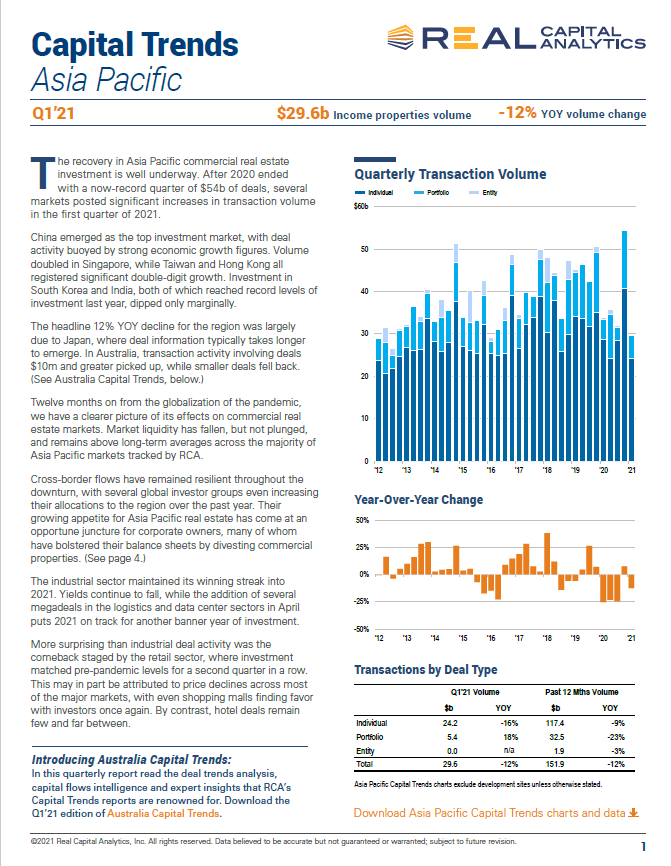
Most property markets in the Asia Pacific region ended a challenging year on the path to recovery, thanks to strong performances by the office, industrial and logistics segments. In China, a combination of government policies and the ongoing e-commerce boom powered demand for business parks and warehouses. Hong Kong saw a jump in transactions after the government reduced stamp duty on the sale of commercial properties, while Singapore saw a surge in investment sales amid improving sentiment. The market outlook improved in Australia as the country bounced back quickly from a recession, while New Zealand continued to reap the benefits of its successful management of COVID-19. Vietnam, which also has managed to control the spread of COVID-19 and perform better than other Southeast Asian economies in 2020, is attracting the attention of a growing number of local and foreign investors, especially in the industrial and logistics sectors. Japan is another market where logistics assets are highly sought after, reflecting growing demand from the e-commerce sector. In Indonesia, the hard-hit hospitality sector saw a surge in interest from investors looking to acquire discounted hotel assets, while fast-growing Myanmar continued to draw interest in the logistics and affordable housing segments. The residential segment is also seen trending up in the Philippines, where remittances from overseas workers is driving demand. Overall, investors are expected to act quickly to make the most of a conducive environment as markets across the region emerge from lockdowns and economies regain momentum.
市場好轉:復甦可望在2021年為全球投資帶來501兆至3兆美元的成長
高力國際預計,隨著全球房地產市場復甦,2021年下半年投資活動將激增5,010兆美元。
由於投資者手握大量可用資金,並尋求彌補先前的損失,高力國際預計2021年總投資活動將增加至多50%。我們的全球投資者調查結果顯示,所有地區的98%投資者計劃今年擴大其投資組合,其中約60%投資者計劃擴大超過10%,包括23%投資者希望擴大20%或更多。.
隨著市場挑戰緩解,第二季收購活動將加速進行。
新冠疫苗的推廣將對市場產生非常正面的影響,而英國脫歐貿易協定和美國大選結果的出爐,則為全球地緣政治穩定提供了亟需的確定性。這些因素將有助於推動2021年市場成長。儘管許多投資者希望儘早入場,並在第一季度尋找收購目標,但高力國際的專家認為,由於第一季旅行前景仍存在不確定性,市場活動的反彈將從第二季開始增強。.
一線城市辦公大樓仍然是首選資產。
關於「辦公大樓消亡」的說法似乎為時過早,辦公大樓仍然是全球主要的資產投資目標。紐約、倫敦和雪梨等主要商業中心的辦公大樓市場規模龐大且流動性強,使投資者能夠輕鬆進行交易,從而支持核心型、核心增值型和價值提升型投資策略。重新定位辦公大樓資產以達到健康、永續性和技術基準是投資者的明確優先事項,旨在實現長期價值。.
Uncertainty surrounding COVID-19 continued to put potential transaction activity on standby mode in Q42020. We saw largely muted cap rate fluctuations across the region.
Key Highlights in Q4 2020:
Overall, we believe that varying expectations on economic outlook has translated into mismatch between buyers’ and sellers’ price expectations.
The gradual restoration of activity will drive capital back to office, retail and industrial sectors, in turn affecting their cap rates later in 2021.
The retail sales index (RSI) (excluding motor vehicles in chained volume terms) fell by a slight 2.4% year-on-year (y-o-y) to 98.0 in November 2020. Retail sales performance improved in the month, led by prominent large-scale sales events such as 11.11 and Black Friday on digital platforms. Prior to these events, many brick-and-mortar stores also started going virtual with establishments such as Isetan and Metro selling their products on platforms like Lazada, and BHG setting up their own shopping site. This resulted in increased online sales in November, which accounted for about 16.7% (excluding motor vehicles), or some S$516.4 million of the total retail sales amounting to S$3.1 billion. Of these, majority of the retail trade mainly comprised transactions of Computer and Telecommunications Equipment, Furniture and Household Equipment, and Supermarkets and Hypermarkets.

Kemmu Kawai 於 2022 年 9 月加入 Longevity Partners Japan 擔任國家總監。他以東京為基地,負責監督日本、亞太地區及其他地區的所有營運和活動。他擁有超過16年的金融經驗,專門從事房地產和信貸投資。在加入 Longevity Partners 之前,他曾在 Norinchukin Bank 擔任投資組合經理,並在 Center Point Development 擔任投資經理。.
Kemmu Kawai
董事總經理
長壽夥伴