APREA Logo

Knowledge Hub

Conducive global developments placed financial markets on a risk-on mode in the final month of 2020. The prospect of widely available coronavirus vaccines, the US bipartisan agreement on fiscal stimulus, and the EU-UK post-Brexit trade agreement’s conclusion provided the necessary fillip to sentiment, sustaining momentum for real estate stocks to conclude on a positive note.
However, for the whole of 2020, real estate stocks continued to lag the wider equity markets, which have been supported by tech and pharma counters. Property cycles will eventually chart the sector’s own way out of the crisis, which although historically it lags an economic recovery, will be longer-lived, sustained by the region’s enduring structural fundamentals.

View more here

Regional performance has been tepid due to the absence of big players, but some markets are showing signs of improvement.

  • Contrary to industry beliefs, the region showed faint signs of a recovery during Q4/2020. The consensus of keeping travel bans and closed borders in place is shared by governments around the world. A few have engaged in bilateral travel green lanes but only very cautiously, with infections still rising daily and signs of mutant virus strains emerging. With the future of hospitality still in question, hotel transaction activity continues to be impaired.
  • In Q4/2020, the APAC hotel investment market volume stood at US$976 million across 30 transactions, a decline of 81% compared with Q4/2019. The top three performing markets this quarter were India, Australia, and South Korea. These three represented 65% of the transactional dollar proportion.
  • India led the region with only one high-profile hotel transaction valued at US$282 million, a 44% fall year-on-year (YoY).
  • Besides Malaysia, Australia was the only other market in the region which saw a growth in hotel investment in the quarter under review. Australia reported five transactions with total volume of US$219 million, a 27% YoY increase.
  • South Korea remained in the top three markets with a transaction volume valued at US$117 million across 12 deals, a 77% YoY fall from Q4/2019.

China Real Estate Market 2021 – Finding The Way Forward

2020 has been a challenging year for all. With China now seemingly on its way to a full recovery, Savills has published its China market overview and outlook “Finding a way Forward, 2021”, which analyses key drivers and trends of five asset classes and the property management sector. 

Investment: National transaction volumes decreased YoY, while niche assets increased their share of investments to all-time highs. 

Office: Occupiers look to optimise their office portfolios through flexible space arrangements while also securing cost savings. 

Retail: Landlords increase the share of leisure tenants in malls to attract consumers back to the high-street. 

Residential: Upgrade and end-user demand supports the stable market foundations, while the multi-family sector sees new regulations to protect tenant rights. 

Logistics: New infrastructure initiatives will level up warehouse standards and scale. Transparency and asset liquidity is also expected to improve with the launch of REITs. 

Property management: New IPOs saw a record high in 2020, while PropTech opens the way for additional value-added services.

With the acceleration of digitalisation as well as changing consumer behaviour, it is imperative for retail tenants and landlords alike to adapt to the rapidly-evolving multiplatform retail scene to remain relevant, retaining the physical shopper catchment in shopping malls through an online presence. Malls should no longer purely be just a point of sale, but also extend towards being a focal point that incorporates meaningful and memorable experiences that are able to resonate with the varying consumer needs. This would make for an in-store shopping environment that is more enjoyable and appealing than just traditional brick-and-mortar shopping or mere e-commerce, as part of their placemaking strategy.

With Singapore in Phase Three of Re-Opening, increased footfall to retail spaces is expected with the relaxation of measures for gatherings and a majority of the workforce back to the workplace.

The recent slowdown in rental declines of prime retail spaces point to a potential bottoming out of rents by early 2021, and any rental reduction during the year is projected to be about 5%, barring lockdowns as a result of recurring community infections. Rentals of prime retail spaces located in Orchard might require a bit more time to recover and are expected to only return to pre-COVID-19 levels once mass vaccinations prove successful enough for the nation as well other key cities to relax travel restrictions.

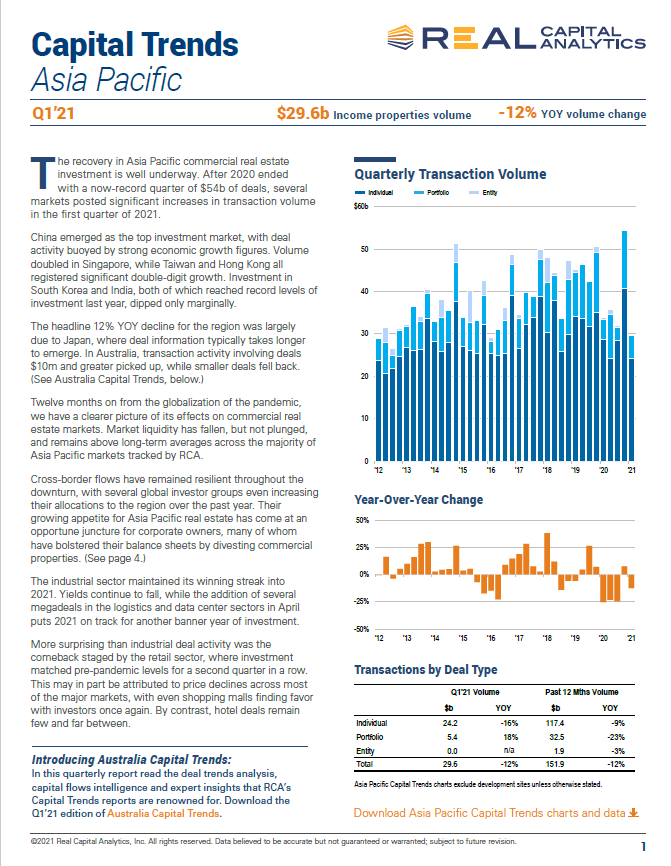
Most property markets in the Asia Pacific region ended a challenging year on the path to recovery, thanks to strong performances by the office, industrial and logistics segments. In China, a combination of government policies and the ongoing e-commerce boom powered demand for business parks and warehouses. Hong Kong saw a jump in transactions after the government reduced stamp duty on the sale of commercial properties, while Singapore saw a surge in investment sales amid improving sentiment. The market outlook improved in Australia as the country bounced back quickly from a recession, while New Zealand continued to reap the benefits of its successful management of COVID-19. Vietnam, which also has managed to control the spread of COVID-19 and perform better than other Southeast Asian economies in 2020, is attracting the attention of a growing number of local and foreign investors, especially in the industrial and logistics sectors. Japan is another market where logistics assets are highly sought after, reflecting growing demand from the e-commerce sector. In Indonesia, the hard-hit hospitality sector saw a surge in interest from investors looking to acquire discounted hotel assets, while fast-growing Myanmar continued to draw interest in the logistics and affordable housing segments. The residential segment is also seen trending up in the Philippines, where remittances from overseas workers is driving demand. Overall, investors are expected to act quickly to make the most of a conducive environment as markets across the region emerge from lockdowns and economies regain momentum.

A Changed Landscape

The covid-19 pandemic will leave a lasting impression on the commercial real estate sector across Asia-Pacific. While it brought more pain to the already battered retail sector, it put more wind in the sails of the industrial sector via the flourishing e-commerce industry, as many business-to-customers (B2C) firms were forced to adapt quickly as lockdown and movement restrictions in many markets prompted a huge shift to inline retail activity. Much of these activity result in higher online retail sales growth and penetration across the region, regardless of market maturity. 

This is evident when we look at the growth rate of online retail penetration across a few selected key markets across the Asia-Pacific with online penetration rates rising an average 14%year-on-year over 2020. We do not expect this growth to abate over the near-term and penetration rates should grow further, potentially reaching the regional leaders such as the Chinese Mainland and South Korea. 

Cloud Computing, AI, and 5G Accelerate Growth of Data Center Development and Investment Around the World

Data Centers, once an afterthought for global enterprises, are now a cornerstone of the information economy, and well over $100 billion has poured into the asset class over the past decade, according to Cushman & Wakefield’s Global Data Center Market Comparison.

The Global Market Comparison is the first data center report of its kind, openly discussing and ranking top markets for site selection and investment. This study reveals the thought process that underpins all data center work on behalf of our clients at Cushman & Wakefield, providing a rigorous and analytical approach for maximum value.

This study evaluated 1,189 data centers around the world, utilizing a unique weighted methodology to rank 48 global markets and arrive at our Overall Top Ten External Link markets.

Market turnaround: Recovery could deliver 50% uplift in global investment in 2021

Colliers anticipates a 50% surge in investment activity in the 2nd half of 2021 as global real estate markets rebound

With investors sitting on substantial amounts of dry powder and looking to make up for lost ground, Colliers expects total investment activity to increase by up to 50% in 2021. Our Global Investor survey results highlight that 98% of investors across all regions aim to expand their portfolios this year, with around 60% looking to expand by more than 10%, including 23% who want to expand by 20% or more.

Acquisitions to pick up pace in Q2 as market challenges ease

The roll out of COVID-19 vaccines will have a very positive impact on markets and global geo-political stability, courtesy of a Brexit trade deal and a U.S. election result, provide much needed certainty. These factors will help drive market growth in 2021. Although a large proportion of investors are looking to get out of the blocks early and identify acquisitions in Q1, Colliers experts believe the rebound in activity will gain strength from Q2 onwards due to lingering uncertainty over travel in the first quarter.

Tier-1 city offices remain the asset of choice

Reports of the ‘death of the office’ appear premature, with offices remaining the primary asset target globally. The scale and liquidity of the office sector in major commercial hubs like New York, London and Sydney allows investors to readily transact, supporting core, core-plus and value-add strategies. Re-positioning office assets to meet health, sustainability and technical benchmarks is a clear investor priority, delivering value for the long term.

Largely muted cap rates across Asia Pacific.

Uncertainty surrounding COVID-19 continued to put potential transaction activity on standby mode in Q42020. We saw largely muted cap rate fluctuations across the region.

Key Highlights in Q4 2020:

  • In India, notable exceptions included dips in industrial cap rates as the region-wide proliferation of e-commerce for both F&B and retailing generates sustained demand for warehousing and logistics facilities.
  • Mumbai’s retail cap rates edged upward as drops in rental and vacancies exert downward pressure on asset values.
  • Elsewhere in Manila, we witnessed a drop in rental values which are yet to be reflected on asset values.
  • In Australia’soffice sector, we expect modern assets with long term leases to continue showing resilience in value as investors focus more on low-risk buying opportunities.
  • While the underlying appetite for office assets in Australia remains healthy, transaction volumes is temporarily being affected by international travel restrictions which has impeded upon site visits. Further, limitations brought about by the foreign investment approval process has posed uncertainties on inbound capital flows. However, recent inroads to policies have been made which appear optimistic.

Overall, we believe that varying expectations on economic outlook has translated into mismatch between buyers’ and sellers’ price expectations.

The gradual restoration of activity will drive capital back to office, retail and industrial sectors, in turn affecting their cap rates later in 2021.

The retail sales index (RSI) (excluding motor vehicles in chained volume terms) fell by a slight 2.4% year-on-year (y-o-y) to 98.0 in November 2020. Retail sales performance improved in the month, led by prominent large-scale sales events such as 11.11 and Black Friday on digital platforms. Prior to these events, many brick-and-mortar stores also started going virtual with establishments such as Isetan and Metro selling their products on platforms like Lazada, and BHG setting up their own shopping site. This resulted in increased online sales in November, which accounted for about 16.7% (excluding motor vehicles), or some S$516.4 million of the total retail sales amounting to S$3.1 billion. Of these, majority of the retail trade mainly comprised transactions of Computer and Telecommunications Equipment, Furniture and Household Equipment, and Supermarkets and Hypermarkets.