APREA 標誌

知識中心

  • 自2020年11月取消雙重印花稅以來,投資情緒有所改善。.
  • 2021 年第一季,房地產基金的投資金額達到 331 兆令吉,其中包括十大交易的一半。.
  • 工業交易佔總投資額的 43%,是自 2005 年第四季以來的最高比例。.
  • 世邦魏理仕預計,今年工業地產改造租賃變更的新標準費率將提振該產業的投資。.

• 雖然仍有一些科技業的公司希望擴大業務,但其他租戶正在考慮‘調整規模’,因為他們正在採用遠端辦公方式。.

• 租賃活動也來自那些因舊建築將於今年稍後進行重建而被迫搬遷的租戶,他們需要尋找新的辦公室。此外,由於新建築的建設延期,近期租約即將到期的租戶可能會選擇續約或尋找其他辦公室。.

• 新供應延遲、遠距辦公限制解除後更多員工返回辦公室以及健康的辦公大樓投資市場,提振了甲級辦公室業主的信心。.

• 2021 年第一季度,Savills CBD A 級辦公室的整體空置率連續第四季度上升 0.3 個百分點,達到 7.3%。.

• 2021年第一季度,儘管市區重建局(URA)中央區辦公大樓租金指數環比增長3.31萬億新元,但第一太平戴維斯(Savills)中央商務區甲級寫字樓的平均月租金連續第五個季度下降,儘管環比降幅有所放緩,為1.21萬億新元,儘管每平方英尺9.41平方英尺。我們維持先前對租金年減51兆新元的預測。.

重點總結

  1. Co-investment is a nifty tool of capital management that delivers efficiencies to both LPs and GPs.
  2. A Category I / II AIF is not permitted to invest more than 25% of investible funds in a single investee company. This restricts the formation of dedicated co-investment vehicles.
  3. The IFSCA issued a circular in late 2020 permitting AIFs in GIFT City to disapply the 25% diversity requirement subject to certain conditions.
  4. More recently, SEBI released a consultation paper on the concept of ‘accredited investors’, which contemplates an enhanced degree of flexibility (including on the diversity requirement) for funds populated solely by AIs.
  5. These new measures are likely to facilitate the proliferation of co-investment activity in India.
  • 租戶諮詢和現場考察數量持續增長,但與前兩個月相比增速放緩。.
  • 彈性辦公空間需求保持穩定,大多數受訪者表示他們沒有發現任何重大變化。.
  • 受訪者表示租金面臨更大的下行壓力,而大多數主要市場的激勵措施預計將會增加。.
  • 在連續兩個月保持樂觀之後,租賃市場情緒略有惡化,再次轉為負面。房東實力也減弱。.

Manufacturing property as an asset class is rising in importance as more new or rejuvenated production locations outside of China emerge, with transactions of manufacturing assets growing 19% p.a. since 2011.

In the logistics sector, online grocery sales – the fastest-growing category of online retail sales in Asia Pacific – is predicted to rise 30% p.a., driving demand for last mile delivery facilities.

在本報告中,我們將研究
  • China Plus One strategies and the opportunities for industrial property occupiers and owners
  • Opportunities in the last mile and cold chain segments of logistics networks
  • The most attractive cities in Asia Pacific for industrial occupiers and owners
  • Investment trends in key markets

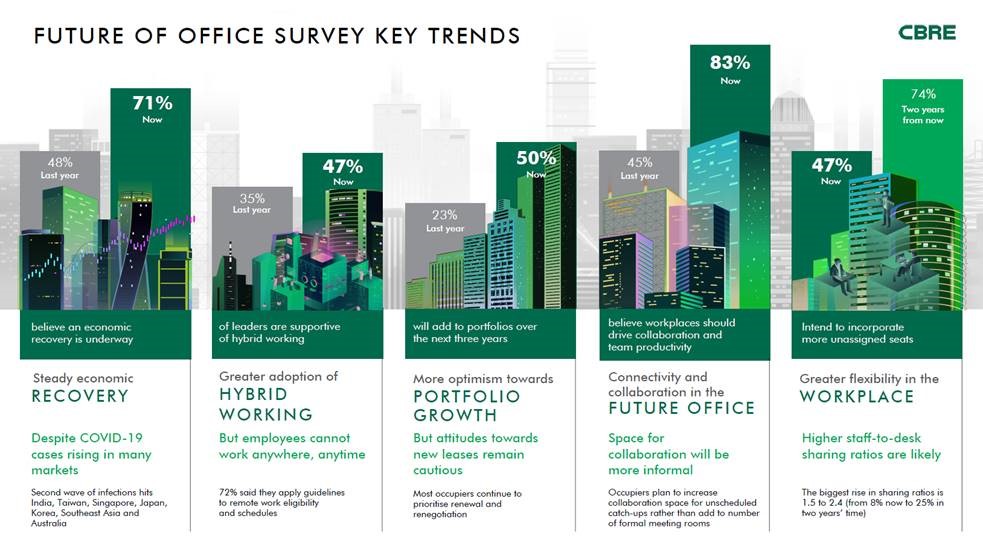
Most major regional economies continue to make steady progress after a devastating 2020 and ‘reform and recovery’ should emerge as the key themes of the year. While a smooth transition to normality is not assured (as India has shown) a pick-up in transactions volumes suggests a growing confidence among regional real estate investors as Asia continues to outpace both Europe and the US.

資本市場

With economic recovery gaining traction, preliminary real estate investment volume in Singapore increased by 11.5% q-o-q, to $3.523 bn for Q1 2021.

辦公室

Supported by the tight vacancy, the rental decline in the Grade A (Core CBD) market was arrested after four quarters of correction. Conversely, the Grade B market continued to grapple with higher vacancy rates and rents registered a further decline.

Business Parks

The performance of the business park market softened slightly in Q1 2021. Negative net absorption was noted, contributed by the City Fringe submarket.

零售

There has been a slowdown in rental declines of prime retail spaces. Landlords continue to maintain a flexible stance towards rental expectations.

住宅

The strong performance in the residential market has further shored up homebuyers’ confidence and take-up of new launches.

工業的

Leasing activity was stable in Q1 2021, albeit slowing down from the strong performance of the previous quarter. Transactions consisted mainly of renewals and relocations, along with a handful of new set ups and expansions.

去年對新加坡和馬來西亞的商業房地產來說是艱難的一年。但隨著2020年底交易量創下歷史新高,以及新冠疫苗的快速推廣,前景一片光明。.


本週,Yardi匯聚了該地區一些最傑出的經濟專家,共同解讀數據,挖掘趨勢。以下是五大洞見,可幫助您指導2021年及以後的投資決策…

  1. 兩個市場都在波動 牛津經濟研究院預測新加坡GDP將反彈至7.11兆英鎊,馬來西亞將反彈至5.41兆英鎊。新加坡預計在第二季恢復到新冠疫情前的水平,馬來西亞則可能在第四季。但牛津經濟研究院亞洲首席經濟學家西恩·芬納警告說,“經濟成長復甦取決於公共衛生狀況”,並且與各國遏制新冠疫情的努力息息相關。芬納強調,疫苗接種是經濟復甦的關鍵。在新加坡,已有近2.41億人接種了第一劑疫苗。到第三季度,新加坡的疫苗接種率將達到8.01億人,進而實現群體免疫。芬納表示,雖然目前只有2.31億馬來西亞人接種了疫苗,但到年底,全國將有7.01億人完成疫苗接種。.
  2. 經濟創傷需要時間才能癒合。 芬納在Yardi面向房地產專業人士的演講中表示,兩國經濟的反彈和復甦都將受到「經濟創傷」的影響。她解釋說,企業需要時間來修復資產負債表,勞動市場也需要時間來解決技能錯配問題。新加坡在經歷了GDP的歷史性下滑後,實現了V型復甦。芬納的同事、牛津經濟研究院經濟學家鄭成恩表示:「新加坡的產出損失幾乎已經完全彌補,其GDP目前已接近疫情前的水平。」但這一總體數據掩蓋了各行業的差異。由於對消費性電子產品和藥品的強勁需求,製造業表現「非常出色」。受疫情限制措施重創的服務業將「持續表現不佳」。同時,金融業則持續擴張。芬納補充說,儘管1月份收緊的限制措施不如2020年那樣具有破壞性,但馬來西亞仍然陷入了衰退,並且「對經濟的服務業造成了沉重打擊」。馬來西亞的基礎設施項目是一大亮點,預計短期和長期項目都將對經濟產生「強大的乘數效應」。.
  3. 去年亞太地區的投資金額創下歷史新高 2020年可謂是惡夢般的一年,亞太地區的投資額年減了191兆美元,但第四季卻創下了歷史新高。 「人們都在為最後的衝刺積蓄資金,」Real Capital Analytics亞太區董事總經理David Green-Morgan表示,「交易源源不絕。」這使得2020年的投資額回升至1500億美元,達到了可觀的水平。然而,新加坡是2020年亞太地區房地產市場表現最疲軟的市場之一,交易額比去年同期下降了601兆美元。 Green-Morgan補充道,馬來西亞的情況也好不到哪裡去,交易額下降了561兆美元。.
  4. 房地產市場的表現不僅與新冠疫情有關。 格林-摩根表示,在新冠疫情爆發前,新加坡是該地區最活躍的商業房地產市場之一。這個城市國家在2018年和2019年排名第六,但去年下滑至第11名。 在Real Capital Analytics的排名中,新加坡的銷售額年減了731兆令吉($32億令吉)。同時,吉隆坡甚至未能躋身前20名。 Green-Morgan表示,新加坡的下滑並非新冠疫情造成的,而是自然衰退的結果,疫情只是「加速並加劇了這一趨勢」。新加坡在2019年創下了’歷史新高“,因此”2020年想要超越這一成績注定會很艱難“。新冠疫情延續了馬來西亞商業地產活動原本就呈現下滑的趨勢。是什麼導致了這種下滑? Green-Morgan表示,最顯著的因素是政治環境的持續波動造成了不確定性,其次是資本轉向越南等更遠的地方。他表示,馬來西亞政府正在尋求出台政策以便利資本流動,這將起到「巨大的推動作用」。.
  5. 有大量資金正在尋找交易機會。 Real Capital Analytics預計今年新加坡的房地產市場活動將會成長。 Green-Morgan指出,三星中心(Samsung Hub)的交易就是一個例證。三星中心是一棟30層樓高的分層地契建築,於2005年完工。價格已經攀升,最近的交易價格接近每平方英尺14000美元,Green-Morgan補充道,這對新加坡市場來說是一個「相當重要的里程碑」。儘管面臨挑戰,資金仍持續流入馬來西亞的商業房地產市場。去年最大的一筆交易是收購吉隆坡的一處前空軍基地,該基地由馬來西亞政府和中國國營企業中國鐵路工程總公司合資購得。 「這筆土地交易價值15億美元,但如果一切順利推進,其開發價值將達到360億美元。在東協範圍內,這是一個規模龐大的項目,」Green-Morgan總結道。.

在網路研討會的總結環節,Yardi的Devine指出,兩個市場的前景「既樂觀又充滿挑戰,但仍存在不確定性」。 “過去12個月裡,我們學到的最重要的一點是,確定性是一種相當稀缺的資源。”.

閱讀更多 點這裡

提高投資確定性的最佳方法是掌握市場情報。. 錯過了Yardi最新一期的高階主管簡報會?千萬別錯過下一期! 訂閱我們的更新 密切關注房地產市場動態。.

Across the Asia Pacific region, property markets started the year on a strongAcross the Asia Pacific region, property markets started the year on a strongnote, with office, industrial and logistics assets driving the ongoing recovery.

In China, the busy first quarter saw end-users and investors, including foreign investors, closing major deals in keycities. There was a resurgence in investor interest in Hong Kong and Singapore, while Japan witnessed the completionof a number of commercial and residential transactions. In Korea, low interest rates and liquidity continued to fueldemand for office space, a trend likely to persist as competition intensifies for a shrinking pool of assets, while Taiwansaw demand spike for commercial properties. In Australia, a typically quiet quarter witnessed heightened activity in theoffice segment, while New Zealand’s property market, buoyed by policy changes, low interest rates and expectations ofreopened borders, is gearing up for an active year.

In the region’s emerging markets, India saw healthy demand for residential and commercial assets, and investorsremain bullish about the market’s medium to long-term prospects. Vietnam’s property sector is in the midst of arebound supported by government reforms, while Indonesia’s property market is benefiting from a smooth rolloutof vaccines and policy changes that should strengthen purchasing power, improve market confidence and encourageinvestment. Thailand is also witnessing higher levels of market activity, especially in the logistics, warehousing andindustrial sectors, but a rebound in the hospitality sector will depend on the resumption of international travel. In thePhilippines, where the economy shrunk last year for the first time since 1998, the property market is likely to pick upfollowing the easing of quarantine restrictions and the deployment of vaccines. Meanwhile, in Myanmar, the ongoingpolitical turmoil will affect the near-term outlook, but the market is expected to retain its long-term growth potential,especially in the infrastructure and industrial segments.