APREA 徽标

知识中心

After a turbulent start to the decade, globalisation is settling into a new equilibrium. A series of major economic and geopolitical shocks have reshaped the cross-border flows of goods, capital and people that defined the previous era of ‘Great Moderation’.

A key driver of change is an increase in state influence. Governments have implemented around 220 new investment policy measures annually since 2022. This represents a 75% increase on the pre-Covid-19 average, according to analysis of the UN Conference on Trade and Development’s Investment Policy Monitor.

These initiatives are designed to meet a broad set of objectives, including responding to common structural pressures such as growing economic and technological competition. Many focus on supporting ‘strategic’ sectors, including semiconductors, clean energy and digital infrastructure, often with a national security dimension.

Asian real estate securities continue to underperform broader equity markets, which have been carried by technology, semiconductor, and banking names. Real estate fundamentals across the region remain sound; the disconnect between fundamentals and price performance reflects investor apathy toward rate-sensitive assets in an environment where inflation remains elevated and central bank direction is uncertain. A resolution of Middle East tensions and a shift toward less hawkish central bank guidance remain the most likely catalysts for a sustained sector recovery.

  • June 16th is the pivotal date for the region. The BOJ and RBA announce rate decisions simultaneously. We expect the BOJ to hike despite May’s softer Tokyo CPI print, where core-core inflation decelerated to 1.6% against a 1.9% consensus. The RBA is expected to pause, with three of the four major banks now seeing 4.35% as the cycle peak and the next move a cut in 2027. BOJ guidance on the pace of subsequent hikes will matter as much as the decision itself.
  • Japan: valuations are mispriced and offer a good risk/return for medium-term investors. Developers and J-REITs have struggled as JGB yields have moved higher, yet cap rates remain firm and transaction activity is robust. The sale of Fuji Media’s Sankei Building subsidiary, which has attracted bids exceeding ¥1 trillion against a book value of ¥613bn, is the largest property transaction in Japanese history and will establish a definitive cap rate benchmark for Grade-A Tokyo office. A transaction at current bid levels, driven by TSE governance reform pressure, would accelerate the broader wave of corporate real estate asset monetisation across the market.
  • Australia: A-REIT valuations in some cases have reverted to 2022 levels, when rate increases were only beginning. Given the severity of the correction relative to other markets, a confirmed RBA pause followed by softer macro data could produce a stronger-than-expected rally. Residential developers Mirvac and Stockland are the most direct beneficiaries of a rate peak, with settlement volumes and lot sales acutely sensitive to mortgage affordability. The 2026 Federal Budget’s negative gearing reform, restricting deductions to new builds from July 1, 2027, adds a structural tailwind for both names. Goodman offers defensiveness in a higher-for-longer scenario, with data center development now representing 73% of work-in-progress.
  • Hong Kong: capital control enforcement is the key near-term risk to monitor. Mainland Chinese buyers set a record HK$43bn in residential purchases in Q1 2026. Beijing’s May tightening of cross-border capital flow rules has raised concern, though JPMorgan estimates that non-HKID mainland buyers represented only 5.5% of transaction volume and 7.2% of value, limiting the practical impact. Mid-end residential demand remains supported by population growth and rental yields. Q2 transaction data due in July will be the first clean read on whether stricter enforcement is affecting volumes.
  • Singapore: the catalyst must come from outside. With no MAS meeting until October and 3-month SORA at 1.06%, the domestic policy backdrop is benign. S-REITs offer reasonable yields and solid underlying fundamentals across retail, office, and data center sectors, yet remain lackluster absent a broader shift in sentiment. A drop in crude oil prices and less hawkish global central banks would likely be the trigger. City Developments’ strategic review, due by end of June, is the most significant near-term company-specific catalyst, with SGD 6-7bn of non-core asset disposals identified and the return of Kwek Leng Peck as Vice Chairman signalling active family involvement in the portfolio repositioning.

Artificial intelligence (AI) represents the latest in a long line of general‑purpose technologies. Like electrification, computing and the internet before it, its economic and built environment impacts will unfold gradually, unevenly and nonlinearly.

Rather than attempting to predict how AI itself will evolve, this research focuses on how firms, sectors and the macroeconomy will respond to AI – and how those responses will translate into CRE fundamentals, including: 

  • Productivity, growth and interest rates 
  • Employment trends and space demand 
  • Vacancy and absorption for major CRE sectors 
  • Capital markets behavior 
  • Differentiation in performance across assets and geographies 

Why this matters: The future of commercial real estate will depend less on AI’s technical capabilities and more on how productivity gains flow through hiring, revenue growth and capital allocation – dynamics tracked in real time by the AI Impact Barometer.

以下是再平衡结果(生效日期为 2026年6月22日 交易开始)

  • GPR/APREA 可投资100指数
  • GPR/APREA 可投资房地产投资信托基金100指数
  • GPR/APREA 综合指数
  • GPR/APREA 综合房地产投资信托指数(标有星号)

GPR/APREA 可投资 100 指数

包含物

中国大湾区人工智能计算科技有限公司
中国深圳投资有限公司
日本环球一号房地产投资信托基金
日本和平房地产有限公司.

除外条款

澳大利亚Ingenia社区集团
日本日本物流基金
菲律宾SM Prime Holdings
TWN金多姆发展有限公司


GPR/APREA 可投资 REIT 100 指数

包含物

日本日本酒店及住宅投资公司.
韩国韩国房地产投资信托有限公司
韩国乐天房地产信托基金

除外条款

澳大利亚算盘存储之王
新加坡CDL酒店信托

GPR/APEA 综合指数

包含物

香港朗廷酒店投资有限公司

除外条款

中国中国农产品交易所有限公司
国际化名PT PP (Persero) Tbk
韩国东元发展有限公司
泰国未来城市租赁权房地产投资信托基金 *
泰国普斯卡控股有限公司
TWN山源有限公司
TWN我们与赢发展有限公司

主要收获

  • 2026年第一季度,新车上市量增速放缓,环比(QoQ)下降近30.01%至1,844辆。受此影响,新车销量环比下降31.51%至2,013辆。.
  • 2026年第一季度,二手房销量环比下降9.61%,至3,400套。这可能归因于新房竣工量减少、利率走势不明朗,以及购房者转向新房市场。.
  • 非有地住宅总销量出现下滑,新加坡公民和新加坡永久居民(PR)的交易量均出现两位数降幅。另一方面,外国买家的购房量出现反弹,较前三个月增长7.21%,达到89套。.
  • 就第一太平戴维斯(Savills)的豪华非地契私人住宅项目篮子而言,2026年第一季度价格环比微升0.21%,至每平方英尺1,426新元。.
  • 该岛大部分地区在2024至2025年期间已经历过价格重置。因此,下一次全面的价格重新基准化可能还需要一到两年的时间。鉴于此,我们维持此前对2026年私人住宅价格将上涨约3%的预测

正如本报告2025年版所概述的,"加速增长"已不再是描述这一充满活力且快速演变的全球市场的最准确表述。 更精准的表述应是“有序增长”。全球各国政府正在重塑规则,以确保新建数据中心不会给现有资源(尤其是电网)带来过重负担,并解决与该行业扩张相关的各类问题。.

全球数据中心市场仍主要由云计算和企业应用主导,截至2025年,人工智能在总工作负载中的占比不足15%。由于目前大部分人工智能需求集中在美国,亚太地区的占比则更为微小。.

随着供应链多元化、数字化转型以及人工智能驱动的需求重塑该地区的资本流动,东南亚的实物资产市场持续呈现出极具吸引力的投资机遇。 投资者正日益瞄准物流、工业资产、数据中心及酒店业等高增长领域,而越南、马来西亚、印度尼西亚和菲律宾正因制造业扩张、旅游业复苏及数字基础设施投资而成为主要受益者。 即便在地缘政治不确定性和借贷成本上升的背景下,强劲的国内需求、基础设施建设以及对稳定长期收益的追求,正进一步巩固东南亚作为全球资本吸引地的地位。.

  • 在政策支持、资产类别不断扩大、机构级资产管理和价值创造日益受到重视的推动下,中国的商业房地产投资信托市场正进入一个新的发展阶段。.
  • 一个多层次的房地产投资信托生态系统正在形成,机构和私人房地产投资信托基金在资本循环、运营提升和创收资产成熟方面发挥着至关重要的作用。.
  • 中国的房地产投资格局正在经历结构性重置,国内资本、选择性部署战略和以房地产投资信托基金为基础的退出途径日益成为市场复苏和长期抗风险能力的核心。.
  • 数据中心、可再生能源和以体验为主导的零售等高增长行业正在重塑中国的实物资产市场,技术应用、不断变化的消费行为以及向更清洁能源基础设施的转型都为其提供了支持。.
  • C-REIT 生态系统正朝着更具运营驱动力和机构规模的模式发展,不良资产、城市更新和专业资产管理等领域都蕴含着机遇。. 

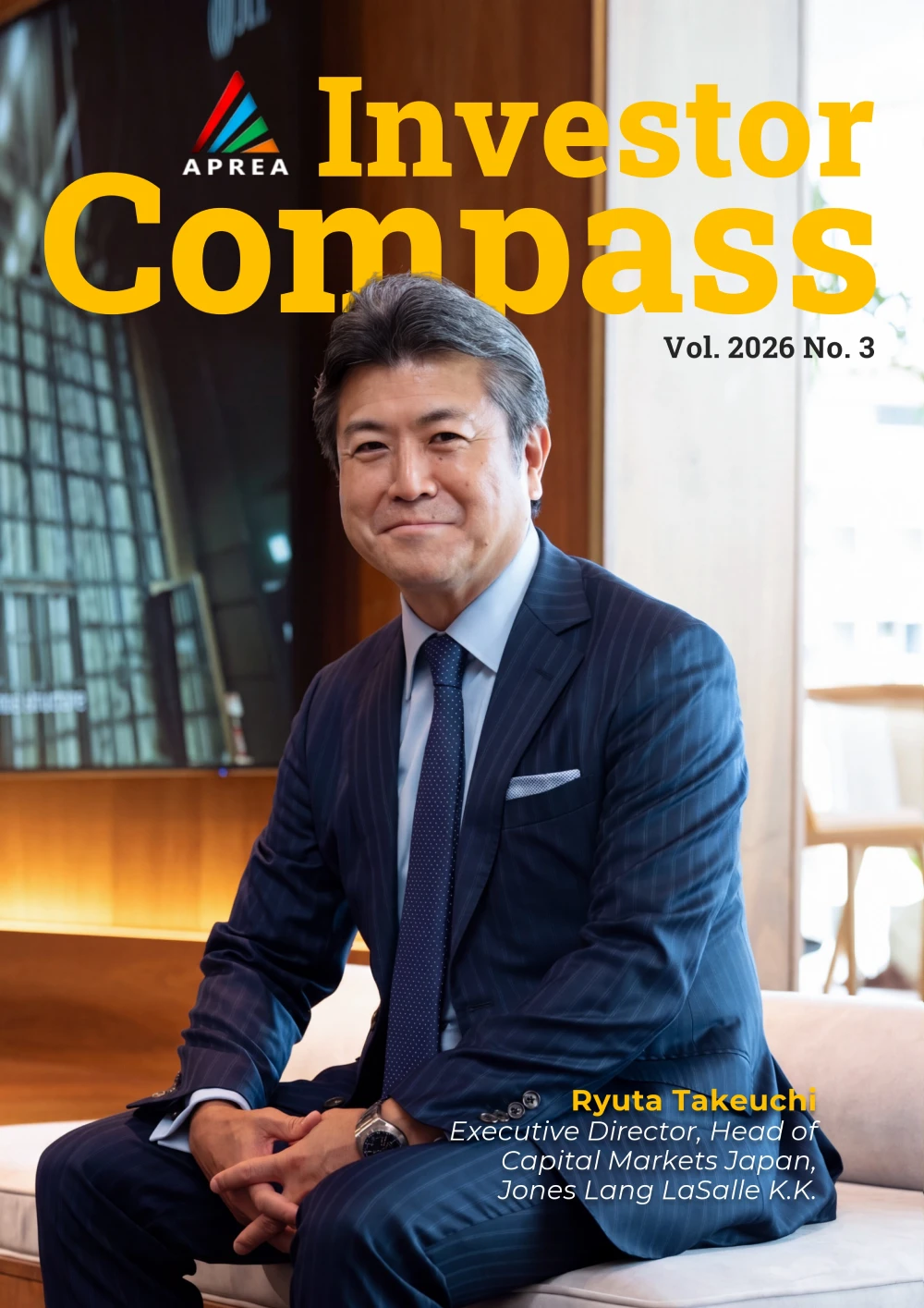
APREA 投资者指南针:Jericho P. Go(RL Commercial REIT Inc.)

亮点:

  • 真实的资产,真实的人:RL Commercial REIT Inc. (RCR) 总裁兼首席执行官 Jericho P. Go
  • 趋势观察:政治稳定与结构性需求助力日本下一个房地产周期
  • ESG热点:基于自然的解决方案如何保障亚太地区房地产资产的未来发展