
APREA 標誌

市場展望

The ongoing recovery in key property markets across Asia Pacific continued in the second quarter of 2021 and looks set to sustain through the second half, aided by strong demand for commercial assets from end-users as well as investors.

In China, a total of 30 deals were finalised across major markets, as both domestic and foreign market participants sought to acquire key assets across property segments. Korea continued to witness record-high unit prices for prime office space in Seoul, and Japan’s property markets remained buoyant in the face of stringent restrictions. In Singapore, investment activity was dominated by the privatisation of REITs, while in India, global private equity (PE) firms and developers made significant acquisitions in metro markets. Taiwan witnessed a surge in demand for commercial property from manufacturers on the back of strong export growth. In the Philippines, e-commerce companies and outsourcing firms took up space in data centres while healthcare and logistics companies should lead office take-up in the coming months. Thailand’s office market remained stable though its troubled hospitality industry could see higher transaction levels as beleaguered owners look to sell assets. We also expect to see more joint ventures between Thai and international investors across sectors. In Indonesia, the residential sector is expected to receive a boost from the extension of a tax waiver while urban mixed-use projects in the capital, Jakarta, received an influx of foreign funds as investors bet on a speedy post-COVID-19 recovery.
APREA的四項核心服務之一,共同為整個地區的成員企業的永續發展創造協同效應:

倡導方式:

  • 持續努力,積極主動地與亞太地區的政策制定者進行策略性溝通。
  • 確保亞太地區證券化實體資產產業的長期成長
  • 促進利害關係人之間的就業、經濟成長和永續環境。
  • 協調行業標準,尤其是在報告透明度和可持續性方面。

請繼續閱讀我們2021年第二季宣傳簡報的完整更新內容,其中包括以下項目: 

• 國家發展委員會於7月2日發布了關於中國基礎設施房地產投資信託基金的新公告
• 印度證券交易委員會(SEBI)降低了房地產投資信託基金(REIT)和基礎設施投資信託基金(InvIT)的交易單位,以提高流動性。
• 大悉尼地區建築活動暫停
• 香港光纖到府及房地產投資信託基金的資助計劃
• 新加坡交易所推出全球首個ESG REIT衍生性商品
• 2021年新加坡土地改良費法案
• 七國集團全球最低企業所得稅對新加坡的影響
• 因2019冠狀病毒病(COVID-19)疫情,延長針對房地產行業的臨時救濟措施
• 完善與新加坡有實質關聯的上市房屋開發商豁免資格證書制度的標準

尽管新冠疫情前景尚未完全明朗,其对亚太地区写字楼租户的干扰正在减少。在灵活办公和新型工作模式日益普遍的趋势引导下,区域内企业已经在重启对不动产策略的长期规划。

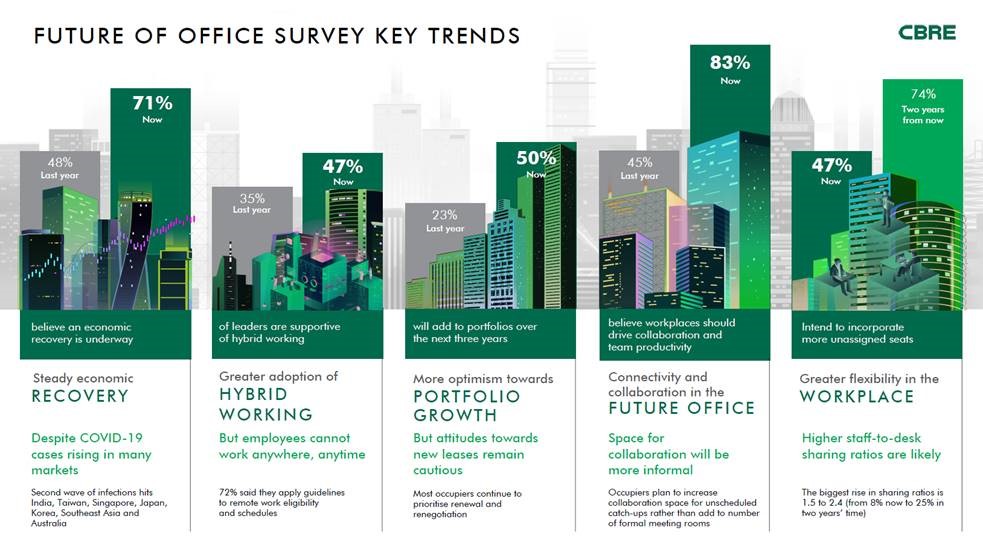
针对“新常态”之下的写字楼发展和企业租户的应对措施,CBRE世邦魏理仕于5月启动了《未来的办公场所——2021年亚太区写字楼租户调查》,并于近期发布调查结果,确立了“区域内经济稳步复苏”、“企业不动产组合规模增长预期提高”、“混合办公趋势上升”、“未来的工作场所将更重视促进沟通与协作”、“企业将实施更具灵活性的工作场所设置”等五个主要的写字楼趋势。

该项针对亚太区各地不同行业写字楼租户的调查发现,大部分(71%)受访企业都认为企业经营环境正持续改善,这一比例显著高于2020年4月(22%)与10月(48%)的两次调查结果。其中,大中华区和太平洋地区受访企业的市场信心水平最高,而印度和东南亚地区企业对市场的乐观程度则相对较低。

With many markets succeeding in containing the pandemic and relaxing restrictions on business and social activity to some degree over the past six months, this year has seen a significant improvement in business sentiment across Asia Pacific. About 71% of survey respondents believe current business conditions are improving, marking substantial progress from the two surveys CBRE conducted in October and April 2020. Confidence was highest in Greater China and the Pacific, while India and Southeast Asia were less optimistic as they struggle to contain a new wave of infections. The unpredictability of infection rates will continue to weigh on the pace of the regional recovery for the foreseeable future. However, the rapid increase in vaccination rates in mature Asia markets and the reopening of offices globally will further strengthen corporate confidence in the handling of the pandemic.

亞太房地產制勝策略

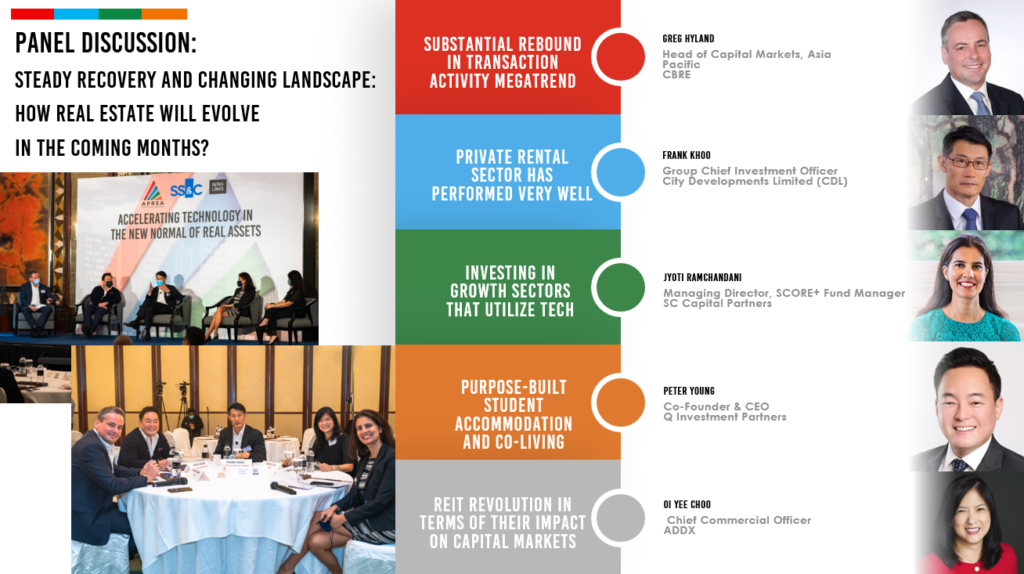
頂尖房地產和金融高管齊聚新加坡,參加由亞太房地產協會 (APREA) 主辦的活動,共同探討該地區房地產行業面臨的機會和挑戰。.

該活動由APREA、SS&C和Intralinks共同舉辦,「“加速技術在新常態下應用於實體資產,這場直播活動涵蓋了改變產業的各種議題,從房地產數據到 ESG(環境、社會和治理)目標。.

ある調查會社によると、今年上半期におけるある調查會社によると、今年上半期におけるオると、今年上半期におけるオると、前年比で倍増となり、コロナ対策を著実に行い一定の成果を示し続けているオゼtorこうした狀況を踏まえ、このほどAPREA はオーsutoraria不動產市場の倉庫や稅務に關する網路研討會を開の倉庫や稅務に關する網路研討會を開のぁ。今回は市場概要をお屆けする。

コロナ対策に一定の成果 コロナ対策に一定の成果経済回復は早期に実現

メルボルンでのロックダウン期間は長かったもメルボルンでのロックダウン期間は長かったものの、オーsutoraria政府はコロナウィルsu対策を效果に行い封じ込めに成功したと言えるであに。オーsutorariaの大學生感染は約3萬人、総人口のたった0.12%に過ぎない。政府は景気刺激措施に2000 億ドル超を投入、事業主に対しては就業継続向けに900億ドル超の租金支援げ行けに900億ドル超の租金支援あただ、シドニーは変異株の流行により先週から2週間のロックダウンがワクチン領取率はほかの先進性國よりはやや遅れておりまだ人口の1/4 程度だぅおりまだ人口の1/4 程度だが、後りまだ人口の1/4 程度だあ、後ク予後あ。

金利引き下げ策および量的緩和策の実行金利引き下げ策および量的緩和策の実行により國債利回りは低いため、不動產利回り同様魅力的なsupureddoとなっている。政策金利は0.1%で、コアの街頭コsutoは140~190bpの範囲に收まると予想している。コロナウィルsu感染拡大は28年ぶりのorisesshonをもたらし、2020年第2四半期のGDPは7%の落ち込みを示したが、回復は年ミック以前のreberuまで持ち直1.1%と、パンデミック以前のoreb eruまで持ち直し2022年は3.5%、2023年は3%と予測されている。

前回の裡塞西恩と比べ遵守は急激に悪前回の裡塞西恩と比べ遵守は急激に悪化した回复ものの、も早悪化した回复ものの、も早く2021年3月は5.1%まで回覆しており、政府の支援政策が功を奏したとのようにる見したとのようにる見えか見。セ

With the need for quality and cost-effective manufacturing becoming even more necessary due, to the disruption and economic implications of COVID-19, and global corporations looking to diversify their manufacturing bases and de-risk their supply chain, India has spotted an opportunity to capitalize on this strategic shift.

India has been active on the policy front and is paving the way to become the world’s most preferred manufacturing hub. The Production Linked Incentive (PLI) scheme is the cornerstone of the Indian government’s masterplan to boost domestic manufacturing and make it globally competitive. Introduced in April 2020, the scheme has set in motion aseries of game-changing reforms that will attract global manufacturing majors with a focus on sectors such as mobilephones, electronics, pharmaceuticals, food processing, IT, battery storage, automobile components and specialty steel.The core objective is to signal a turning point for Indian Industry and gain a global presence while boosting economicgrowth through job creation.

A measure of the government’s seriousness and the scale at which it is pushing the scheme is its outlay: Rs 1.97 lakhcrore, or $26 billion, across 13 key sectors. The highlights are:

● Linking incentives to output: Incentives will be based on the overall rate of growth in that industry. Beneficiarieswill have to consider additional investments in greenfield facilities or even to carry out facility expansions toachieve this increment. All of this will reduce imports too

● Results matter: Incentives will be disbursed only after production has taken place in the country. This will boostexisting capacities in domestic manufacturing for sunrise and strategic sectors, and make domestic manufacturing globally competitive

● Creating ‘champions’ to maximize impact: The focus is on size and scale for the selected industry players todeliver volumes. This will make it exceedingly effective and can make the beneficiaries globally competitive

During H1 2021, private equity (PE) inflow in Indian real estate was noted at USD2.9 billion, more than a two-fold increase from H1 2020. Over the next three years, we expect more capital to be deployed in build-to-core mixed-use, office and logistics assets as more investment platforms are formed between global private equity funds and local developers. We estimate total PE inflows to reach USD5 billion in 2021.

Some of the key highlights from the latest flash report by Colliers Research – ‘Investments Turbocharged with Focus on Alternate Assets Classes’ are:

  • Investors continue to scout for either land or assets in under-construction stage, as they look to build their portfolio for a future REIT listing. About 86% of the total investments in the office sector were in land or projects under-construction.
  • Investments in retail assets accounted for 29% of the total investments in H1 2021 as investor appetite remained intact for exposure to stabilized retail assets as well as for investments in ground-up developments in partnership with selective developers.
  • The increased demand from e-commerce companies for logistics space has in turn resulted in continued interest from institutional investors with inflows of about USD775 million in H1 2021.

In this edition of The Reimagined Workplace Q&A series, we collaborate with Patrick McCreery, Global Head of Commercial and GM for Southeast Asia at Keppel Data Centres, to focus on disaster recovery – also known as business continuity planning – and discuss how the work ‘place’, ‘space’ and ‘pace’ are evolving within the data centres sector, as well as the opportunities for both occupiers and asset owners, going forward.

Q&A Highlights:

  • How has occupier demand for disaster recovery changed in the past 12 months?
  • How is cloud adoption transforming occupiers and why are operators following suit?
  • What are the long-term outlook for disaster recovery and demand, and the opportunities in this space?
  • How do data centres support business continuity planning and the disaster recovery business?

The Asia Pacific office demand declined from 103 million sf in 2019 to 53 million sf in 2020 as occupiers sought to limit cost exposures during the COVID-19 pandemic.
In line with this decline in demand, vacancy has increased, and rents have softened across most markets, pushing them towards greater tenant-friendly status and providing occupiers with a window of opportunity in negotiating any forthcoming lease commitments.

However, corporate occupiers need to be aware that these changes may not bring the cost savings that they might expect – some markets may see tenants having to pay more on a new lease than they were paying on the last year of an expiring lease.

In our Asia Pacific Office Rental Variability Index we take a closer look at:

  • The current state of play in 36 key office cities across Asia Pacific
  • The extent of, and variability in, rental change over the duration of average lease terms at the city level
  • Strategies that occupiers might wish to explore to help navigate the impacts of this rent variability