APREA 徽标

特色观点

The pressures on biodiversity are increasing, making it critical for the real estate industry to consider its impact, particularly across the Asia Pacific region where Southeast Asia alone hosts nearly 20% of the world’s known species within just 3% of the global land area.

Biodiversity contributes significantly to the functioning of ecosystem services such as clean air and water, climate regulation and disaster risk reduction which are essential for human well-being and economic stability. However, this is threatened due to this region’s rapid urbanization, deforestation, and agricultural expansion. For example, air and water pollution are the highest environmental risks that urban Asian cities face, with air pollution being the cause of one in five deaths in India in 2019, resulting in economic losses of USD 36 billion.

Driven by growing investor concerns and the need for robust ESG disclosures, regulatory trends are increasingly focusing on biodiversity. Initiatives like the UK's Biodiversity Net Gain (BNG) and the emergence of frameworks like the Taskforce on Nature-related Financial Disclosures (TNFD) are putting pressure on companies to disclose their environmental impacts and demonstrate how they are contributing to nature conservation.

The real estate sector, a significant contributor to biodiversity loss through land use, consumption of raw materials and disruption of natural cycles, is central to this shift. An upcoming white paper developed by CBRE in collaboration with Nature Positive and the Metis Institute acknowledges this and aims to explore the feasibility and benefits of incorporating biodiversity into green leases in Southeast Asia. Green leases serve as an important link between landlord and tenants on the sustainable objectives of a building, and including biodiversity within would help to integrate both party’s interests.

The white paper acknowledges several challenges when addressing biodiversity risks. Adoption and support for nature-based solutions is low due to weak legislation, lack of awareness, and maintenance difficulties . Additionally, the intangible benefits of nature-based solutions make it hard to justify the capital investments.

Despite these challenges, the real estate sector has a unique opportunity to turn the tide. By integrating biodiversity into urban development, the industry can enhance urban resilience to climate change effects, such as flooding and heatwaves, improving business continuity and urban liveability.  Furthermore, properties that incorporate green spaces and biodiversity measures often see increased market values, as investors are attracted to the operability and resilience of the building, along with higher tenant satisfaction.

While the path forward is fraught with challenges, the potential benefits of addressing biodiversity risks present a compelling case for action within the real estate industry.

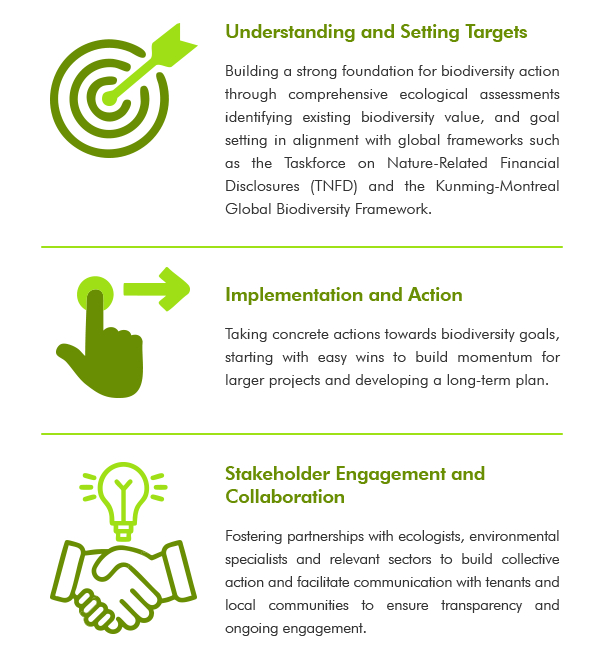
To get started, the real estate industry can consider the following actions.

Prioritising biodiversity should be a necessity in sustainable urban development in Asia Pacific before it is too late to salvage local ecosystems. By setting clear targets, engaging stakeholders, fostering collaboration, and prioritising quick wins, the real estate industry can play a crucial role in preserving the region's rich biodiversity while reaping significant economic and social benefits.

aprea 图标标志

David Fogarty,

Head of ESG Consulting & Sustainability,
APAC, Paia FROM CBRE

aprea 图标标志

Jie Min Ong,

Head of WELL & Circular Economy
Paia 来自 CBRE

aprea 图标标志

梅利亚·蔡

Head of Nature Solutions
Paia 来自 CBRE

Environmental sustainability has taken on increased global significance in recent years, with an increased focus on climate resilience and net-zero carbon (NZC) strategies. This is particularly relevant to the real estate industry as it seeks to future-proof real estate portfolios using effective climate risk management strategies. Environmental sustainability issues are equally applicable in both the developed and emerging real estate markets.

This report focuses on net-zero carbon strategies for real estate in India. We conducted interviews with leading players in India’s real estate industry. This enabled in-depth understanding and insight into the critical issues for achieving net-zero carbon in India and identified the most effective pathways forward for real estate. Many of the issues concerning India are equally relevant to other emerging markets in Asia, so this report should also appeal to a wider audience.

This study evaluates key barriers, challenges, and opportunities in the adoption of NZC and recommends strategies for the low-carbon transformation of India’s real estate sector.

Globally and especially in Singapore, the race to Net Zero has long begun. Like running any race, the motivation and plan must be clear. This paper lays out the urgency and steps to win this race for both commercial real estate owners and occupiers.

Net Zero buildings enhance resilience to energy supply disruptions and reduce dependence on fossil fuels. Although there may be initial costs, long-term savings through reduced energy expenses and increased property value are significant benefits. Net Zero buildings also offer a healthier and more productive environment for tenants, leading to higher occupancy rates and rents.

Finally, a couple of case studies demonstrate the potential savings for typical landlords and occupiers in the commercial space from optimising energy use (without additional capital expenditures) through simulation-based solutions; adopting the smart scheduling of energy use can lead to substantial cost and emission reductions.

The climate impact of the real estate sector cannot be understated, with buildings contributing nearly 40% of global carbon emissions. Asia, home to over half of the world’s urban population, plays a critical role in this equation, with the region’s emissions projected to increase as urbanization and development accelerate. 

With approximately 70 billion square meters of real estate expected to be developed in Asia over the next two decades, the region has the potential to not only reduce emissions but to set new standards in sustainable urban planning and construction.

Key Decarbonization Strategies for Asia:

  1. Limiting Urban Sprawl: Urban expansion in Asia has often led to low-density developments, resulting in higher emissions due to increased infrastructure demands. Cities can mitigate these impacts by focusing on high-density, mixed-use developments, creating efficient urban spaces that minimize transportation needs and reduce the overall carbon footprint.
  2. Sustainable Construction Practices: The materials and processes used in construction have a significant carbon impact. By adopting innovative materials and techniques, such as using greener concrete mixes, and integrating supplementary cementitious materials, developers can dramatically cut emissions. For example, certain concrete mixes can reduce carbon emissions by up to 40% compared to traditional materials.
  3. Carbon Capture and Storage: Emerging carbon capture technologies offer promising solutions to reduce emissions from the manufacturing of construction materials. Though still in early stages, these technologies have the potential to significantly cut emissions if adopted at scale.
  4. Advanced Data and AI Solutions: Accurate data tracking is essential for effective emissions management. Technologies that integrate data from utility bills, smart meters, and Building Management Systems enable real-time tracking and smarter energy management, reducing emissions tied to building operations.

A Path Forward for a Sustainable Asia

The decarbonization of Asia’s built environment represents both a challenge and a $47 trillion economic opportunity, driven by the need to align with global climate goals while catering to the unique demands of the region. Achieving this requires a targeted approach, one that equips developers, investors, and policymakers with strategies that balance sustainability with Asia’s rapid growth.

 To dive deeper into these strategies, download the whitepaper “From Concrete to Carbon Neutral: Decarbonizing Asia’s Built Environment”.

Annu Taljera

Founder, CEO
Accacia

Buildings contribute 40% of global carbon emissions, with Asia representing half of the world’s real estate markets. This whitepaper presents an Asia-first approach to decarbonizing the region’s built environment, addressing rapid urbanization and fragmented geographies through industry case studies. It outlines key strategies, highlights capital investment opportunities, and offers a roadmap for sustainable growth.

While venture capital in sustainable building tech is rising globally, Asian startups secure only 10% of this funding. Technology-led solutions are critical to helping Asia leapfrog towards decarbonization, with both venture capital and corporate initiatives playing essential roles. This transition is estimated to represent a $47 trillion opportunity.

Cushman & Wakefield released its 2023 Sustainability Report, highlighting the firm’s global impact and progress across key sustainability areas. The report underscores the company’s commitment to embedding sustainability in its operations and service offerings, helping clients achieve their goals while strengthening corporate reputation and mitigating risks. It reflects Cushman & Wakefield’s focus on transparency, accountability, and continuous improvement in environmental, social, and governance (ESG) performance. Chief Sustainability Officer Jessica Francisco emphasized the firm’s dedication to shaping a sustainable future, not only for clients and stakeholders but for the planet. Cushman & Wakefield is actively reducing its environmental impact, fostering a diverse and inclusive workplace, and enabling clients to meet their sustainability objectives. With ambitious future targets, the firm is focused on taking immediate action for a better, more sustainable future.

Mindspace Business Parks REIT Group is proud to present its third ESG report for the Financial Year (FY) 2024. Sponsored by the K Raheja Group, Mindspace Business Parks REIT (“Mindspace REIT”) and its Asset SPVs (hereafter referred to as “Mindspace REIT Group” or “Mindspace REIT” or “Group” or “we” or “us” or “our Entity”) are defining the future of efficient and equitable workspaces that are designed around the pillars of occupant wellness and sustainability.

Guided by an impact led ESG strategy, we encourage broader stakeholder participation to expand the reach of our sustainability practices and catalyze change across the larger ecosystem beyond our properties. As we grow our footprint to accelerate long-term value creation for our stakeholders, we continue to be powered by our ESG strategy.

Asia Pacific REITs are leading the charge in sustainability, driving the decarbonization of the region’s real estate. With over 200 REITs and a market cap surpassing $250 billion, they are setting new standards for green assets and aligning with net-zero goals.

However, climate risks and regulatory pressures loom large, making it imperative for REITs to innovate and collaborate to safeguard their assets and seize the massive opportunity in sustainable growth. Learn how APAC REITs are navigating these challenges and pioneering a resilient, green future.

西格丽德-齐亚尔西塔

首席执行官
APREA

Sigrid 是亚太不动产协会(APREA)的首席执行官。她常驻新加坡,负责监督协会在亚太地区的战略方向、计划和运营。在她的领导下,亚太不动产协会重新定位为专注于房地产和基础设施的行业贸易集团。.

Sigrid 于 2019 年 1 月加入 APREA 的执行团队。.

在加入亚太房地产研究协会之前,她于2010年至2018年担任高纬环球(C&W)亚太区研究与咨询服务董事总经理,负责研究、思想领导、战略制定和客户管理。 在调往新加坡之前,她常驻华盛顿特区,领导高纬环球在美国中大西洋地区的研究小组,负责监督华盛顿特区、弗吉尼亚州、马里兰郊区、巴尔的摩和费城地区市场研究活动的方方面面。在加入 C&W 之前,Sigrid 曾担任全美房地产经纪人协会 (NAR) 的高级经济学家。在该职位上,她负责开发 NAR 的办公室、仓库、零售、多户住宅和国际研究项目。.

作为公认的全球经济、公共政策和房地产问题专家,Sigrid 经常在行业活动中发表演讲。 华尔街日报》、《金融时报》、彭博社、《纽约时报》和路透社等众多全球出版物也经常刊登她对商业和住宅房地产市场的评论。此外,她还在 CNBC、彭博社、CNN、国家公共广播电台和亚洲新闻频道等财经网络和广播电台上多次亮相。.

Sigrid 拥有康奈尔大学约翰逊管理研究生院工商管理硕士学位和宾夕法尼亚州立大学经济学硕士学位。她是多个民间团体的成员,包括新加坡莱佛士城扶轮社(Rotary Club of Raffles City),并在该社担任过多个领导职务,同时还是新加坡克罗恩氏症和结肠炎协会(Crohn's & Colitis Society of Singapore)执行委员会的成员。.

大卫·福格蒂

ESG咨询与可持续发展服务主管
Paia 来自世邦魏理仕亚太区

David Fogarty is the Head of ESG Consulting & Sustainability Services, Paia FROM CBRE, APAC.

He has previously the roles of Executive Managing Director for Property Management in the United Kingdom, Managing Director, Property & Asset Management Singapore and Southeast Asia, and Regional Director, Asset Services, Pacific (Australia and New Zealand).

David 热衷于创造一个让人们蓬勃发展的环境,建立社区和联系,将技术、可持续性和人结合起来,以帮助塑造工作场所和房地产的未来。.

With over twenty-five (25) years’ experience adding value in the industry across a range of commercial, retail, residential, mixed use, hospitality, and industrial property, David has successfully led Asset, Property and Sustainability businesses, building effective teams, driving strong growth, performance, and profitability.

There is a growing emphasis on sustainability and environmental footprint in the transportation and logistics industries worldwide, with nearly 70% of companies from these sectors in the Fortune 500 having set a net zero carbon target, and around half aiming to achieve this objective by 2030 or earlier. This growing trend is also influencing logistics occupiers’ real estate decision-making worldwide.

In Asia Pacific, an increasing number of logistics occupiers are seeking more environmentally friendly warehouses and distribution centres. CBRE’s June 2024 Asia Pacific Leasing Market Sentiment Index found that energy-related features, particularly renewable energy supply and energy efficiency management, are most preferred. Many survey respondents indicated that occupiers also have a preference for facilities that possess some form of green certification, and that provide charging infrastructure for electric vehicles.

With more occupiers embedding sustainability into their real estate strategy, landlords and investors must accelerate the greening of their Asia Pacific logistics portfolios.

This Viewpoint explores occupiers’ most sought-after green features and explains how asset owners in the region should respond to rising demand for environmentally friendly logistics real estate.

这份与奥纬咨询公司合作发布的报告强调了城市在引领全球应对气候变化和生物多样性丧失方面发挥的关键作用。城市采取协调一致的自然保护行动,不仅对于实现《全球生物多样性框架》(GBF)设定的目标至关重要,而且鉴于城市与自然和生物圈之间目前失衡的关系所带来的气候、健康和基础设施方面的挑战,也具有战略必要性。.

本报告最初发表于 https://www.weforum.org/publications/nature-positive-cities-guidelines-for-rehabilitating-nature-in-the-urban-era/