APREA Logo

Featured Insights

As ESG adoption in real assets accelerates, identifying the right technology remains a complex challenge. There is no one-size-fits-all approach—ESG tools must align with a firm’s portfolio, investment strategy and data maturity. At the APREA Singapore Conference, industry experts emphasized the need for flexible, value-driven solutions.

For firms like SC Capital Partners, a private equity real estate firm managing over 60 assets across diverse classes in Asia-Pacific, agility and pragmatism in ESG strategy are essential. Unlike traditional developers with long-term investment horizons, SC Capital Partner follows an opportunistic investment strategy, where holding periods vary and assets may be divested ahead of schedule in response to market dynamics. This variability renders costly, rigid digital tools impractical, says Miak Ou, Director and Head of Sustainability at SC Capital Partners.

“Technology must align with a firm’s ESG maturity, portfolio strategy and data readiness,” says Ou. “What works for a long-term core asset might not necessarily work for an opportunistic investment with a short and unpredictable holding period.”

Firms should prioritize value-driven adoption over trends. SC Capital Partners, for instance, currently uses a structured Excel-based system – developed with consultants – as it is flexible, cost-effective, and well-integrated with current workflows. Rather than invest in proprietary tools, the firm integrates with operators’ existing digital platforms to reduce implementation risk and accelerate adoption.

The edge lies not in the tool itself, but in the ability to measure, analyse, and apply data to make better investment decisions. While digital tools enhance tenant and guest experiences, Ou notes that smart building technologies are especially impactful in sectors like co-living, student accommodation, and self-storage, where they drive operational efficiency. In hospitality, innovations like mobile check-ins and smart room controls prioritize personalization over full automation.

Among the panelists, Esther An, Chief Sustainability Officer at City Developments Limited (CDL) highlighted the importance of the built environment in contributing to a net zero carbon future. She shared how CDL has leveraged green building and energy-efficient technologies and practices to reduce operation costs without compromising on users’ productivity and comfort founded on its ethos of ‘Conserving as We Construct’ established in 1995. She pointed to rising carbon taxes and grid prices that will require businesses for deeper and greater sustainability integration and innovation. Digital tools are key to improving ESG data collation, analysis and reporting to meet the rising expectation of regulators, investors and financiers, she said.

“Applying AI to improve business operations is definitely a no-brainer,” An, said. “ The key is on how do you deploy it efficiently to achieve the desired impact? Over the past 10 years, we have been saving an average of $3 to $4 million a year thanks to the effective application of energy-efficient technologies and practices.” AI-powered facility management platforms have helped us to optimize resource use through reducing lighting, air conditioning, and manpower deployment in underutilized spaces. This approach extends to car parks and large-scale infrastructure, reducing costs and improving operational efficiency, she noted. Temperature and grid prices will continue to rise, AI and technologies application to improve performance will be critical to future-proof businesses.

The Social Pillar: A Growing Focus in ESG

While governance and environmental concerns often dominate ESG discussions, the social pillar—spanning diversity, well-being and community engagement—receives less attention. However, demand for human-centric real estate is growing, particularly in student housing and senior living. Investors and tenants increasingly prioritize inclusivity, mental well-being and social impact.

Real estate leaders must integrate social impact in ESG strategies to enhance community well-being, said Tan Szue Hann, Head of Sustainability (Real Estate), and Director of ESG Strategy (Fund Management) at Keppel Ltd. Keppel Bay Tower, Singapore’s first net-zero office building, exemplifies this with efficient air handling, smart lighting, improved air quality, and tenant engagement, boosting sustainability and long-term occupancy.

“Keppel will not just take on a new tool or a new piece of technology because it’s required, there has to be a certain efficiency in it, and there has to be a certain value that’s created as well,” Tan said.

Sustainability in Building Design and Retrofitting

Environmental responsibility is key to ESG, but real impact requires going beyond compliance. Firms must balance regulations with proactive measures like green certifications, carbon reduction and energy-efficient retrofits.

Research and development in carbon capture and nature-based solutions underscore the need for tech-driven approaches, An highlights. Singapore, in particular, faces unique sustainability challenges due to heat, land scarcity and limited renewable energy options. Rising temperatures and cooling demands require energy-efficient solutions such as adding fans to improve ventilation alongside air conditioning and adoption of paint with cooling and purifying effect.

She advocated that Nature-based solutions will be the way forward as climate crisis cannot be resolved without tackling nature crisis.

Tan cites Seoul’s INNO88 tower as a model for sustainability-driven retrofitting. New urban regulations required removing three floors, but a conscious decision was made to retain the majority of the building’s structure, leading to a retrofit that preserved 30,000 tons of embodied carbon, while cutting operational energy use by 30%, saving SGD 1 million annually. The upgrade also boosted the building’s valuation, attracting investors.

SC Capital Partners applies Building Information Modelling (BIM) across all data centre developments under its SC Zeus platform, Ou notes. BIM is critical for optimising energy use and reducing waste—both key in energy-intensive assets like data centres. While adoption in Asia remains uneven, including in Japan and South Korea, the firm has made BIM a baseline requirement to support stronger ESG and operational outcomes from day one.Tan cites Seoul’s INO88 tower as a model for sustainability-driven retrofitting. Heritage regulations required removing three floors, leading to a retrofit that preserved 40,000 tons of embodied carbon and cut energy use by 30%, saving SGD 1 million annually. The upgrade also boosted the building’s valuation, attracting investors.

The future of ESG in real estate hinges on balancing governance, social impact and sustainability. Technology drives efficiency and compliance, but the real value comes from turning data into action. As the industry evolves, ESG must stay at the forefront—ensuring profitability, resilience, and a healthier planet for future generations.

The pressures on biodiversity are increasing, making it critical for the real estate industry to consider its impact, particularly across the Asia Pacific region where Southeast Asia alone hosts nearly 20% of the world’s known species within just 3% of the global land area.

Biodiversity contributes significantly to the functioning of ecosystem services such as clean air and water, climate regulation and disaster risk reduction which are essential for human well-being and economic stability. However, this is threatened due to this region’s rapid urbanization, deforestation, and agricultural expansion. For example, air and water pollution are the highest environmental risks that urban Asian cities face, with air pollution being the cause of one in five deaths in India in 2019, resulting in economic losses of USD 36 billion.

Driven by growing investor concerns and the need for robust ESG disclosures, regulatory trends are increasingly focusing on biodiversity. Initiatives like the UK's Biodiversity Net Gain (BNG) and the emergence of frameworks like the Taskforce on Nature-related Financial Disclosures (TNFD) are putting pressure on companies to disclose their environmental impacts and demonstrate how they are contributing to nature conservation.

The real estate sector, a significant contributor to biodiversity loss through land use, consumption of raw materials and disruption of natural cycles, is central to this shift. An upcoming white paper developed by CBRE in collaboration with Nature Positive and the Metis Institute acknowledges this and aims to explore the feasibility and benefits of incorporating biodiversity into green leases in Southeast Asia. Green leases serve as an important link between landlord and tenants on the sustainable objectives of a building, and including biodiversity within would help to integrate both party’s interests.

The white paper acknowledges several challenges when addressing biodiversity risks. Adoption and support for nature-based solutions is low due to weak legislation, lack of awareness, and maintenance difficulties . Additionally, the intangible benefits of nature-based solutions make it hard to justify the capital investments.

Despite these challenges, the real estate sector has a unique opportunity to turn the tide. By integrating biodiversity into urban development, the industry can enhance urban resilience to climate change effects, such as flooding and heatwaves, improving business continuity and urban liveability.  Furthermore, properties that incorporate green spaces and biodiversity measures often see increased market values, as investors are attracted to the operability and resilience of the building, along with higher tenant satisfaction.

While the path forward is fraught with challenges, the potential benefits of addressing biodiversity risks present a compelling case for action within the real estate industry.

To get started, the real estate industry can consider the following actions.
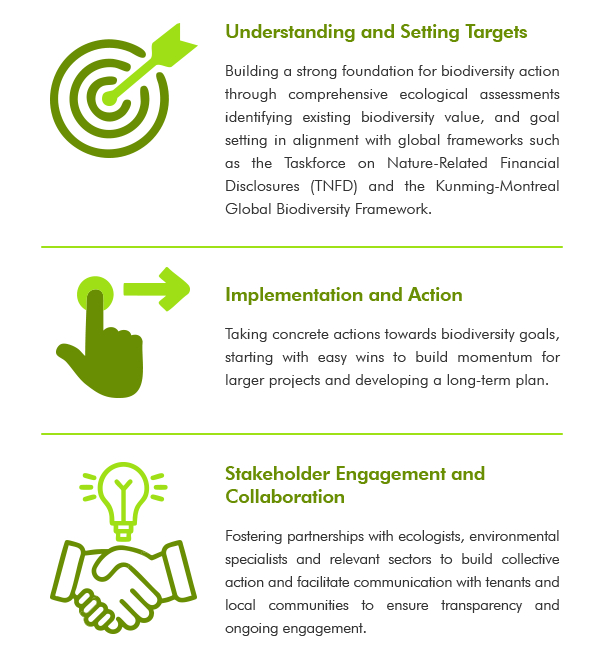
Prioritising biodiversity should be a necessity in sustainable urban development in Asia Pacific before it is too late to salvage local ecosystems. By setting clear targets, engaging stakeholders, fostering collaboration, and prioritising quick wins, the real estate industry can play a crucial role in preserving the region's rich biodiversity while reaping significant economic and social benefits.


aprea icon logo

David Fogarty,

Head of ESG Consulting & Sustainability,
APAC, Paia FROM CBRE

aprea icon logo

Jie Min Ong,

Head of WELL & Circular Economy
Paia FROM CBRE

aprea icon logo

Melia Chua

Head of Nature Solutions
Paia FROM CBRE

Environmental sustainability has taken on increased global significance in recent years, with an increased focus on climate resilience and net-zero carbon (NZC) strategies. This is particularly relevant to the real estate industry as it seeks to future-proof real estate portfolios using effective climate risk management strategies. Environmental sustainability issues are equally applicable in both the developed and emerging real estate markets.

This report focuses on net-zero carbon strategies for real estate in India. We conducted interviews with leading players in India’s real estate industry. This enabled in-depth understanding and insight into the critical issues for achieving net-zero carbon in India and identified the most effective pathways forward for real estate. Many of the issues concerning India are equally relevant to other emerging markets in Asia, so this report should also appeal to a wider audience.

This study evaluates key barriers, challenges, and opportunities in the adoption of NZC and recommends strategies for the low-carbon transformation of India’s real estate sector.

Globally and especially in Singapore, the race to Net Zero has long begun. Like running any race, the motivation and plan must be clear. This paper lays out the urgency and steps to win this race for both commercial real estate owners and occupiers.

Net Zero buildings enhance resilience to energy supply disruptions and reduce dependence on fossil fuels. Although there may be initial costs, long-term savings through reduced energy expenses and increased property value are significant benefits. Net Zero buildings also offer a healthier and more productive environment for tenants, leading to higher occupancy rates and rents.

Finally, a couple of case studies demonstrate the potential savings for typical landlords and occupiers in the commercial space from optimising energy use (without additional capital expenditures) through simulation-based solutions; adopting the smart scheduling of energy use can lead to substantial cost and emission reductions.

The climate impact of the real estate sector cannot be understated, with buildings contributing nearly 40% of global carbon emissions. Asia, home to over half of the world’s urban population, plays a critical role in this equation, with the region’s emissions projected to increase as urbanization and development accelerate. 

With approximately 70 billion square meters of real estate expected to be developed in Asia over the next two decades, the region has the potential to not only reduce emissions but to set new standards in sustainable urban planning and construction.

Key Decarbonization Strategies for Asia:

  1. Limiting Urban Sprawl: Urban expansion in Asia has often led to low-density developments, resulting in higher emissions due to increased infrastructure demands. Cities can mitigate these impacts by focusing on high-density, mixed-use developments, creating efficient urban spaces that minimize transportation needs and reduce the overall carbon footprint.
  2. Sustainable Construction Practices: The materials and processes used in construction have a significant carbon impact. By adopting innovative materials and techniques, such as using greener concrete mixes, and integrating supplementary cementitious materials, developers can dramatically cut emissions. For example, certain concrete mixes can reduce carbon emissions by up to 40% compared to traditional materials.
  3. Carbon Capture and Storage: Emerging carbon capture technologies offer promising solutions to reduce emissions from the manufacturing of construction materials. Though still in early stages, these technologies have the potential to significantly cut emissions if adopted at scale.
  4. Advanced Data and AI Solutions: Accurate data tracking is essential for effective emissions management. Technologies that integrate data from utility bills, smart meters, and Building Management Systems enable real-time tracking and smarter energy management, reducing emissions tied to building operations.

A Path Forward for a Sustainable Asia

The decarbonization of Asia’s built environment represents both a challenge and a $47 trillion economic opportunity, driven by the need to align with global climate goals while catering to the unique demands of the region. Achieving this requires a targeted approach, one that equips developers, investors, and policymakers with strategies that balance sustainability with Asia’s rapid growth.

 To dive deeper into these strategies, download the whitepaper “From Concrete to Carbon Neutral: Decarbonizing Asia’s Built Environment”.

Annu Taljera

Founder, CEO
Accacia

Buildings contribute 40% of global carbon emissions, with Asia representing half of the world’s real estate markets. This whitepaper presents an Asia-first approach to decarbonizing the region’s built environment, addressing rapid urbanization and fragmented geographies through industry case studies. It outlines key strategies, highlights capital investment opportunities, and offers a roadmap for sustainable growth.

While venture capital in sustainable building tech is rising globally, Asian startups secure only 10% of this funding. Technology-led solutions are critical to helping Asia leapfrog towards decarbonization, with both venture capital and corporate initiatives playing essential roles. This transition is estimated to represent a $47 trillion opportunity.

Cushman & Wakefield released its 2023 Sustainability Report, highlighting the firm’s global impact and progress across key sustainability areas. The report underscores the company’s commitment to embedding sustainability in its operations and service offerings, helping clients achieve their goals while strengthening corporate reputation and mitigating risks. It reflects Cushman & Wakefield’s focus on transparency, accountability, and continuous improvement in environmental, social, and governance (ESG) performance. Chief Sustainability Officer Jessica Francisco emphasized the firm’s dedication to shaping a sustainable future, not only for clients and stakeholders but for the planet. Cushman & Wakefield is actively reducing its environmental impact, fostering a diverse and inclusive workplace, and enabling clients to meet their sustainability objectives. With ambitious future targets, the firm is focused on taking immediate action for a better, more sustainable future.

Mindspace Business Parks REIT Group is proud to present its third ESG report for the Financial Year (FY) 2024. Sponsored by the K Raheja Group, Mindspace Business Parks REIT (“Mindspace REIT”) and its Asset SPVs (hereafter referred to as “Mindspace REIT Group” or “Mindspace REIT” or “Group” or “we” or “us” or “our Entity”) are defining the future of efficient and equitable workspaces that are designed around the pillars of occupant wellness and sustainability.

Guided by an impact led ESG strategy, we encourage broader stakeholder participation to expand the reach of our sustainability practices and catalyze change across the larger ecosystem beyond our properties. As we grow our footprint to accelerate long-term value creation for our stakeholders, we continue to be powered by our ESG strategy.

Asia Pacific REITs are leading the charge in sustainability, driving the decarbonization of the region’s real estate. With over 200 REITs and a market cap surpassing $250 billion, they are setting new standards for green assets and aligning with net-zero goals.

However, climate risks and regulatory pressures loom large, making it imperative for REITs to innovate and collaborate to safeguard their assets and seize the massive opportunity in sustainable growth. Learn how APAC REITs are navigating these challenges and pioneering a resilient, green future.

Sigrid Zialcita

CEO
APREA

Sigrid is the Chief Executive Officer of Asia Pacific Real Assets Association (APREA). Based in Singapore, she is responsible for overseeing the strategic direction, initiatives and operations of the association across Asia Pacific. Under her leadership, APREA repositioned to an industry trade group focusing on real estate and infrastructure.

Sigrid joined APREA’s executive team in January 2019.

Prior to APREA, she served as Managing Director of Asia Pacific Research and Advisory Services of Cushman & Wakefield (C&W) from 2010 through 2018, where she was responsible for research, thought leadership, strategy formulation and client management.  Before relocating to Singapore, she was based in Washington, D.C. and led C&W’s U.S. research group in the Mid-Atlantic region, overseeing all aspects of market research activities in the Washington, DC; Virginia; Suburban Maryland, Baltimore; and Philadelphia areas. Prior to joining C&W, Sigrid served as a Senior Economist for the National Association of Realtors (NAR). In that position, she developed NAR’s office, warehouse, retail, multi-family housing, and international research programs.

A recognized expert in global economic, public policy and real estate issues, Sigrid is a frequent speaker at industry events.  Her commentary on commercial and residential real estate markets is also regularly featured in a wide array of global publications, including the Wall Street Journal, Financial Times, Bloomberg, New York Times and Reuters. Additionally, she has made several television appearances on financial networks and radio such as CNBC, Bloomberg, CNN, National Public Radio and Channel News Asia.

Sigrid holds a Master of Business Administration from Cornell University’s Johnson Graduate School of Management and a Master’s degree in Economics from Pennsylvania State University. She is a member of several civic groups including the Rotary Club of Raffles City in Singapore, where she has served in various leadership positions, and serves in the Executive Committee of the Crohn’s & Colitis Society of Singapore.

David Fogarty

Head of ESG Consulting & Sustainability Services
Paia FROM CBRE, APAC

David Fogarty is the Head of ESG Consulting & Sustainability Services, Paia FROM CBRE, APAC.

He has previously the roles of Executive Managing Director for Property Management in the United Kingdom, Managing Director, Property & Asset Management Singapore and Southeast Asia, and Regional Director, Asset Services, Pacific (Australia and New Zealand).

David is a passionate advocate for creating an environment where people thrive, building communities and connections, integrating technology, sustainability, and people to help shape the future of the workplace and real estate.

With over twenty-five (25) years’ experience adding value in the industry across a range of commercial, retail, residential, mixed use, hospitality, and industrial property, David has successfully led Asset, Property and Sustainability businesses, building effective teams, driving strong growth, performance, and profitability.

There is a growing emphasis on sustainability and environmental footprint in the transportation and logistics industries worldwide, with nearly 70% of companies from these sectors in the Fortune 500 having set a net zero carbon target, and around half aiming to achieve this objective by 2030 or earlier. This growing trend is also influencing logistics occupiers’ real estate decision-making worldwide.

In Asia Pacific, an increasing number of logistics occupiers are seeking more environmentally friendly warehouses and distribution centres. CBRE’s June 2024 Asia Pacific Leasing Market Sentiment Index found that energy-related features, particularly renewable energy supply and energy efficiency management, are most preferred. Many survey respondents indicated that occupiers also have a preference for facilities that possess some form of green certification, and that provide charging infrastructure for electric vehicles.

With more occupiers embedding sustainability into their real estate strategy, landlords and investors must accelerate the greening of their Asia Pacific logistics portfolios.

This Viewpoint explores occupiers’ most sought-after green features and explains how asset owners in the region should respond to rising demand for environmentally friendly logistics real estate.