Is Hong Kong is poised for a real estate resurgence?
Two years ago, Hong Kong was the world’s third largest real estate market, trailing only New York and London. The twin challenges of protests and a pandemic have taken their toll. So last week, Yardi called in the experts for their take on Hong Kong’s future.
Is Hong Kong is poised for a real estate resurgence?
Two years ago, Hong Kong was the world’s third largest real estate market, trailing only New York and London. The twin challenges of protests and a pandemic have taken their toll. So last week, Yardi called in the experts for their take on Hong Kong’s future.
David Green-Morgan, Managing Director Real Capital Analytics in Asia Pacific, Tommy Wu, Lead Economist for Oxford Economics in Asia, and Yardi’s Regional Director, 伯尼·德文 joined us for the first instalment of Yardi’s Executive Briefing Series for 2021. And here’s why they think Hong Kong real estate is ready to bounce back.
Political unrest had already damaged Hong Kong’s economy prior to Covid-19, and a 6% contraction followed in 2020, Wu told Yardi’s engaged audience. But Oxford Economics is forecasting a strong recovery, with 4% growth in 2021, and then 2.5% annually out to 2025. All the macro indicators bode well, Devine added, pointing to the vaccine rollout, slowly improving retail performance and unemployment rate, as well as the city’s strong financial governance framework, which remains a source of competitive advantage.
Political protests had a greater impact on Hong Kong’s commercial office sector than the global pandemic, Wu highlighted. Office prices fell during the protests, but the market is “bottoming out” and demand is returning. Green-Morgan agreed, pointing to recent deals struck at the 73-storey skyscraper at 99 Queens Road, The Center, which were “more or less on par” with 2018 prices.
“Quite a few multinationals have been shifting business functions to other key cities in Asia – like Singapore and Kuala Lumpur – but they are still keeping their offices in Hong Kong,” Wu added. Oxford Economics expects the financial sector “to continue to thrive” and the tech sector, while small, will be a powerful engine for growth. Hong Kong remains “the gateway in and out of China”.
While Covid-19 hurt the labour market, and unemployment currently sits at 7%, this has not affected housing demand, Wu said. Why is this? Most participants in the housing market are in the financial and other high-paying sectors, and these weren’t hit hardest by Covid. “The real impact on Hong Kong was the protests. In fact, Covid has had hardly any impact on property prices, when you take a high-level view,” Devine observed.
Will migration, especially from those who hold British National Overseas passports, affect the housing market? Wu pointed out that the bulk of these migrants are young and footloose, but not asset-rich and were unlikely to be in the market for housing. Meanwhile land supply will remain “tight – at least over the next few years,” Wu added.
Retail could take some time to recover, and Oxford Economics does not expect to see a repeat performance of the bounce back in 2003, following SARS. This marked a golden decade for retail and China’s emergence as a “major force” in tourism. “This won’t happen again,” Wu warned.
More than 80% of inbound tourists hail from China, but the falling price of luxury goods in China has eroded Hong Kong’s appeal as a shopping destination. Tourism is now at a “crossroads,” Wu added. Recovery in tourist arrivals will lag other nearby cities, and this will lead to “structural change” in retail.
While Hong Kong has some of the highest rents in the world, and while yields have been “incredibly low” in recent years, some investors are beginning to take a punt on the return of Chinese tourism. “This is the big unknown,” but prices are now low enough “that people are willing to take a bet,” Green-Morgan added.
“The last two years have been a real challenge for Hong Kong, but overall investor sentiment towards the city is becoming more positive,” Green-Morgan said. Despite recent declines, “Hong Kong is still one of the most investable cities in the region, and indeed the world”.
Hong Kong’s performance over the last decade has shown “some of the strongest price growth markets in the world”, and is bested only by Tokyo, Seoul and Shanghai for investment.
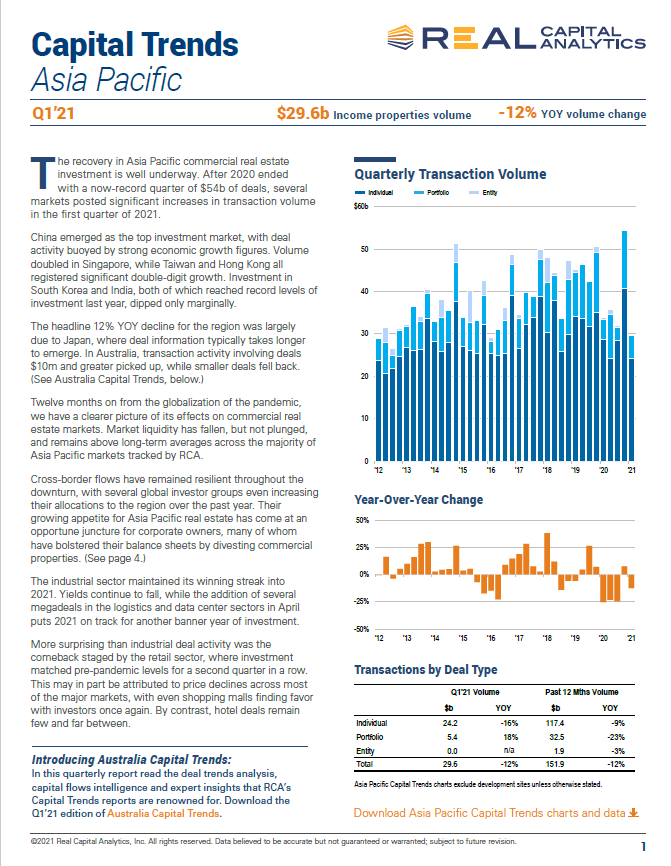
According to Real Capital Analytics data, a massive $50.3 billion in cash was splashed on property throughout the Asia Pacific region in the last quarter of 2020. Hong Kong’s 171% increase in transaction volumes year-on-year was “a big reason why the region as a whole did so well,” Green-Morgan explained.
Real estate investment trusts came under “huge pressure” in 2020, posting 30-40% price declines, Green-Morgan explained. Some of that has been “clawed back”, although retail REITs are “still being quite badly beaten up”.
But Hong Kong and China will continue to be “major players” and an important source of capital around the world, with $10 billion of Chinese and Hong Kong capital flowing out in 2020 alone. Our experts pointed to 联易房地产信托, Asia’s largest REIT in terms of market capitalization, as just one example of investors on the hunt for premium-grade assets.
Private equity, pension funds and sovereign wealth funds are those with the “big war chests at the moment,” Green-Morgan explained, and have real estate in their sights. Expect some “big deals on the horizon,” he said.
If you missed Yardi’s Hong Kong market update, don’t skip our insights into Singapore and Malaysia on 21 April, and Australia and New Zealand on 28 April. 点击此处 to register.
预计今年经济将复苏,开局良好
随着投资者越来越关注私募资产的风险、业绩以及与公开证券的比较,私募资产的透明度要求也日益提高。我们采访了博吉斯(Burgiss)固定收益、多元资产类别及私募资产研究主管彼得·谢泼德(Peter Shepard)和全球产品管理及应用研究主管布莱恩·施密德(Brian Schmid)。.
点击这里收听播客: https://www.msci.com/perspectives-podcast/private-assets-withstand-public-attention
租户采用远程办公理念
2020年第一季度末,由于疫情影响,该国被迫全面封锁商业活动。2020年3月,工作场所关闭,员工在最初几周居家办公。到2020年5月,随着封锁限制的逐步放宽,工作场所开始部分重新开放,但并非所有公司都要求员工返回办公室。此外,我们仍然看到很大一部分员工居家办公。‘居家办公’和‘随时随地办公’的趋势此后日益显著,企业也对远程办公表现出开放态度。调查结果显示,大多数企业(60%)预计,未来12-24个月内,其员工中将有约21%至40%在非办公地点工作。然而,随着租户重新审视现有办公空间的密度规划,以确保员工安全复工,我们预计该行业将逐步复苏,办公空间吸纳量将在2021年下半年开始显现回升迹象。我们认为,租户可能会采用‘中心辐射式’模式,为员工提供灵活的办公地点选择,让他们可以在任何地方或客户附近工作。因此,种种迹象表明,在这种情况下,灵活办公空间的重要性将日益凸显。.
The commercialisation of the property management industry in China started in 1981 with the incorporation of China’s first property management company managing a residential property in Shenzhen. In the subsequent ten years, residential property management continued to mature with the eventual establishment of the Shenzhen Real Estate Management Bureau in 1985. One of the first Grade A office buildings to be professionally managed was the Guangzhou World Trade Centre in 1992, where it was co-managed by Savills and Guangzhou Pearl River Hotel Management. In the early days of property management in China, the sector remained immensely scattered and only basic property management services were provided. The China Property Management Association was eventually established in 2000, with the first nationwide property management regulations issued in 2003. As the property management sector continued to grow, local governments set standards for the market, requiring firms to obtain operation licenses and setting residential property management fee caps.
The industry started to undergo greater liberalisation in 2014-2016, with property managers no longer required to obtain the national ‘Certified Property Manager’ qualification license and commodity housing management fees caps removed and instead set by market forces. In more recent years, property managers have started providing value-added services (VAS) to boost revenues and profit margins. At the same time, many developers have spun off property management divisions in separate listings, with many of them given the mandate to aggressively expand market share, often through mergers and acquisitions. The property management industry is now also taking on a broader range of property types. In addition to the more standard commercial and residential developments, firms are be contracted for work at schools, hospitals, airports, sports stadiums and public utilities, to name just a few.
欲了解更多信息,请访问: https://www.msci.com/www/blog-posts/open-vs-closed-end-real-estate/02413249714
报告要点:
制造业推动工业部门反弹

Kemmu Kawai 于 2022 年 9 月加入 Longevity Partners Japan,担任国家总监。他常驻东京,负责日本、亚太地区及其他地区的所有业务和活动。他拥有超过 16 年的金融从业经验,专门从事房地产和信贷投资。在加入 Longevity Partners 之前,他曾在 Norinchukin 银行担任投资组合经理,并在 Center Point Development 担任投资经理。.
Kemmu Kawai
常务董事
长寿伙伴