essensys Research: The Business Case For An Integrated Digital Infrastructure In Multi-Tenanted Offices
The commercial real estate industry is navigating changing dynamics with the rise of flexible office spaces and hybrid working environments. Landlords and operators looking to capitalise on these changes, must invest in technology that enables them to optimise the user experience and reduce time to value.
The eBook will cover the decision flow of commercial landlords and multi-site flexible office providers when investing in a new technology solution for their business portfolio with common use cases:
CONSIDERATIONS For Investing Into Software & Technology For Offices
DETERMINE The Need For An Integrated Digital Infrastructure Platform
EVALUATE The Strengths Of The Digital Infrastructure Provider & Ensure A Successful Partnership
ADAPT Common Features & Use Cases Of Integrated Digital Infrastructure Platform
“If I can track my pizza on my phone, why can’t I expect a fast and frictionless rental experience?”
This question – or various iterations of it –is being asked by an entirely new generation of renters who have very different expectations of customer service than their parents once did.
In an era of instant information, where ecommerce allows us to shop from anywhere and anytime, renters no longer want to spend their Saturdays pounding the pavement or filling in dozens of rental application forms. They don’t expect to deal with real estate agents and property managers that operate in an analog world. And they don’t understand why paying their biggest monthly expense – their rent – is not a positive and personalised interaction.
Whether virtual tours or AI-enabled customer service bots, technology can make the process of renting better. Despite rapid advances in real estate technology, many property companies operate in an analog world; and that means from the start the discovery process to the day they move out, the renter is beset by pain points.
But as ‘Generation Rent’ demand a better rental experience, leaders in the build-to-rent sector are answering the call. The savviest operators are delivering better customer service – and better rental – with the help of a platform powered by the smartest of smart technology.
Yardi’s latest whitepaper, Better Rental, explores the opportunities in the build-to-rent, or BtR, sector and outlines three customer pain points that are easiest to address. Australian build-to-rent specialist Arklife, showcased in the report, reveals some of the processes it is automating to make life easier for customers.
Because BtR is designed for tenants, each development is crafted and curated for a better rental experience. Think concierge services and high-quality communal facilities, the choice to paint the walls or own a pet, flexible leases and security of tenure, as well as professional management and property maintenance.
BtR is well-established in the United States, Europe and the United Kingdom, where it is known as multi-family housing. In the UK, BtR covers 2% of existing housing stock, while in the US it accounts for 12%. Other markets, like Australia, are in their infancy. But industry analysts predict up to 175,000 BtR apartments could be available in Australia within a decade.
Arklife’s managing director Scott Ponton has a clear message to every build-to-rent operator looking to improve the customer experience: “There is no one technology solution that fits all issues. Proptech won’t stop evolving because the customer pain points move. As you solve one pain point another pops up. Our focus is on listening to our customers and using technology to address that.”
Most importantly, operators need to start seeing their building as a device much like the mobile phone. When we start to look at buildings through this lens, we gain a laser focus on the user experience. How good is the user interface and functionality? What hardware and software will power our device? And what platform will help us create the best user experience?
While some build-to-rent operators cobble together a range of solutions, the smartest BtR specialists are embracing a single end-to-end platform. In the United States, for example, eight million people pay their rent each month through Yardi, and everything from leasing to repairs supports a seamless customer experience.
Our buildings are far more than bricks-and-mortar. They are devices that can boost productivity, performance and the human experience. This shift in thinking will change the way buildings are designed, how services are provisioned, how assets are valued and, most of all, what customers expect of space.
Singapore’s carbon tax will be gradually increased from the current SG$5/tonne of carbon emissions up to SG$50-80 in 2030.
The first payments under the newly proposed tax levels will be due in 2025, based on 2024 emissions. Large facilities will be most impacted, but end-energy consumers will also feel the increase.
There are meaningful ways to reduce exposure – both for OPEX (facilities) and end-energy consumers. Facilities should look into driving energy efficiency and carbon efficiency into operations via building controls, fabric improvements, and efficient building services and installations through CAPEX.
Meanwhile, a reduction in end-energy user exposure can be countered by providing subsidies and monetary incentives.
Sustainability is paramount for Singapore’s next gen data centres (Savills)
Singapore has announced that it is lifting a 2019 moratorium on the construction of new data centres, however government concerns about energy efficiency and consumption mean new facilities will need to meet rigorous standards.
In the short term, the number of new data centres will be very limited, with a maximum of three approvals in a new post-mortarium pilot phase, which begins in the second quarter of this year and which will last 12-18 months. The new data centres will also have a cap on their power use: all must be between 10MW and 30MW.
Jack Harkness, director, industrial & logistics, Asia at Savills, says: “The end of the moratorium and permission for new data centres is good news, as is the focus on sustainability, however with only three approvals in this pilot phase, competition will be fierce.”
The Singapore government imposed a moratorium on construction of new data centres in 2019, due to concerns about the amount of electricity they use. At present, the city-state has 70 data centres with aggregate capacity of 1000MW; the sector uses around 7% of Singapore’s electricity.
However in January, Minister for Trade and Industry Gan Kim Yong said: ““While we continue to welcome data centre investments, we intend to be more selective of which DCs we can accommodate. In particular, we seek to anchor DCs that are best in class in terms of resource efficiency, which can contribute towards Singapore’s economic and strategic objectives.” An online meeting later outlined the government’s requirements for new centres.
Data centres use electricity to power the servers running inside them and more significantly to keep them cool, as thousands of servers running constantly generates a lot of heat.
The efficiency of data centres can be measured by Power Usage Effectiveness (PUE), a metric which evaluates the energy performance of a facility by calculating the ratio of the energy used as a whole to the energy used by the IT equipment alone. A perfect score would be 1. Singapore will require that new data centres have a PUE of 1.3 or lower. A typical data centre has a PUE of around 1.5-1,7, while the newest data centres in Australia and South Korea, for example, have target PUEs of 1.2-1.4.
Applicants with a track record in building and operating data centres in Singapore will be considered favourably, government officials said. In the longer term, Singapore is determined to remain a data and connectivity hub, they added.
The end of the moratorium is expected to provoke a rush of applications as data centre developers and operators compete to be one of the three approved data centres during the moratorium period. “We expect fierce competition for the limited permissions from developers and operators already present in the market,” says Harkness. “We may also see joint ventures between private equity real estate funds and operators, as we have seen in Australia and South Korea.
“The Singapore data centre market will be entering a new era, where efficiency is crucial. Over the longer term, as newer facilities with lower PUEs come onstream, we may see a flight to quality. This would create opportunities for redeveloping older data centres.”
Stewardship Asia Centre Launches New Edition of Singapore Stewardship Principles for Responsible Investors
The enhanced principles were based on feedback from industry participants and stressed the importance of stewardship outcomes.
31 March 2022, Singapore – Stewardship Asia Centre (SAC) today released the second edition of the Singapore Stewardship Principles (SSP) for Responsible Investors, updating practices to enhance Singapore’s investment environment. The revisions were driven by a 10-member steering committee, supported by the Monetary Authority of Singapore (MAS) and the Singapore Exchange (SGX).
Singapore first introduced the principles in 2016, outlining practices related to the core behaviour and actions associated with stewardship to promote active and responsible investment. Since then, capital markets have undergone profound developments as global concerns intensified over the impact of financial investments on the economy, society and the environment. Stakeholders emphasised that investors should become better stewards by demonstrating a genuine intent to deliver sustainable performance and long-term value to clients and beneficiaries, as well as to factor in environmental, social and governance (ESG) considerations. The steering committee took into account the global market developments in shaping the principles. An industry survey was conducted in March 2021 to garner feedback from the asset management industry on their perspective of investment stewardship. This was followed by an open consultation to obtain stakeholders’ feedback on the draft of the updated SSP in November 2021.
“We received feedback from more than 20 stakeholders. These recommendations were taken into consideration to enhance the principles in the areas of internal structures and governance, stewardship beyond listed companies, and ESG considerations. We urge the financial services and investment industry to adopt the updated SSP and make a greater commitment towards responsible investment,” said Rajeev Peshawaria, CEO of SAC.
An as industry-led initiative, compliance to the principles remains voluntary. However, under the enhanced SSP, signatories are strongly encouraged to submit evidence of their stewardship efforts annually to the secretariat of the steering committee.
Abigail Ng, Executive Director and Head of Markets Policy and Infrastructure Department of MAS, said: “MAS is supportive of SAC and the industry’s collective efforts in updating the Singapore Stewardship Principles. Effective stewardship calls for a multi-stakeholder approach by market participants including asset owners, asset managers and service providers. Responsible investment stewardship can help raise corporate governance standards, drive positive change and create sustainable long-term value for all stakeholders – not just for the individual company or investor, but also for the wider economy, environment and society. This is in line with MAS’ efforts to promote sustainable financing in our financial sector. We strongly encourage market participants to become signatories of the SSP and to co-create sustainable business value in an environment of good governance.”
“SGX supports the updated Singapore Stewardship Principles for Responsible Investors. Institutional investors, through their investment strategies, play an important role in the allocation of capital to companies. Institutional investors can shape the practices of their portfolio companies through active stewardship and their investment decisions. This is especially pertinent with the market’s increased focus on ESG considerations and outcomes. With institutional investors engaging actively with companies, I hope SGX-listed companies will be more motivated towards creating and sustaining long term value,” said Tan Boon Gin, CEO of Singapore Exchange Regulation.
Industry participants, including asset managers and asset owners, welcome and support the updated principles.
Amar Gill, Head of Investment Stewardship for APAC, BlackRock, said: “The updated SSP and its enhanced rigour reflecting international developments and local trends in stewardship and corporate governance are welcome steps towards creating a positive investment ecosystem in Singapore. Its guidance will help managers like us and companies themselves protect and advance the economic interests of long-term investors like our clients.”
Sherene Ban, CEO of Singapore and Southeast Asia of J.P. Morgan Asset Management (JPMAM), said: “Active ownership is woven into our active management heritage and we constantly evolve our sustainable investing approach to keep pace with the changing requirements of our clients and regulators. The renewed principles, including monitoring investments regularly, staying active through constructive and purposeful engagement, and taking a collaborative approach in exercising stewardship responsibilities, are in line with JPMAM’s approach to stewardship and engagement.”
Prudential Singapore’s CEO Dennis Tan said: “In the drive for sustainability, every voice matters. We are proud to be an SSP signatory as its principles are aligned with our approach to responsible investment. Through active engagement with companies in our investment portfolio, we aim to achieve our net-zero target by 2050. We look forward to working collectively to further our commitment to creating a stronger, healthier future for all.”
Manish Tibrewal, CEO of Maitri Asset Management, a multi-family office, said: “Given the complexities of managing ESG issues, regular communication and collaboration form a key part of how we engage with our portfolio companies. At Maitri, we constantly align ourselves with industry-leading standards to engage with our portfolio companies. This has enabled us to exchange knowledge and further hone our ESG expertise in a transparent manner so both investor and investee are constantly ahead of the curve when it comes to adapting to the latest ESG trends.”
For more information about the updated principles, also known as SSP 2.0, please click here.
###
About Stewardship Asia Centre (SAC)
SAC is a non-profit organisation established by Temasek, dedicated to helping business and government leaders, investors and individuals activate stewardship practices through research, executive education and engagement. We define stewardship as creating value by integrating the needs of stakeholders, society, future generations and the environment.
Steering Committee of SSP 2.0:
Members
Stewardship Asia Centre (Chair and Secretariat)
Association of Chartered Certified Accountants
Asia Pacific Real Assets Association Ltd.
CFA Society Singapore
CPA Australia
Investment Management Association of Singapore
Institute of Singapore Chartered Accountants
Securities Investors Association (Singapore)
Singapore Institute of Directors
Singapore Venture Capital and Private Equity Association
SS&C Intralinks’ new report, Gender Diversity and Dealmaking 2022, draws on data from more than 11,000 M&A deals announced between 2010 and 2021 and features commentary from senior dealmakers to understand this trend.
Download the new report to understand:
Why women CEOs outperformed men during the pandemic on post-deal share price, ROE, EBIT/sales and EBITDA/sales
How short-term investor reaction to deals announced by female leaders has slightly improved since our first report
Innovative female CEO M&A strategies and decision-making, such as managing risk by leveraging more advisors and structuring cash-only or all-stock deals
Significant gender-based differences in acquisition target types and deal processes
Why the pandemic has improved perceptions of female CEOs and diversity
To address climate change, leading real estate funds and companies around the world are setting decarbonization and net-zero targets. These targets can differ widely and consist of many elements, and some may be more credible than others. In this report — which builds on our net-zero report for companies, “Breaking Down Corporate Net-Zero Climate Targets” — we outline an approach for evaluating real estate funds’ and companies’ decarbonization and net-zero targets. It aims to help the industry set net-zero commitments, as well as support asset owners in evaluating decarbonization targets of companies and funds they invest in. It argues that best practices for decarbonization and achieving net-zero are:
Comprehensive: Include all significant sources of emissions, even those that may be hard to quantify, including Scope 3 emissions from tenant-controlled energy use and development activities.
Ambitious: Pursue absolute reductions in the short and long term, in line with accepted, science-based pathways.
Feasible: Demonstrate progress toward goals, supported by a robust business strategy
Environmental, Social and Governance (ESG) integration is no longer a choice today. In the global Race to Zero[1], led by UNFCCC, over 5,200 businesses, 1,040 cities and 440 investors have stepped up their ambition and joined the global alliance to catalyse climate change. Following COP26, over 90% of global GDP has committed to achieving net zero by or near mid-century.[2] According to the 17th Edition of the World Economic Forum Global Risks Report, environmental risks were perceived to be the five most critical long-term threats over the next 10 years.[3] Climate risks are investment and business risks – the damage caused by climate change is projected to result in an increase of up to 41% of global property premiums until 2040.[4] With the building and construction sector accounting for about 40% of global carbon emissions[5], the real estate sector is in a prime position to advance sustainable development.
Integration: Strong Fundamentals for Business and Climate Resilience
City Developments Limited (CDL)’s ESG strategy stems from its corporate ethos, “Conserving as we Construct” established in 1995. Its value creation business model is anchored on four key pillars—Integration, Innovation, Investment, and Impact; guiding CDL to achieve three key deliverables: “Decarbonisation”, “Digitalisation & Innovation” and “Disclosure and Communication”. The CDL Future Value 2030 sustainability blueprint, implemented in 2017, maps out clear strategic goals and ESG targets across CDL’s business strategies and operations.
CDL’s sustainability portfolio reports directly to the Board Sustainability Committee with ESG factors effectively integrated into its business, operations and growth strategy. In 2018, the CDL Group introduced its G.E.T. strategy—focusing on Growth while adopting an ESG lens, Enhancement of assets to drive operational efficiency and Transformation to deliver long-term and sustained value.
Innovation: Scaling up Sustainable Technologies for a Green Revolution
Recognising that innovation is a key accelerator of climate solutions, CDL set up a Green Building & Technology Application team in 2020. The team collaborates with the organisation’s Enterprise Innovation Committee, leveraging cutting-edge technology to reduce CDL’s carbon footprint in the way it designs, builds, and manages its assets.
To advance circularity solutions, CDL is studying the feasibility of advanced low-carbon construction methods and materials to reduce embodied carbon. To do this, CDL has ramped up on buildable designs moving towards less labour-intensive processes, and focuses on Integrated Digital Delivery and Design for manufacturing and Assembly (DfMA) technologies. Through this, CDL can reduce reliance on on-site workers, enhance workplace safety and health, and drive productivity improvements in construction and facility management.
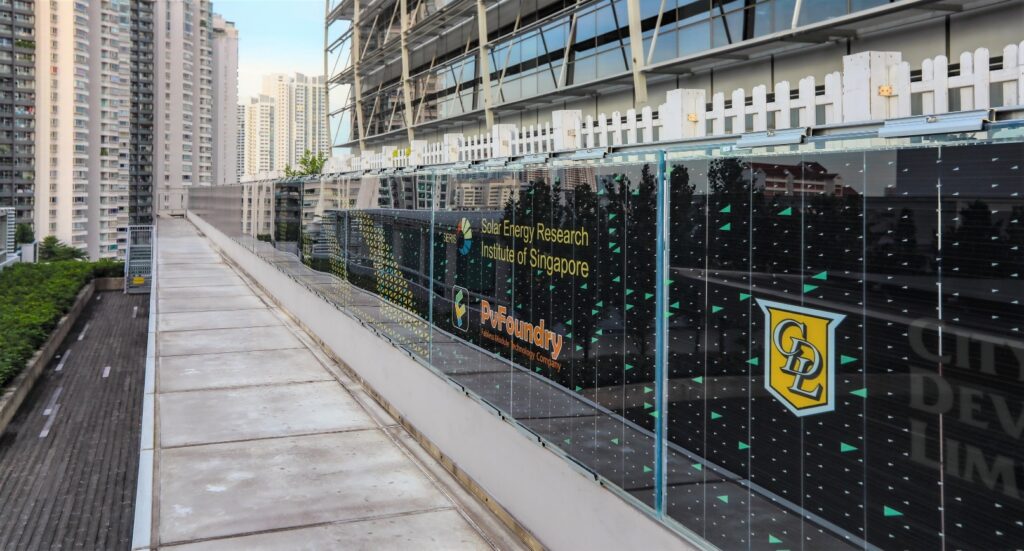
CDL also capitalises on the power of cross-sector partnerships to develop low-carbon technologies. The company has partnered with the Solar Energy Research Institute of Singapore to pilot Building-Integrated Photovoltaics (BIPV) modules and panels at various developments. The pilot on Bifacial BIPV panels with prints at CDL’s Sustainability Academy aims to optimise aesthetic value whilst generating power.
CDL and SERIS piloted a new generation of PV art wall (bifacial BIPV panels) at the Singapore Sustainability Academy at City Square Mall in 2020. This serves as a testbed for more efficient PV Installations
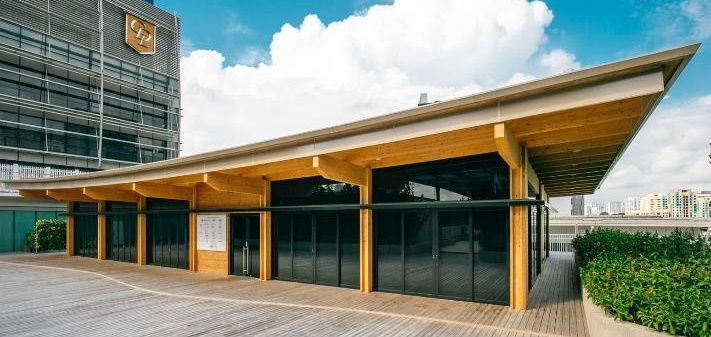
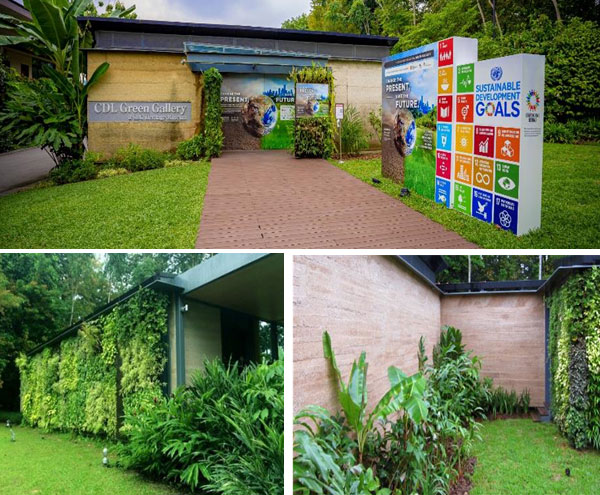
In order to achieve a net zero world, zero energy buildings are the way forward. To date, CDL has built two net zero facilities using eco-friendly technologies—the Singapore Sustainability Academy (SSA) and the CDL Green Gallery at the Singapore Botanic Gardens. The SSA, a BCA Green Mark Platinum-certified building, is the first in Singapore to have its construction materials, Cross Laminated Timber and Glued Laminated Timber, verified by the Nature’s BarcodeTM system as coming from responsible sources.
The SSA is the first ground-up initiative and zero-energy facility in Singapore dedicated to capacity building and thought leadership for climate action. Since its opening in 2017, it has tapped on 3,200 sq ft of solar panels on its rooftop as its energy source. The entire facility is built with over 80% of structural materials that come from sustainable sources.
In February 2021, CDL became the first real estate conglomerate in Southeast Asia to sign on to the World Green Building Council’s (WorldGBC) Net Zero Carbon Buildings Commitment. At COP26, CDL was one of 44 pioneering companies to expand its commitment towards a net-zero whole life carbon-built environment. Through this commitment, CDL pledged net zero operational carbon by 2030 for its new and existing wholly-owned assets and developments under its direct operational and management control. This also entails a reduction in embodied carbon and compensating residual upfront emissions via offsetting for new developments by 2030 and for all buildings to be net zero carbon by 2050.
To move towards a low carbon economy, CDL has aligned itself with even more ambitious carbon emissions reduction targets that have been successfully assessed and validated by Science Based Targets Initiative (SBTi) in 2021, in line with a 1.5°C warmer scenario. CDL was the first Singapore real estate company to validate its targets by SBTi for a 2°C warmer scenario in 2018.
The CDL Green Gallery is built with several eco-friendly technologies, including two innovative features – the biomaterial known as Hempcrete (largely made from the hemp plant) and a prefabricated modular system.
Investment: Building Leverage for the Future via Sustainable Finance
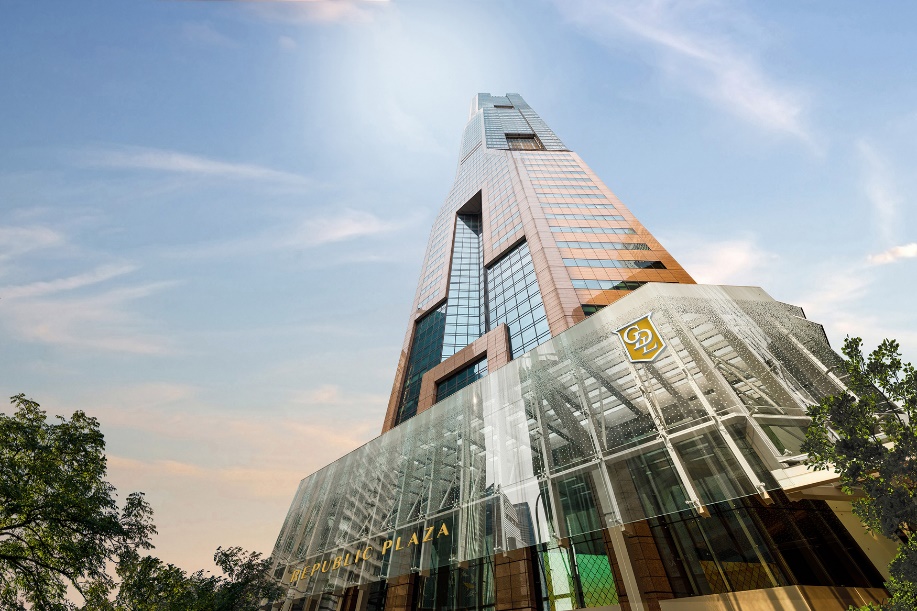
CDL’s Republic Plaza Green Bond was the first green bond issued by a Singapore company in April 2017.
CDL has secured more than $3 billion worth of sustainable finance, in the form of various green loans, a green bond, and a sustainability-linked loan, to help accelerate its green building action. It takes pride in issuing the first green bond by a Singapore company in 2017, which has helped to tap into alternative financing streams. In September 2021, CDL secured a discount for the SDG Innovation Loan provided by DBS Bank Ltd, for its successful R&D and pilot of digiHUB. This enabled CDL to be the first Singapore entity to achieve a discount on a sustainability-linked loan through the adoption of an innovative project that supports the SDGs on a large-scale basis.
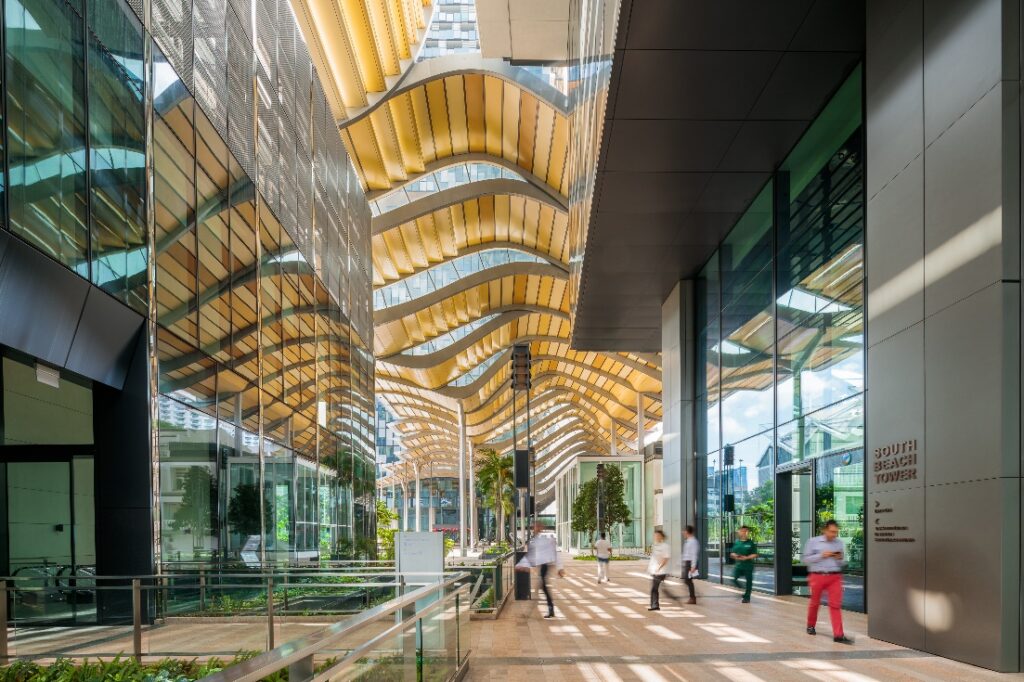
At CDL’s mixed-use development South Beach, PV panels have been installed at the tower roof and louver modules, covering a total area of approximately 1,800 m2.
What gets measured gets managed—CDL’s longstanding experience in ESG disclosure and sustainability has helped it identify gaps and improve its ESG performance. Its robust ESG integration and disclosures are widely recognised by 13 global ratings, rankings and indexes, including double ‘A’s in the 2021 CDP Global A List for corporate climate action and water security.
CDL is honoured to have achieved its best performance in the Corporate Knights’ 2022 Global 100 Most Sustainable Corporations in the World, jumping from 40th place in 2021 to 5th position this year. In addition, it has maintained its ranking as the world’s top real estate management and development company and Singapore’s top sustainable company for the fourth consecutive year, and has been the first and only Singapore company to be included in the renowned index for 13 consecutive years.
The race to zero requires conviction and engagement with all stakeholders. After two decades of integrating ESG into our business, we have captured growth opportunities while mitigating ESG risks, enhancing value for our investors, communities, and the planet.
Across the Asia Pacific, what are companies doing to achieve NET ZERO carbon emissions?
APREA’s latest issue of Knowledge Brief, The Race to Net Zero, gathers thought leaders in the region, from real estate developers and investors to assets managers and technology providers, providing insightful perspectives and best practices on how businesses and stakeholders in the real assets sector can embark on a journey to #sustainability.
What will 2022 and the next decade bring? In recent years, climate change has come to surpass corporate governance as the most pressing ESG issue commanding investors’ attention, and ESG investing truly has gone mainstream (and is attracting the regulatory attention to prove it). Yet there are new risks emerging for companies, investors and the planet in the coming decade that will test how well we have learned the lessons of the past.
Kemmu Kawai joined Longevity Partners Japan in September 2022 as the Country Director. Based in Tokyo, he oversees all operations and activities in Japan, the Asia-Pacific region and beyond. He brings him more than 16 years of experience in finance where he specialised in real estate and credit investments. Before joining Longevity Partners, he served as a Portfolio Manager at Norinchukin Bank and as Investment Manager at Center Point Development.