APREA Logo

Featured Insights

Discover the Disconnect Between Landlords & Tenant Expectations
Did you know that only 13% of tenants believe landlords are strongly positioned to serve their flexibility requirements? 

The research addresses the following questions:

  • What are enterprises looking for in their commercial property? 
  • How does flex space and tech feature in landlord and occupier real estate strategies?
  • What are the financial benefits on offer for landlords that effectively provide flex space?

Download the Research Here

In this report, we examine:
  • The top 10 established and upcoming technology submarkets within major APAC cities, including key and upcoming key tech subsectors, and workplace and real estate considerations in each submarket
  • The rapid growth of Chinese tech firms as a major new class of owner-occupier
  • Opportunities and strategy recommendations for technology occupiers planning for expansion
  • Opportunities for property owners and investors beyond rental growth

  • The top five technology centres in APAC are Beijing, Shanghai, Bengaluru, Shenzhen and Singapore. Other cities are developing strengths in specific areas of technology, e.g., Seoul and Hong Kong in fintech, while in Hyderabad and Sydney are emerging
  • Among upcoming Indian submarkets, Colliers highlights Whitefield and North Bengaluru in Bengaluru, Peripheral Business District in Hyderabad, and Noida Expressway and Golf Course Extension Road (Gurguram) in Delhi NCR, among others.
  • In APAC, technology occupiers should account for 20%-25% of office leasing demand in the next five years. Our research identifies the most attractive technology submarkets across APAC to help occupiers plan their expansion
  • The emergence of technology groups as large owner-occupiers creates a new source of capital for investors planning asset disposals, as well as new opportunities for joint ventures and partnerships for developers.

Customer expectations, advancing technology and a burgeoning build-to-rent sector are encouraging the best residential landlords to boost their “digital kerb appeal”, says Yardi’s Paul Yount.

Yount, Yardi’s industry principal and product manager for RENTCafé, says renters no longer expect to spend their Saturdays pounding the pavement or filling in dozens of rental application forms.


“We know many apartment hunters prefer online interactions, and 14 per cent of today’s apartment renters are willing to sign a lease without even seeing the property in person,” he says.

The explosion of ecommerce in recent years has driven an evolution in customer expectations. If a customer can expect a fast and frictionless experience when they make a purchase online, why wouldn’t they expect the same experience when choosing their next apartment?

“Physical kerb appeal has always been important in real estate. But now digital kerb appeal is more important,” Yount explains.

Virtual tours, a phenomenon already gathering speed before COVID-19, are now the preferred way for renters to select their next apartment, Yount adds. He points to a Yardi survey of RENTCafé users which found nearly a third (31%) preferred self-guided tours or had no preference, pre-COVID.

“Now, most renters would prefer a self-scheduled tour in their next apartment search – in fact 83 per cent of apartment shoppers tell us they’d prefer to take a self-guided tour if one was available.”

Yardi’s research is backed up by the largest survey of apartment residents, undertaken by the National Multifamily Housing Council in the United States. This survey, which got inside the minds of 372,000 apartment residents in 2020, found:

  • 100% would prefer to engage with a mobile app rather than a website
  • 90% want to make an individual apartment selection online and
  • 81% want videos of apartment models and amenities.

The appeal of self-guided tours, powered by Yardi’s technology, is not just about social distancing. Two thirds of renters want to tour a property at their own pace, and just under half want to check out a property after hours.

Does that mean today’s renter prefers a high-tech experience over a high-touch, personalised approach? Yount compares the expectations of today’s renter with that of a grocery shopper.

“Some people like old-school checkouts, others prefer self-checkout, some like kerbside pickups while others opt for delivery services. Today’s consumer wants to do business in a lot of different ways.”

So, what are Yardi’s top three high-tech, high-touch plays to build loyalty and create long-term connections with renters?

Download Yardi’s latest paper to find out.

Rajah & Tann’s Sustainability Practice brings to you the inaugural issue of the Sustainability Updates which shares with you insights distilled from conversations between our Sustainability Partners and experts across sectors and domains on key environmental, social and governance (“ESG”) developments and trends. In this issue, Lee Weilin and Soh Lip San, our Partners with the Sustainability Practice, explore ESG issues in infrastructure projects by speaking with Seth Tan, Executive Director of Infrastructure Asia (“InfraAsia”), on his views on green and sustainable infrastructure and ESG factors for bankable projects in the region.


Rajah & Tann’s Sustainability Practice brings to you the inaugural issue of the Sustainability Updates which shares with you insights distilled from conversations between our Sustainability Partners and experts across sectors and domains on key environmental, social and governance (“ESG”) developments and trends. In this issue, Lee Weilin and Soh Lip San, our Partners with the Sustainability Practice, explore ESG issues in infrastructure projects by speaking with Seth Tan, Executive Director of Infrastructure Asia (“InfraAsia”), on his views on green and sustainable infrastructure and ESG factors for bankable projects in the region.

To read the article in PDF, please click below

APREA advocates the adoption of ESG and Sustainability Best Practices in the real assets industry. Making sustainable investment decisions is increasingly a part of APREA members’ DNA, and APREA is committed to be at the forefront of that transition to a net-zero world.


APREA advocates the adoption of ESG and Sustainability Best Practices in the real assets industry. Making sustainable investment decisions is increasingly a part of APREA members’ DNA, and APREA is committed to be at the forefront of that transition to a net-zero world.

Recently, APREA together with its ESG and Sustainability Committee conducted an ESG Member Survey to find out real assets companies’ sentiments towards their implementation of ESG.

Now more than ever sustainability and ESG topics are coming to the forefront across the globe from a diverse group of stakeholders including employees, customers, suppliers, communities, investors and regulators. Driven in part by the Covid-19 pandemic, there is a focus on employee health & safety, supply chain resilience, and corporate culture, along with growing concerns on climate risk to reputation and the associated impact on corporate value creation.


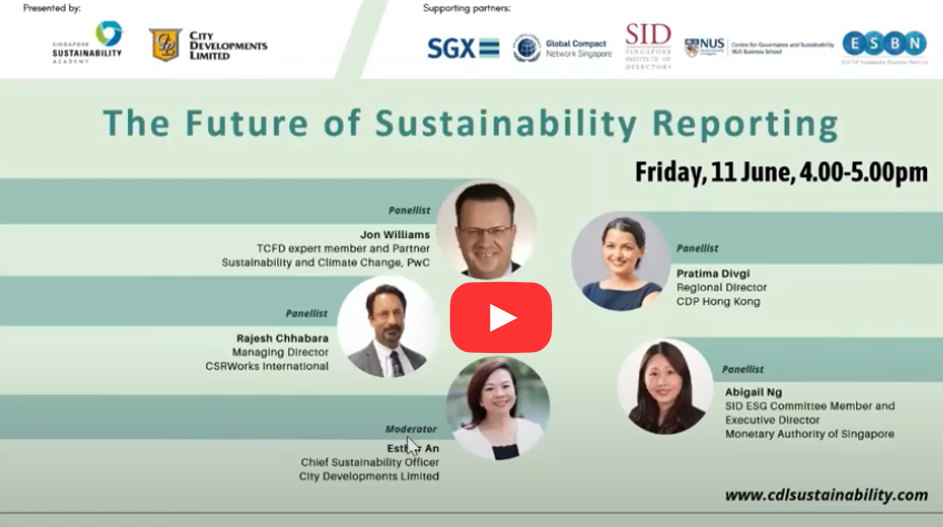
Following the ESG webinar jointly presented by DFIN (Donnelley Financial Solutions), SGX RegCo and industry leaders in October 2020, DFIN’s John Truzzolino, Director of Corporate Governance Services continued the dialogue with Esther An, Chief Sustainability Officer of City Developments Limited (CDL). Esther is an active advocate for green building and sustainability, she spearheaded the publication of the first sustainability report using GRI standards in Singapore in 2008. Today, CDL is ranked as a top real estate company on the Global 100 Most Sustainable Corporations in the World 2020 list.

Watch the full interview to learn more about CDL’s sustainability journey, and hear Esther’s suggestions to businesses on driving preparedness for climate change, improving investor communications and creating decision-useful disclosures in the post-pandemic era.

Watch the Interview Here

Many institutional investors are facing their greatest challenges for many years. They are transforming their investment processes at high speed to reflect today’s imperatives, such as environmental, social and governance (ESG) investing, innovative technology, ever-shifting regulations and demands for greater transparency. Yet they must do this in a complex and unstable financial environment. I compare this challenge to changing the sails and masts of a ship as it is battered by a storm. For this report, we surveyed 200 asset owners (pension funds, insurers, sovereign wealth funds and endowments/foundations) owning assets of around $18 trillion. Reading it, I was struck by how the pandemic has further accelerated the shift to ESG. Asked for the top 3 trends that will affect their organization over the next three to five years, 62% cited either climate change or the increasing complexity of ESG measurement — far ahead of other themes such as market volatility and regulation. But it is not the only transformation. A new wave of data technologies is bringing very significant changes to investment processes. These technologies open the door to new ways of understanding markets and increasing efficiency.

  • Savills Tech Cities are important centres for tech in their region and venture capital (VC) investment hotspots. Vibrant cities in which to live and work, they are magnets for talent.
  • Wellness matters more than ever to both tech talent and business occupiers. Our Tech Lifestyle Cities have an edge here, with better air quality, access to greenspace and smaller footprints. Savills Digital Nomad Essentials Index highlights some of the factors that count to talent today.
  • In spite of 2020’s upheavals, the Tech Megacities continue to dominate VC investment, led by Beijing and San Francisco. Singapore has received a boost, benefiting in part from the US-China trade war.
  • A new raft of Rising Global Tech Contender cities are emerging, ranging from Detroit to Yokohama. Growth is fuelled by technological advances, government initiatives and cost advantages.
  • While many tech companies have adopted work from home strategies in the wake of the pandemic, their city centre offices and campuses, in which they have invested heavily, will remain important as places for staff to collaborate, to instil company culture, and to attract the best and brightest.
  • Out of town tech campuses have taken on a fresh relevance in a time of social distancing and newfound focus on health and wellbeing. We explore five examples with wellness at their core