With the pandemic now well into its third year, most markets in Asia Pacific have adopted a policy of living with COVID-19 as high vaccination rates, effective medical care and the emergence of weaker variants reduce the severity of the virus and remove the need for lockdowns and other related measures. The findings from CBRE’s 2022 Asia Pacific Occupier Survey, which was conducted from March-April of this year, reflect this new paradigm.The report identifies and explores the five key real estate priorities for Asia Pacific occupiers in the post-pandemic era:
Adopting Flexible Working as the New Normal
Refining Workplace Strategies and Policies
Augmenting Office Wellness and Sustainability
Facilitating a Return to the Office
Pursuing Long-Term Portfolio Expansion
The report also highlights the challenges that companies will need to address during this period of transformation.
New data centre supply in the four tier I Asia Pacific markets (Greater Tokyo, Sydney, Singapore and Hong Kong SAR) totalled 305MW in H2 2021. This marked the highest total for a six-month period since CBRE’s records began.
The record volume of new supply pushed up net absorption in the four Asia Pacific tier I markets to over 280MW in H2 2021. Hyperscale cloud providers remained the main demand driver, with many groups exhibiting requirements for bigger facility sizes and multiple-site deployments.
Asia Pacific direct data centre investment turnover totalled US$4.8 billion in 2021, an increase of over 100% from the previous year. Data centre operators completed several acquisitions; capital-raising remained strong; and more investors are setting up operational platforms.
Large populations of internet users, solid economic growth, government support for industry 4.0 and 5G development continue to drive interest in data centre development in emerging Southeast Asia, with Indonesia and Malaysia the largest markets at present.
Asia Pacific Market Sentiment Survey – March 2022 (CBRE)
Within the office sector, occupiers can focus on higher-quality assets that possess green and sustainable features and establish a roadmap to adopt an ESG agenda from green buildings to energy audits, to green leases. Meanwhile, landlords can invest in smart and green buildings, including retrofitting older stock and prepare for new ESG requirements by embedding sustainability into every stage of the building life cycle. In the industrial and logistics sector, a paramount trend to watch is the sharper focus on ESG criteria, evident from 67% of occupiers believing that green or sustainability features will be more prominent in logistics facilities in the future in CBRE’s 2021 APAC Logistics Occupier Survey.
2022 Asia Pacific Investor Intentions Survey (CBRE)
535 Asia Pacific-based investors participated in the survey, which asked respondents a range of questions regarding their buying appetite and preferred real estate strategies, sectors and markets for 2022. Investment sentiment towards Asia Pacific commercial real estate remains positive. A key finding is that investors continue to regard the incorporation of ESG criteria into investment strategies as critical to fulfilling regulatory requirements, preserving future asset value, protecting the environment and enhancing brand image. As a result, ESG criteria continue to gain traction among investors. Approaches include incorporating ESG into AEI and consulting external rating parties like GRESB when assessing potential acquisitions. More investors are also leveraging green financing for ESG upgrades as additional costs are required. These include developers, REITs and fund managers.
Augmenting reality: The metaverse opens a world of real estate without limits (Colliers)
Ready or not, the metaverse is already a force to be reckoned with. This fast-evolving network of virtual spaces is not just defying physics – it’s set to redefine real estate as we know it.
The metaverse is a network of virtual spaces where people can socialise, play, work, and even own property. On this platform, billed as the next iteration of the internet, just about anything is possible – owning a Grand Slam tennis court in pixel form, becoming the virtual neighbour of millionaire celebrities, or acquiring a stake in a digital shopping mall selling high fashion.
But can virtual worlds generate tangible value for occupiers and investors? According to our experts, the answer is an emphatic yes.
With names like The Sandbox and SuperWorld, virtual communities are beckoning investors, developers, occupiers and an entire generation of digital natives that have grown up inhabiting avatar-filled online games such as Minecraft and Roblox. Despite the nascency of the concept, the metaverse is on the cusp of fomenting a real estate revolution, with sales of virtual land exceeding USD500 million in 2021 alone and expected to double in 2022.
Just as technological advances took us from dial-up modems to blazing-fast broadband, we see the immersive nature of the metaverse as the logical next step in the ongoing evolution of the internet. With Covid-19 encouraging people to shift more of their lives online, recognition of the metaverse’s potential to transform everything from the retail experience to office interactions is growing.
“People are very curious at the moment and are asking: ‘What’s so special about the metaverse?’,” says Hannah Jeong, Head of Valuation & Advisory Services | Hong Kong. “The answer is that it’s a place where no matter who or what you are, you can do just about anything. It is accessible to everyone.”
Businesses everywhere are also eager to understand what the metaverse means for their operations and how it can be best harnessed. Because virtual properties are relatively easy to create, experiment with and upgrade, developers, as well as landlords and occupiers, can explore the metaverse to complement their offerings in the physical world, according to Jeong.
Given that the supply of virtual land is unlimited, metaverse assets are going for a fraction of the cost of physical land, prompting companies and investors around the world to rush into the space. Developers, meanwhile, are keen to deploy it as a marketing tool, building communities to attract a new generation of clients that may struggle to afford physical property. Furthermore, real estate investment trusts (REITS) are looking to capitalise on opportunities to acquire, create and lease digital assets in the metaverse.
Jeong notes the metaverse also promises to take the virtual tours that developers and investors have relied on to continue dealmaking during Covid-19 to an entirely new level. With cutting-edge virtual reality (VR) and augmented reality (AR) tools, it’s become possible to inspect the features and finer touches of properties, even entire neighborhoods, in any corner of the world without traveling a step.
“While nothing can replace face-to-face interaction, the metaverse can make the virtual interaction much closer to physical interaction than any technology we’ve had previously,” agrees Bajpai. The metaverse is set to have significant impact in the retail sector, in particular by providing companies an interactive platform to advertise and market their products, which will help enhance sales in the physical world. Additionally, it will create fresh revenue streams by enabling firms to monetise digital versions of their physical products in the form of NFTs, Bajpai says.
As businesses look to exploit the metaverse’s vast potential, it’s important to bear in mind some key caveats.
For starters, the metaverse has no significant barriers to entry, which is a plus when it comes to inclusion, but also allows for the kind of crowding and speculation that leads to volatility, notes Bajpai. And while it’s currently dominated by platforms like Decentraland, the landscape could change over time with the entry of other players – just as internet pioneers Netscape and MySpace were completely displaced by Google and Facebook.
Bajpai notes it’s also crucial to understand that while location and footfall may not play as big a role in the metaverse as they do in the physical world, they will remain key considerations in asset appreciation.
The ever-present technology risks of privacy and cybersecurity are exacerbated in the metaverse, which, for now, is an unregulated space. The fact that cryptocurrencies feature heavily in metaverse transactions adds an additional layer of volatility, and sustainability concerns given the vast computing power and energy consumption they require.
However, Jeong notes regulators and private entities in Asia Pacific and elsewhere are already working to address these challenges. “Many countries are looking at this issue closely, and trying to regulate the crypto market and change market behaviour,” she says. “The cryptocurrency community is also putting together plans to reduce their carbon footprint and become more ESG-friendly.”
In the years ahead, a combination of technological advances in areas such as 5G, VR, artificial intelligence and blockchain, as well as the rise of a digitally native generation, will push the metaverse further into the real estate mainstream. This means every industry player will have to formulate a metaverse strategy of some kind.
“There’s a lot of opportunity in the space,” notes Bajpai. “That’s why we’re really focused on building our technical advisory capability, so we can outline to clients the advantages and the challenges, and guide them through the process if they decide to take the plunge.”
While the metaverse will never replace real-world assets, our experts see it becoming more and more capable of cultivating synergies with the physical world, and underpinning exciting new solutions and business models for owners, occupiers and investors.
Mainland China’s pursuit of zero-covid continues to result in sudden and intermittent disruption to manufacturing, logistics and supply chain operations.
CBRE expects this environment to drive the further strengthening of just-in-case strategies as occupiers look to build up inventory to mitigate potential disruption – a trend that will generate substantial new demand for industrial and logistics real estate on the mainland.
As industrial and logistics occupiers look to extend their footprint to emerging hubs, tier I and satellite cities of key metropolitan areas are likely to attract stronger demand.
Occupiers are advised to focus on securing space in modern logistics facilities in locations with good transportation links, while investors are recommended to consider constructing greenfield developments in emerging hubs.
The Q4 2021 Knight Frank Data Centre Report continues our growing coverage of the Asia Pacific region. Market analysis includes both established data centre hubs such as Singapore, Hong Kong, Mumbai, Sydney, Seoul, and Tokyo; and fast growth markets including Hanoi, Bangkok, Shanghai, and Kuala Lumpur – to provide the most wide-ranging view of the region.
The momentum of Q3 carried into the fourth quarter, with several major announcements across key markets in Asia Pacific. Total supply (live, phased, and under construction) in APAC increased almost 185MW in Q4, bringing total capacity in the region to over 7,900MW. Take-up was around 120MW, moderating slightly from Q3 but in line with previous quarters. For the whole of 2021, IT capacity across APAC grew by over 1,500MW.
The gigawatt markets of Tokyo and Shanghai added significant capacity in 2021, adding between 300MW to 400MW each, to their respective markets. In Q4, AirTrunk’s TOK1 facility opened in Tokyo, with its first phase up to 60MW. STT also announced its plan for two data centres in Inzai totalling 60MW. In addition, Stack Infrastructure’s has plans for a 36MW campus, and Colt has secured land for two sites in Inzai and Northern Tokyo for 45MW.
The Chinese authorities have announced the setting up of four mega clusters of data centres in the north and west of the country. This was followed by an announcement of a further 10 national data centre clusters as part of a broader strategy to transport data from eastern regions of China to western regions for storage and calculation. On the back of government plans to classify data centres as infrastructure assets for easier access to funding, India also saw several major new investments into data centre platforms, including Hiranani-Yotta and Kotak-Sify.
In Southeast Asia, Singapore lifted its hold on new data centre builds after a two-year moratorium. Under a new pilot program, up to 60MW of capacity will be made available in 2022, to developments of between 10 to 30MW each. As part of the consideration, applicants for new data centre facilities will need to commit to achieving a PUE of below 1.3 and obtain Singapore’s Green Mark for Data Centres-Platinum certification – in addition to adding strategic value for Singapore. We expect this pathfinder approach to serve as a model to other countries looking to find the right balance between their digitalization and sustainability goals.
Growing interest is also seen in emerging APAC markets like Seoul, Osaka, Ho Chi Minh, and Bangkok.
Hong Kong Market Direction 2022: What You Need to Know in the Year of the Tiger
The emergence of a fifth wave of COVID-19 in Hong Kong, together with continued strict border controls, has seen investors and corporations looking to adopt new strategies to manage the new normal in commercial real estate business operations.
In our Hong Kong Market Direction 2022 report, we highlight six factors we see impacting the future direction of the commercial real estate market in the Year of The Tiger:
ESG Is Too Important to Be Ignored
Bargain Hunting for Premium Office Properties
Developers to Enrich Landbanks in the Northern Metropolis
Automation and Warehouses are Connecting
Healthy Lifestyles to Forge New Demand for Fitness Centers
Growing Needs for Quality Virtual Conferencing and Collaborative Workspaces
The Power of Deep Reinforcement Learning to Transform the Built Environment
What can Artificial Intelligence (AI) offer the built environment in our age of climate emergency? At the heart of Deep Reinforcement Learning is an agent and an environment. Just as we are starting to learn that our actions within our environment have consequences on an immense, planetary scale, innovative AI is learning too – and faster than us.
By using Deep Reinforcement Learning to optimise the energy efficiency of HVAC systems in the built environment, we can minimise the negative impact of our own actions without sacrificing occupant comfort. As businesses all over the world attempt to transition to Net Zero, this technology has a pivotal role to play.
But why is Deep Reinforcement Learning the best way to optimise HVAC performance?
Environmental, Social and Governance (ESG) integration is no longer a choice today. In the global Race to Zero[1], led by UNFCCC, over 5,200 businesses, 1,040 cities and 440 investors have stepped up their ambition and joined the global alliance to catalyse climate change. Following COP26, over 90% of global GDP has committed to achieving net zero by or near mid-century.[2] According to the 17th Edition of the World Economic Forum Global Risks Report, environmental risks were perceived to be the five most critical long-term threats over the next 10 years.[3] Climate risks are investment and business risks – the damage caused by climate change is projected to result in an increase of up to 41% of global property premiums until 2040.[4] With the building and construction sector accounting for about 40% of global carbon emissions[5], the real estate sector is in a prime position to advance sustainable development.
Integration: Strong Fundamentals for Business and Climate Resilience
City Developments Limited (CDL)’s ESG strategy stems from its corporate ethos, “Conserving as we Construct” established in 1995. Its value creation business model is anchored on four key pillars—Integration, Innovation, Investment, and Impact; guiding CDL to achieve three key deliverables: “Decarbonisation”, “Digitalisation & Innovation” and “Disclosure and Communication”. The CDL Future Value 2030 sustainability blueprint, implemented in 2017, maps out clear strategic goals and ESG targets across CDL’s business strategies and operations.
CDL’s sustainability portfolio reports directly to the Board Sustainability Committee with ESG factors effectively integrated into its business, operations and growth strategy. In 2018, the CDL Group introduced its G.E.T. strategy—focusing on Growth while adopting an ESG lens, Enhancement of assets to drive operational efficiency and Transformation to deliver long-term and sustained value.
Innovation: Scaling up Sustainable Technologies for a Green Revolution
Recognising that innovation is a key accelerator of climate solutions, CDL set up a Green Building & Technology Application team in 2020. The team collaborates with the organisation’s Enterprise Innovation Committee, leveraging cutting-edge technology to reduce CDL’s carbon footprint in the way it designs, builds, and manages its assets.
To advance circularity solutions, CDL is studying the feasibility of advanced low-carbon construction methods and materials to reduce embodied carbon. To do this, CDL has ramped up on buildable designs moving towards less labour-intensive processes, and focuses on Integrated Digital Delivery and Design for manufacturing and Assembly (DfMA) technologies. Through this, CDL can reduce reliance on on-site workers, enhance workplace safety and health, and drive productivity improvements in construction and facility management.
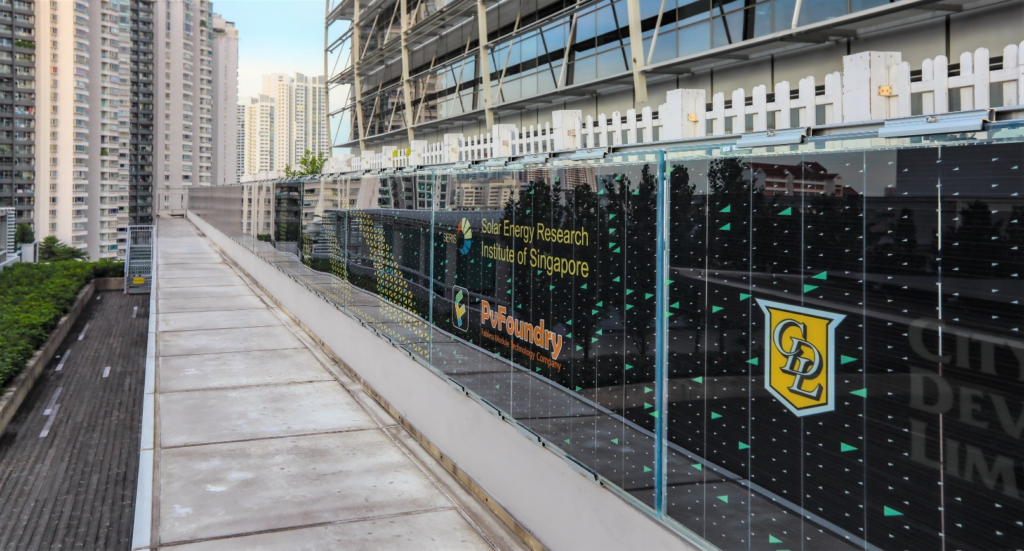
CDL also capitalises on the power of cross-sector partnerships to develop low-carbon technologies. The company has partnered with the Solar Energy Research Institute of Singapore to pilot Building-Integrated Photovoltaics (BIPV) modules and panels at various developments. The pilot on Bifacial BIPV panels with prints at CDL’s Sustainability Academy aims to optimise aesthetic value whilst generating power.
CDL and SERIS piloted a new generation of PV art wall (bifacial BIPV panels) at the Singapore Sustainability Academy at City Square Mall in 2020. This serves as a testbed for more efficient PV Installations
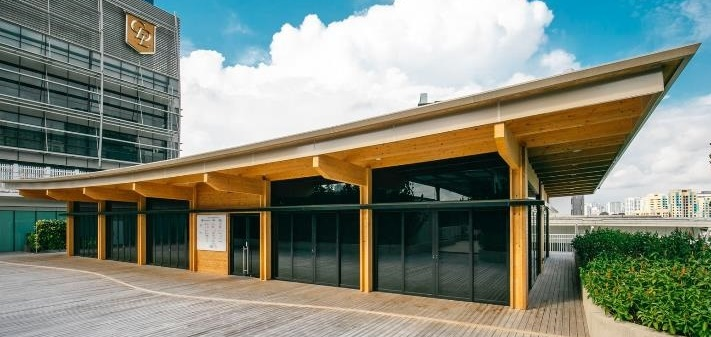
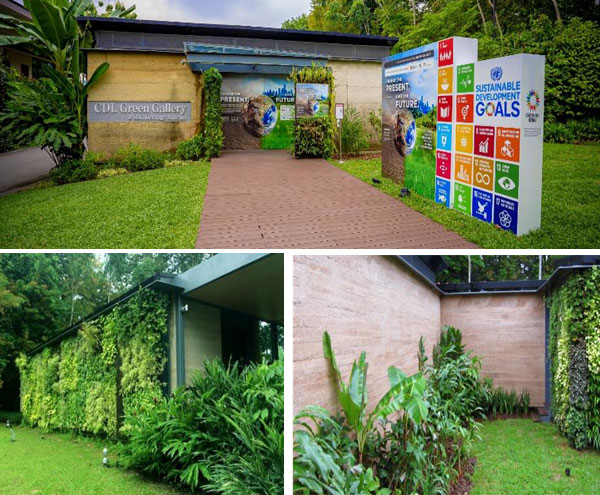
In order to achieve a net zero world, zero energy buildings are the way forward. To date, CDL has built two net zero facilities using eco-friendly technologies—the Singapore Sustainability Academy (SSA) and the CDL Green Gallery at the Singapore Botanic Gardens. The SSA, a BCA Green Mark Platinum-certified building, is the first in Singapore to have its construction materials, Cross Laminated Timber and Glued Laminated Timber, verified by the Nature’s BarcodeTM system as coming from responsible sources.
The SSA is the first ground-up initiative and zero-energy facility in Singapore dedicated to capacity building and thought leadership for climate action. Since its opening in 2017, it has tapped on 3,200 sq ft of solar panels on its rooftop as its energy source. The entire facility is built with over 80% of structural materials that come from sustainable sources.
In February 2021, CDL became the first real estate conglomerate in Southeast Asia to sign on to the World Green Building Council’s (WorldGBC) Net Zero Carbon Buildings Commitment. At COP26, CDL was one of 44 pioneering companies to expand its commitment towards a net-zero whole life carbon-built environment. Through this commitment, CDL pledged net zero operational carbon by 2030 for its new and existing wholly-owned assets and developments under its direct operational and management control. This also entails a reduction in embodied carbon and compensating residual upfront emissions via offsetting for new developments by 2030 and for all buildings to be net zero carbon by 2050.
To move towards a low carbon economy, CDL has aligned itself with even more ambitious carbon emissions reduction targets that have been successfully assessed and validated by Science Based Targets Initiative (SBTi) in 2021, in line with a 1.5°C warmer scenario. CDL was the first Singapore real estate company to validate its targets by SBTi for a 2°C warmer scenario in 2018.
The CDL Green Gallery is built with several eco-friendly technologies, including two innovative features – the biomaterial known as Hempcrete (largely made from the hemp plant) and a prefabricated modular system.
Investment: Building Leverage for the Future via Sustainable Finance
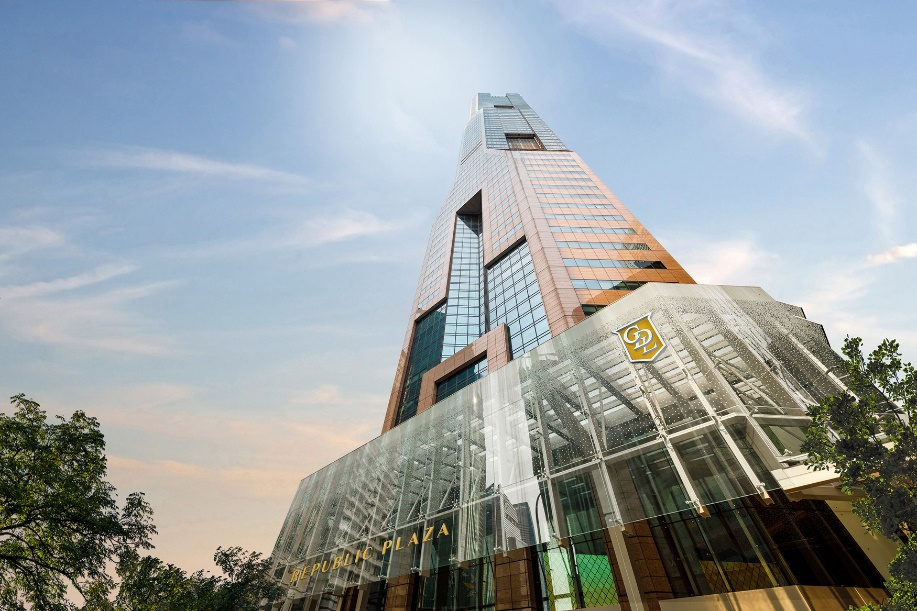
CDL’s Republic Plaza Green Bond was the first green bond issued by a Singapore company in April 2017.
CDL has secured more than $3 billion worth of sustainable finance, in the form of various green loans, a green bond, and a sustainability-linked loan, to help accelerate its green building action. It takes pride in issuing the first green bond by a Singapore company in 2017, which has helped to tap into alternative financing streams. In September 2021, CDL secured a discount for the SDG Innovation Loan provided by DBS Bank Ltd, for its successful R&D and pilot of digiHUB. This enabled CDL to be the first Singapore entity to achieve a discount on a sustainability-linked loan through the adoption of an innovative project that supports the SDGs on a large-scale basis.
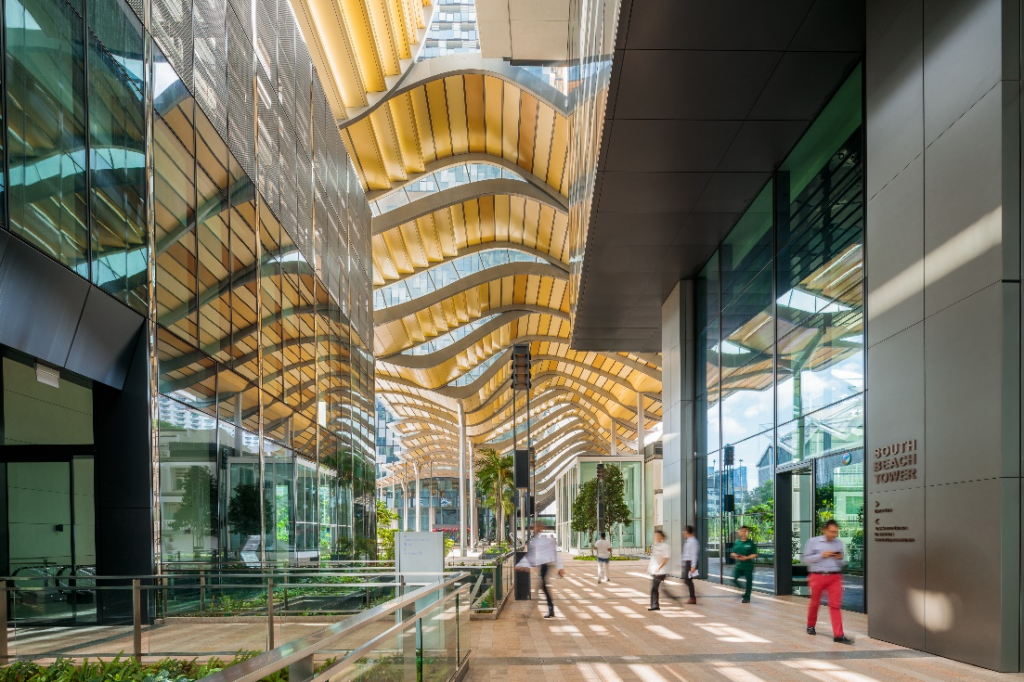
At CDL’s mixed-use development South Beach, PV panels have been installed at the tower roof and louver modules, covering a total area of approximately 1,800 m2.
What gets measured gets managed—CDL’s longstanding experience in ESG disclosure and sustainability has helped it identify gaps and improve its ESG performance. Its robust ESG integration and disclosures are widely recognised by 13 global ratings, rankings and indexes, including double ‘A’s in the 2021 CDP Global A List for corporate climate action and water security.
CDL is honoured to have achieved its best performance in the Corporate Knights’ 2022 Global 100 Most Sustainable Corporations in the World, jumping from 40th place in 2021 to 5th position this year. In addition, it has maintained its ranking as the world’s top real estate management and development company and Singapore’s top sustainable company for the fourth consecutive year, and has been the first and only Singapore company to be included in the renowned index for 13 consecutive years.
The race to zero requires conviction and engagement with all stakeholders. After two decades of integrating ESG into our business, we have captured growth opportunities while mitigating ESG risks, enhancing value for our investors, communities, and the planet.
Kemmu Kawai joined Longevity Partners Japan in September 2022 as the Country Director. Based in Tokyo, he oversees all operations and activities in Japan, the Asia-Pacific region and beyond. He brings him more than 16 years of experience in finance where he specialised in real estate and credit investments. Before joining Longevity Partners, he served as a Portfolio Manager at Norinchukin Bank and as Investment Manager at Center Point Development.