2023: Pivoting Towards Opportunities – Asia-Pacific Outlook (Knight Frank)
Knight Frank takes a look at some of the ‘big picture’ issues impacting owners and users of real estate in the Asia-Pacific region for the upcoming year.
Global inflation in 2022 is at its highest since 1996. As most central banks in Asia-Pacific turn the screws on monetary policies to stave off inflation, growth will inevitably slow in the coming year. As monetary authorities are compelled to keep pace with the Fed’s hiking cycle in addition to walking the tightrope between growth and inflation, the region’s interest rates in 2023 will approach multi-year highs.
Despite these ongoing stressors, Asia-Pacific is set to remain the world’s fastest-growing region in 2023. Even as growth momentum continues to normalise across much of the region, domestic-oriented economies such as emerging Southeast Asia and India are forecast to remain supportive of overall regional growth in the upcoming year.
As such, Knight Frank expects to see real estate markets in the region weather a period of transition as occupiers and investors review their strategies in a rapidly evolving environment.
Please find below the rebalancing results for the following GPR/APREA index series, which will become effective as of 19 December 2022 (start of trading):
GPR/APREA Investable 100 Index
GPR/APREA Investable REIT 100 Index
GPR/APREA Composite Index
GPR/APREA Composite REIT Index (indicated with an asterisk)
GPR/APREA Investable 100 Index
INCLUSIONS
CHN
2768 HK
Jiayuan International Group
CHN
123 HK
Yuexiu Property Co Ltd
HKG
4 HK
Wharf Holdings
JPN
8986 JT
Daiwa Securities Living Investment Corp.
JPN
3278 JT
Kenedix Residential Next Investment Corp.
THA
AP TB
AP Thailand PCL
EXCLUSIONS
AUS
CIP AT
Centuria Industrial REIT
Liquidity too low
CHN
3883 HK
China Aoyuan Group Limited
Liquidity too low
CHN
2777 HK
Guangzhou R&F Properties Company Limited
Liquidity too low
JPN
3295 JT
Hulic REIT
Liquidity too low
JPN
8956 JT
NTT UD REIT Investment Corporation
Liquidity too low
THA
AMATA TB
Amata Corp PCL
Liquidity too low
GPR/APREA Investable REIT 100 Index
INCLUSIONS
JPN
2971 JT
ESCON JAPAN REIT Investment Corporation
JPN
8979 JT
Starts Proceed Investment Company
EXCLUSIONS
AUS
COF AT
Centuria Office REIT
Liquidity too low
SGP
AAREIT SP
AIMS APAC REIT
Liquidity too low
GPR/APREA Composite Index + GPR/APREA Composite REIT Index
At a time when many mature economies are reaching peak carbon, emissions in Asia Pacific remain on an upward trajectory as the region continues along a path of rapid urbanisation and economic growth.
Asia Pacific accounted for 53% of global carbon emissions in 2021, and has been responsible for more than 80% of global growth in carbon emissions over the past decade.
To improve transparency around the role that cites and the built environment play in carbon emission reduction, CBRE has developed the Asia Pacific Sustainable City Ranking, which measures current and future environmental resilience and its impact on commercial real estate across 28 cities in the region.
Cities are evaluated according to a range of environmental factors including greenhouse gas emission reduction, physical climate risk, water stress, air pollution, renewable energy use, green bond issuance, and green office building adoption.
Q3 2022 Investment Trends features in-depth and up to date insights on demand drivers and other key investment trends in Australia, mainland China, Hong Kong SAR, Taiwan, Japan, Korea, India, Singapore, and New Zealand.
The Asia Pacific flexible office space market continued to display cautious growth in 2022, with the total volume of flexible office space in the region reaching 76 million sq. ft. as of September, an increase of 6% y-o-y on 2021 and 15% on pre-pandemic levels.
As of September, flexible office space accounted for about 4% of total office stock and 3% of total Grade A office stock in Asia Pacific. In the Grade A segment, India and Singapore reported the highest penetration of flexible office space, while most North Asian markets are just below 2%.
Tech firms and business services companies remain the top corporate users of flexible office space. Interest is also growing among financial, life science and consumer product firms.
Trends that will continue to shape the flexible office landscape in 2023 include:
Flexible space operators offering on-demand memberships to cater to more dispersed workforces resulting from the widespread adoption of hybrid work
Growing occupier demand for customised enterprise and turnkey solutions to mitigate rising fit out costs and CapEx constraints
The use of asset-light strategies as flexible space operators form partnership with landlords using management contracts
Case Study of Mass Timber Construction – GDI Property Group (Australian REIT)
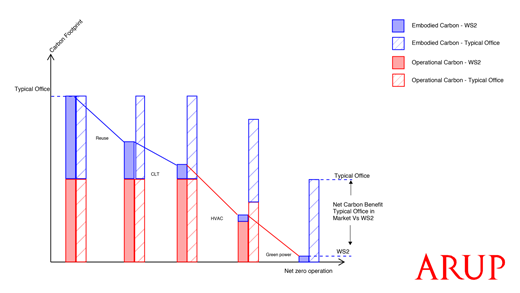
GDI Property Group (GDI), an Australian listed REIT headquartered in New South Wales, Australia, is currently constructing Perth’s first hybrid mass timber and steel frame office building. GDI will utilize a mix of cross laminated timber and steel to construct WS2, an 11 story, 9,500 square meter office building with the goal of creating a best-in-class, sustainably focused asset.
GDI underwent extensive research to understand both the environmental and economic impacts of developing what they’re calling Perth’s most environmentally friendly premium grade office building. Upon completion in late 2022, WS2 will boast a 5-star NABERS Energy Rating, a 5-star Greenstar Rating and will show a reduction of carbon by approximately 50% over the building’s lifespan vs. a similar al concrete/steel-based building and a reduction of 80% embodied carbon during the construction phase. This reduction will be captured through a combination of offsets, renewable energy systems within the building, and significantly lower embodied carbon during the construction phase. Ultimately, the goal is to achieve net zero operation, lowering scope one and two emissions, while achieving a better economic outcome as timber construction is “quicker and cheaper to build on a Total NLA Basis” according to the company in their 10 November presentation.
What Is Mass Timber Construction?
Mass timber, sometimes referred to as Cross Laminated Timber, consists of multiple layers of dried lumber stacked in alternating directions and bound together with structural adhesives and pressed to form a single panel. The panels are specifically engineered to meet the high strength ratings of load bearing walls, floors and roof trusses and are often produced on-site. The resulting mass timber panels are significantly lighter than both concrete and steel (on average 1/5th the weight of steel beams) while maintaining a stronger strength to weight ratio.
Current building codes for mass timber projects vary across different countries, but recent legislation in the United States and Canada has allowed for construction of mass timber buildings up to 18 stories tall. Other markets, such as parts of Europe and Australia, are seeing even more progressive mass timber building requirements with a new 40-story mass timber building in Sydney being designed and scheduled to start construction in 2023.
Building and Environmental Advantages of Mass Timber
Environmental Impact:
Mass timber decomposes at a natural rate when discarded as opposed to waste from concrete or steel.
One cubic meter of mass timber sequesters roughly one ton of CO2.
In a full lifecycle analysis of mass timber vs reinforced concrete on a mid-rise building, mass timber represented a 26% reduction in global warming potential.
Mass timber construction as an alternative to steel reduces CO2 emissions by 1.9 metric tons per cubic meter of wood product
Tensile Strength: Timber supports its own weight at a higher degree than both steel and concrete.
Electrical & Heat Resistance: Natural resistance to electrical conduction when dried to standard moisture levels. Strength and dimensions are not significantly affected by heat, providing stability to the finished building.
Sound Absorption: Acoustic properties make it ideal for minimizing echo in living or office spaces. Wood absorbs sound, rather than reflecting or amplifying it.
Economic Feasibility of WS2 and Mass Timber Construction
David Ockenden, GDI’s Head of Development, explains the similarly robust economic benefits of the mass timber build due to the expedited construction timeline and relatively light material. Namely, the tensile strength of mass timber allowed for a larger construction footprint than previously thought on the WS2 building:
“When we initially started looking at traditional concrete structures it [could] only be two stories, but timber, when we started exploring that we could build a lot more and reinvest in the precinct to upgrade it.”
The demand for sustainable assets is especially high in Perth, a city known for commodity extraction, where companies are often seeking ways to improve their ESG impacts. GDI is already seeing strong leasing interest from potential full-building, multi-floor and single-floor tenants, claiming overwhelming praise and popularity of the WS2 project. When fully completed, the WS2 building will be a flagship office space within GDI’s portfolio and will serve as the basis for continued mass timber development throughout Western Australia. As mentioned above and in their recent Managing Director’s update, GDI has identified other projects where they plan to use timber construction in their recent update and are exploring redevelopment opportunities at 1 Mill Street and the Wellington car park. Their presentation cites that development approvals have been lodged or are in the process of being lodged.
Benefits of Investing in Mass Timber Projects
At B&I Capital, an Asset Manager with offices in Zurich, Singapore and Austin focused on listed real estate investing, we strive to integrate Environmental, Social, and Governance criteria throughout our investment process and company operations. We believe mass timber construction projects, such as WS2, align directly with our aim to minimize environmental footprint by lowering scope one and two emissions as much as possible. Moreover, given timber construction permitted significant increase in net leasable area and has a quicker construction time, timber construction led to a better economic return. The strong reduction in carbon emissions due to their construction will lower their need to purchase green power or carbon credits to achieve net zero for WS2. Our investment in GDI follows our support of their drive to build environmentally friendly projects and belief of their viability as strong real estate investments. It is through our investments in companies like GDI we actively participate in the creation of a sustainable future.
Retail Rebound: How Retail Real Estate Fared During the Great Pandemic Stress Test (Cushman & Wakefield)
Almost three years after the onset of the global pandemic, the retail industry has been through one the biggest stress tests imaginable, but best-in-class real estate has remained robust – and even emerged stronger in some markets.
Cushman & Wakefield’s flagship Main Streets Across the World report tracks the top retail districts across 92 cities and ranks the most expensive by prime rental value. An annual report until 2019, this year’s report is the first since then, allowing insight into comparative performance pre- and post-pandemic.
Rent Growth Highlights
Rents across global prime retail destinations declined by 13% on average during the depth of the pandemic but have rebounded to just 6% below pre-pandemic levels.
The Americas, thanks largely the to the U.S., was the most resilient region – on average rents now sit at a 15% premium to pre-pandemic levels.
In Asia Pacific rents fell on average by 17%, impacted by international border closures, which curbed tourism in prime locations.
Global Rankings
New York’s Upper Fifth Avenue moves up one spot to number one, now ranks as the most expensive retail destination in the world.
Hong Kong has slipped to second place, with Tsim Sha Tsui overtaking Causeway Bay as the most expensive precinct in the city-state.
Via Montenapoleone in Milan has jumped two positions to achieve third place, followed by London’s New Bond Street and The Avenues des Champs Elysees in Paris rounding out the top five.
Kemmu Kawai joined Longevity Partners Japan in September 2022 as the Country Director. Based in Tokyo, he oversees all operations and activities in Japan, the Asia-Pacific region and beyond. He brings him more than 16 years of experience in finance where he specialised in real estate and credit investments. Before joining Longevity Partners, he served as a Portfolio Manager at Norinchukin Bank and as Investment Manager at Center Point Development.