APREA Logo

Featured Insights

It has become clear over the last decade that environmental, social and governance risks are financial risks. What does that look like for the year ahead? The 2024 edition of MSCI’s Sustainability and Climate Trends to Watch (formerly ESG and Climate Trends to Watch) brings together the key questions that our global research team are asking, and offers thoughtful analyses and useful insights to help assess and navigate the investment landscape that lies ahead.

This report was originally published in https://www.msci.com/research-and-insights/2024-sustainability-climate-trends-to-watch

Climate risk has rapidly emerged as a critical consideration for real estate investors, owners and occupiers.

Managing climate risk starts with pinpointing climate-related hazards, reporting these risks, and finally embedding climate risk management into your organizational processes.

This guide is a companion to help you better identify and mitigate physical climate risks. It may seem like a big task, but we help outline simple steps.

As the world continues to transition, companies are asking themselves how they can contribute, lower the effects of climate change, and bring meaningful value into the lives and communities in which they operate. Here at KIC we build and manage logistics centers, and we ask ourselves those questions during our entire process. From finding the correct building site, to the construction of the logistics center, all the way down to finding the best tenants and managing the property. Here is how energy generation and energy management are being used in our facilities to help bring about a low carbon future.


Energy Generation (PPA Application)

Construction and retrofitting buildings with more energy efficient features is becoming a common practice and an important factor to tenants. Logistics facilities can be power hungry structures especially those with cold storage and large rooftops. Therefore, it is important for builders and management companies to continue to apply new energy technology.

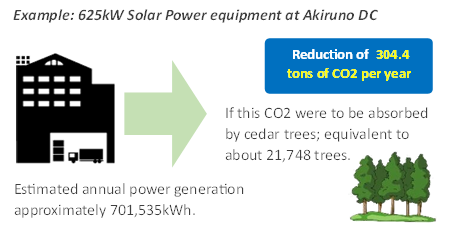
Solar energy and power purchase agreements (PPA) are perfect examples of how a logistics facility can implement new energy technology to help lower its carbon dioxide emissions. With a power purchase agreement (PPA), a third party installs a solar power generation system on the roof of the logistics building and supplies the generated electricity to the tenants. This allows the tenants to use green energy, lowers their electricity rates compared to conventional electricity and provides them with power even in the event of a disaster.

Energy Management

In addition to energy generation technology, energy management is also a very important factor in lowering electricity consumption and the overall carbon footprint of the facility.  Energy management increases efficiency and limits the waste of power. For example, saving energy by switching to LED lights. LEDs consume less power and have a longer life span. The power consumption of LED is about 20% of incandescent bulbs, 30% of fluorescent bulbs and 25% of mercury lamps. It significantly reduces the electricity bill and lasts about 10 years. As a result, fewer electric lights are thrown away and labor cost of switching light bulbs is reduced.

Conclusion

Overall, energy generation and energy management are important to tenants and investors. Simple solutions such as switching to LED lights are available as well as more complicated ones such as solar power rooftops and large capacity rechargeable batteries. As we continue forward, it is important to keep in mind that green energy solutions are already making their way into logistics real estate.

Katsuyuki Victor Mineta

Founder & CEO
KIC Holdings

2023 is set to be the hottest year since records began in the mid-1800s. The Swiss Re Institute further warns that without climate action, the world economy could shrink by 18% in the next 30 years. Asian economies are particularly vulnerable – with China at risk of losing almost 24% of its GDP under the most severe climate scenario. In contrast, these figures can lessen and be as low as 4% if the 2015 Paris Agreement targets are met.

The cost of inaction is greater than the cost of action. With societal demands for ethical and responsible business practice intensifying, consumers, investors, and employees are increasingly scrutinising companies’ ESG (environmental, social and governance) performance, favouring those that prioritise environmental stewardship, social responsibility, and sound governance.

City Developments Limited (CDL)’s ESG strategy and firm commitment to “Conserving as We Construct”, established in 1995, has positioned the company well in the transition towards sustainable business operations. Its value creation business model anchored on four key pillars — Integration, Innovation, Investment, and Impact – provides the company with a solid foundation to mitigate and adapt to unprecedented threats and challenges. With long-standing board and leadership commitment and stakeholders’ support, CDL has remained effective in achieving three deliverables: “Decarbonisation”, “Digitalisation and Innovation” and “Disclosure and Communication”.

Integrating Sustainability into a Company’s Governance Structure, Strategy and Operations

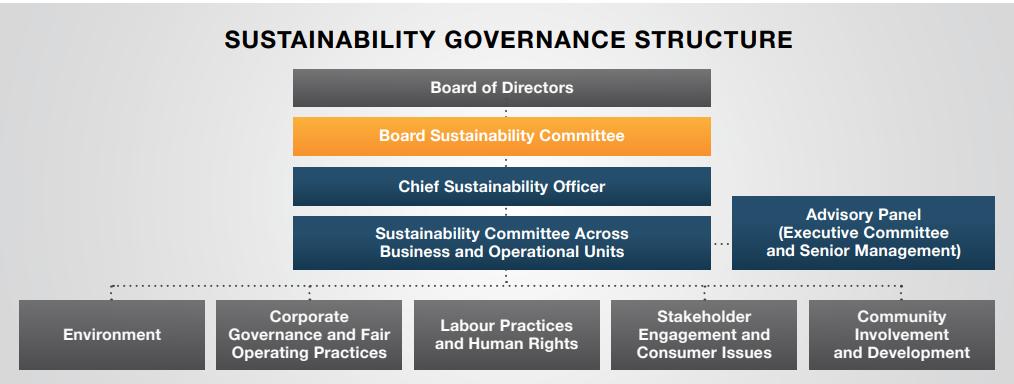
In 2012, CDL established a dedicated Corporate Social Responsibility (CSR) and Corporate Governance comprising independent directors, to provide strategic direction and oversight of its ESG activities. In 2016, the committee was renamed Board Sustainability Committee. The committee ensures that ESG considerations are embedded within CDL’s corporate strategy and decision-making processes.

CDL’s integrated sustainability governance structure that extends both horizontally between the ESG pillars and functions and vertically across hierarchical levels up to the Group CEO and the Board

Effective corporate governance includes putting in place essential policies and guidelines across the organisation. To enhance transparency, CDL’s corporate policies and guidelines are publicly available on its corporate website, sustainability microsite and staff intranet.

Innovation and Investment: Harnessing Green Technologies and Sustainable Financing

Climate and social risks are business and investment risks. As demand for green financing grows, companies with strong ESG performance will gain better access to fast-growing ESG investment funds. In 2022, CDL established its Sustainable Investment Principles to govern ESG factors in investment decisions, aligning CDL’s investments with its commitment towards a low-carbon future.

Building a green and low-carbon future is not possible without smart and innovative solutions. In 2020, CDL set up Green Building, Decarbonisation and Safety team to play a pivotal role in driving innovation and investment. The team identifies and implements cutting-edge technologies and solutions to reduce CDL’s carbon footprint in construction, operations, and asset management.

Impact: Setting targets, tracking, and disclosing ESG performance

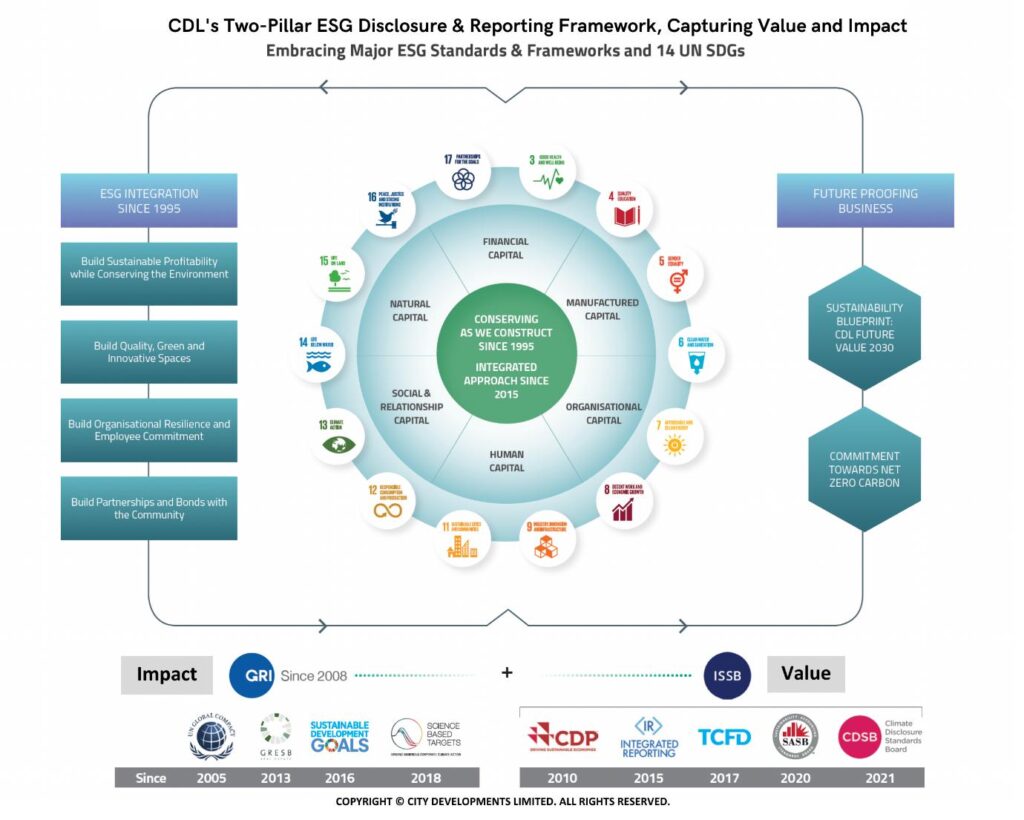
Companies can only manage what they measure. As the first Singapore company to publish a dedicated sustainability report since 2008, CDL has benefitted from the hands-on experience of producing 16 sustainability reports to-date. Using a unique blended reporting model harmonising key and relevant international reporting frameworks, standards, and approaches with the GRI Standards at its core, CDL has been able to identify material issues, set targets, track performance, and improve deliverables. This has enabled its management to take strategic and prompt action to improve, generate positive impacts and future-proof its business.

CDL’s Value Creation Model, a unique blended two-pillar sustainability reporting framework that harmonises nine key ESG reporting standards and 14 UN Sustainable Development Goals

Looking ahead, the global race to zero will continue to exert pressure on countries and companies to accelerate climate action. Sustainability-related risks and opportunities will likely increase as social, political, and cultural attitudes continue to evolve. The integration of ESG into a company’s corporate strategy is thus critical for sustained value creation.


1 Analysis: ‘Greater than 99% chance’ 2023 will be hottest year on record | Carbon Brief, Oct 2023
2 Climate change has cost the EU €145 billion in a decade | World Economic Forum, Dec 2022
3 The Paris Agreement is a legally binding international treaty on climate change. It was adopted by 196 Parties at the UN Climate Change Conference (COP21) in Paris, France, on 12 December 2015 and entered into force on 4 November 2016. It aims to keep the increase in the global average temperature to well below 2°C above pre-industrial levels and pursue efforts to limit the temperature increase to 1.5°C above pre-industrial levels. | United Nations Climate Change

aprea icon logo

Esther An

Chief Sustainability Officer
City Developments Limited

The urban area and its associated design, planning, development and operation, plays and will continue to play a big role in bringing transformational change to address the changing way we live as well as our changing climate. To bring about beneficial living and urban environmental sustainability change that results in sustainable urban environs, in this report we will look at the following topics:

  • A Change for the Good
  • The 15-Minute City
  • Urban Public Space
  • Transit-Orientated Development
  • Ecological Solutions
  • Net-Zero Buildings

Key Takeaways

To hike sustainability and bring about beneficial urban environmental sustainability change that results in walkable sustainable urban environs, one concept cities in Asia Pacific can look to adopt and implement is the ‘15-minute city’ concept.

The 15-minute city is a fresh concept that promotes both urban environmental sustainability and urban livability.

When specifically considering urban public space in the Asia Pacific region in relation to sustainable 15-minute city urban environs, the aim for local governments is to generate all-inclusive citizen-friendly settings that are also economically workable.

To interconnect sustainable 15-minute urban environs, it is essential for cities in general, including those in Asia Pacific, to have a well-planned and efficient overall public transport system that is easily accessible, is convenient and cuts both journey times and air pollution levels for all their citizens.

The 15-minute city concept also places much emphasis on the need for greater food production via urban agriculture.

Finally, in order to reduce the amount of energy used by, and carbon emissions from, buildings in the Asia Pacific region, including buildings in walkable 15-minute city precincts, it will additionally be important to take the next step and go carbon neutral, which requires a “carbon balance” to be established.

With carbon reduction deadlines looming and regulations tightening, more businesses are adopting fast-evolving technologies to measure, monitor and manage their emissions and guide future sustainability decisions.

Sustainability technologies will account for the biggest share of increased tech budgets for both occupiers and investors over the next three years, according to JLL’s survey of 1,000 companies. Over two thirds of occupiers say tech that helps them to manage and report on their sustainability progress is a top budget priority.

Globally, 45% of occupiers and 62% of investors surveyed plan to adopt energy or emissions management tech in the coming year. Another 62% of investors are interested in tech that supports sustainability monitoring and reporting while evaluating climate risk in portfolio planning is an emerging area.

“Tech is a critical enabler for companies to better understand how they’re doing in terms of their net zero goals through from flagging risks in their portfolio to monitoring their day-to-day operations,” says Ramya Ravichandar, Vice President, Technology Platforms – Smart & Sustainable Buildings at JLL.

“There’s now a mature market to address companies’ sustainability reporting and management needs and ensure they can comply with incoming public disclosure regulations such as California’s new Climate Corporate Data Accountability Act.”

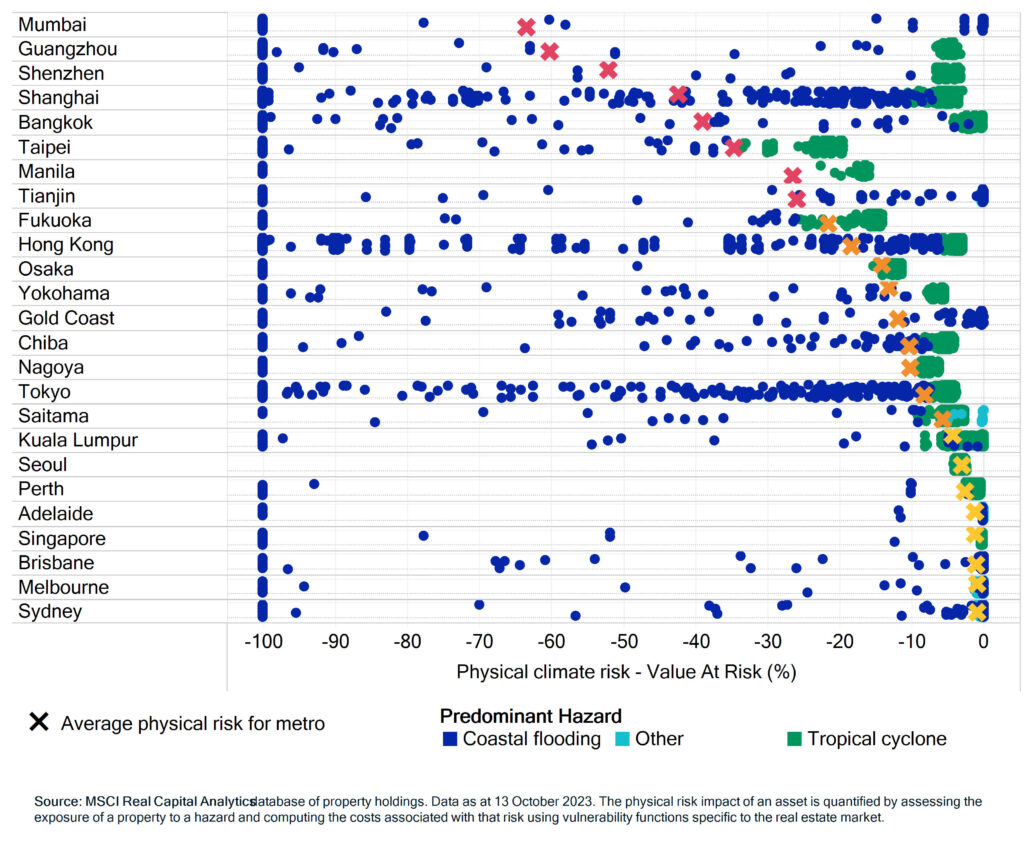
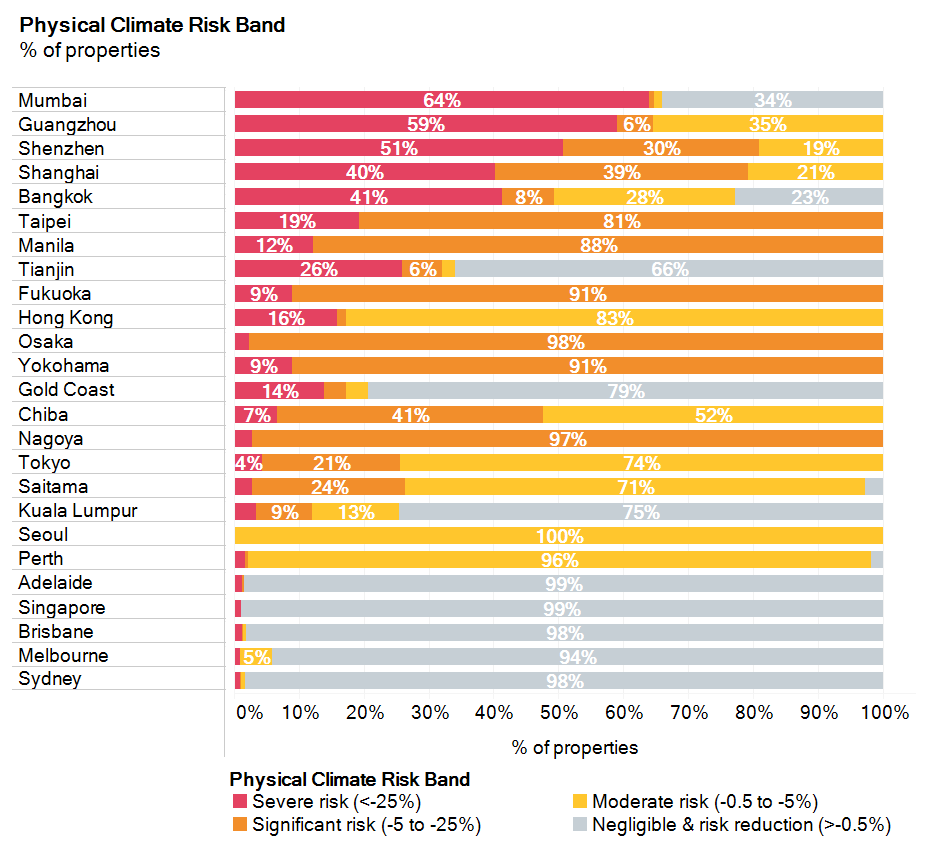
Applying climate analysis to MSCI’s Real Capital Analytics database of global property holdings, we can see a broad range of aggregated physical climate risks across real estate in selected Asia-Pacific cities. As we previously showed for cities worldwide, these risks were not equally distributed within each city.

Once again, location and topography were decisive factors behind the impact of physical climate change, reinforcing the idea that investors may wish to consider climate risk at the individual asset level, rather than relying solely on market-level data.

The charts below illustrate Average physical risk vs. risk distribution across major Asia-Pacific metros

Physical Climate Risk

Average for metro and asset-level

Physical Climate Risk Band

% of properties

Niel Harmse

Vice President
MSCI Research ×

Niel Harmse

Vice President
MSCI Research

Niel Harmse works on the real estate-solutions research team. He focuses on performance measurement, portfolio management and risk-related research for asset owners and investment managers. Prior to joining MSCI, Niel was an investment analyst at Old Mutual Property and a research analyst at Investment Property Databank. He holds a B.Com in economics and a B.Com, with honors, in econometrics from the University of Johannesburg.

According to the World Economic Forum, 80% of the buildings today will exist in 2050. The built environment is responsible for about 40% of global CO2 emissions. Retrofitting is the least capital-intensive way to make our existing buildings smarter and more efficient in order to reduce carbon emissions. It is also an effective and efficient way to drive financial outcomes capital and operational changes within the current parameters of a building’s design.

Companies around the world are stepping up on their efforts to decarbonise their business, and countries are setting national targets to reach net zero under the Paris Agreement. As APAC’s largest real asset manager powered by the New Economy and the third largest listed real estate investment manager globally, ESR Group Limited (“ESR” or “Group”) places top priority on its transition to become a net zero organisation.

Climate Emergency and the Era of Global Boiling

Recent climate events – extreme heatwaves and devastating floods – are occurring globally and this highlights the urgent need for concerted climate action. Instead of focusing on this urgency, some countries are shifting their focus to address energy security as a result of external headwinds such as
economic recession, supply chain disruptions, and geopolitical tensions. The disparity between the current climate crisis and inadequate actions has resulted in global greenhouse gas (“GHG”) emissions reaching an all-time high this year. This prompted the United Nations to warn that the era of global warming has ended, and the era of global boiling has arrived. To address the catastrophic impacts of climate change, ESR believes that immediate decarbonisation actions must be taken to transit to a net zero future.

Net Zero in the Real Estate Sector

The built environment is responsible for almost 40% of global energy related GHG emissions and the real estate sector could contribute to a positive impact. Achieving net zero depends on a myriad of factors such as the type of asset class, location, and condition of buildings, with a fit for purpose strategy. In developing a decarbonisation strategy, real estate owners and managers should consider their building portfolios, regulatory requirements, and the market availability of low-carbon technologies and solutions.

At a basic level, real estate companies should reduce their Scope 1 and 2 operational GHG emissions, which are normally associated with energy use from direct and indirect sources (e.g., on-site fuels and grid electricity). Specifically for developers and owners, GHG emissions across their value chain such as embodied carbon should also be considered. This includes tackling other forms of Scope 3 GHG emissions throughout the life cycle of a building (i.e., from design, construction, operation to demolition) and addressing tenants’ energy consumption within the portfolio.

After establishing the boundaries and sources of GHG emissions, companies should set realistic targets which are aligned to global standards such as SBTi , WorldGBC or RE100. However, companies must avoid setting underpromise or ambiguous net zero targets with misleading climate claims. Companies’ targets should be supported by robust performance data which are collected through the data management system to facilitate monitoring and reporting.

ESR’s Decarbonisation Approach

As part of its ESG 2030 Roadmap, ESR is on track to develop and announce its net zero commitment and strategy this year. This encompasses a carbon mitigation hierarchy approach which prioritises GHG emissions avoidance through low-carbon design and construction (i.e., minimise embodied carbon) and achieves energy efficiency through the asset enhancement initiatives and optimisation of operations (i.e., reduce operational carbon). These efforts will be complemented with the adoption of on-site renewable energy from sources such as solar or hydrogen to further reduce emissions. As of first half of 2023, close to 100 MW of rooftop solar power capacity has been installed across the Group’s global portfolio with approximately 39% of its assets being awarded with sustainability building certifications and ratings. Additional highlights include ESR leveraging on the rooftop space of its assets to provide renewable energy certificates for its customers. For more information, please refer to ESR’s ESG Report 2022.

Climate change has no boundaries and affects the current and future generations. The real estate sector could play a significant role in combating the climate change. However, fighting this uphill battle is a collective effort that requires everyone’s commitment, collaboration, and concerted actions. In accelerating a positive impact in the real estate sector, ESR will lead the way forward to a climate resilient future.

aprea icon logo

Tang Boon Kang

Group Head
Governance & Sustainability ESR Group

Cushman & Wakefield’s ESG Report covers our global impact during 2022, select highlights from 2023 and targets for the years to come as we work toward shaping a more sustainable, inclusive future for commercial real estate.