The large-scale trends shaping the ESG investing world have become well recognized: climate change risk and the road to net zero, the growing existential threat of biodiversity loss, social inequalities, regulation and, lately, debate and controversy over greenwashing and what ESG should be.
Against a backdrop of a war in Europe, inflation, energy markets in turmoil, political uncertainty and an unending stream of climate-induced disasters, MSCI’s ESG and Climate Trends to Watch for 2023 report takes a closer look at how some of the major developments may shape the investment environment and impact the challenges and opportunities for companies.
At a time when many mature economies are reaching peak carbon, emissions in Asia Pacific remain on an upward trajectory as the region continues along a path of rapid urbanisation and economic growth.
Asia Pacific accounted for 53% of global carbon emissions in 2021, and has been responsible for more than 80% of global growth in carbon emissions over the past decade.
To improve transparency around the role that cites and the built environment play in carbon emission reduction, CBRE has developed the Asia Pacific Sustainable City Ranking, which measures current and future environmental resilience and its impact on commercial real estate across 28 cities in the region.
Cities are evaluated according to a range of environmental factors including greenhouse gas emission reduction, physical climate risk, water stress, air pollution, renewable energy use, green bond issuance, and green office building adoption.
Case Study of Mass Timber Construction – GDI Property Group (Australian REIT)
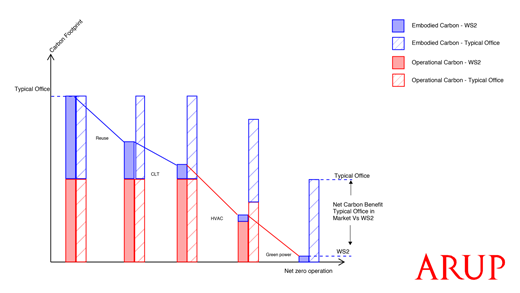
GDI Property Group (GDI), an Australian listed REIT headquartered in New South Wales, Australia, is currently constructing Perth’s first hybrid mass timber and steel frame office building. GDI will utilize a mix of cross laminated timber and steel to construct WS2, an 11 story, 9,500 square meter office building with the goal of creating a best-in-class, sustainably focused asset.
GDI underwent extensive research to understand both the environmental and economic impacts of developing what they’re calling Perth’s most environmentally friendly premium grade office building. Upon completion in late 2022, WS2 will boast a 5-star NABERS Energy Rating, a 5-star Greenstar Rating and will show a reduction of carbon by approximately 50% over the building’s lifespan vs. a similar al concrete/steel-based building and a reduction of 80% embodied carbon during the construction phase. This reduction will be captured through a combination of offsets, renewable energy systems within the building, and significantly lower embodied carbon during the construction phase. Ultimately, the goal is to achieve net zero operation, lowering scope one and two emissions, while achieving a better economic outcome as timber construction is “quicker and cheaper to build on a Total NLA Basis” according to the company in their 10 November presentation.
What Is Mass Timber Construction?
Mass timber, sometimes referred to as Cross Laminated Timber, consists of multiple layers of dried lumber stacked in alternating directions and bound together with structural adhesives and pressed to form a single panel. The panels are specifically engineered to meet the high strength ratings of load bearing walls, floors and roof trusses and are often produced on-site. The resulting mass timber panels are significantly lighter than both concrete and steel (on average 1/5th the weight of steel beams) while maintaining a stronger strength to weight ratio.
Current building codes for mass timber projects vary across different countries, but recent legislation in the United States and Canada has allowed for construction of mass timber buildings up to 18 stories tall. Other markets, such as parts of Europe and Australia, are seeing even more progressive mass timber building requirements with a new 40-story mass timber building in Sydney being designed and scheduled to start construction in 2023.
Building and Environmental Advantages of Mass Timber
Environmental Impact:
Mass timber decomposes at a natural rate when discarded as opposed to waste from concrete or steel.
One cubic meter of mass timber sequesters roughly one ton of CO2.
In a full lifecycle analysis of mass timber vs reinforced concrete on a mid-rise building, mass timber represented a 26% reduction in global warming potential.
Mass timber construction as an alternative to steel reduces CO2 emissions by 1.9 metric tons per cubic meter of wood product
Tensile Strength: Timber supports its own weight at a higher degree than both steel and concrete.
Electrical & Heat Resistance: Natural resistance to electrical conduction when dried to standard moisture levels. Strength and dimensions are not significantly affected by heat, providing stability to the finished building.
Sound Absorption: Acoustic properties make it ideal for minimizing echo in living or office spaces. Wood absorbs sound, rather than reflecting or amplifying it.
Economic Feasibility of WS2 and Mass Timber Construction
David Ockenden, GDI’s Head of Development, explains the similarly robust economic benefits of the mass timber build due to the expedited construction timeline and relatively light material. Namely, the tensile strength of mass timber allowed for a larger construction footprint than previously thought on the WS2 building:
“When we initially started looking at traditional concrete structures it [could] only be two stories, but timber, when we started exploring that we could build a lot more and reinvest in the precinct to upgrade it.”
The demand for sustainable assets is especially high in Perth, a city known for commodity extraction, where companies are often seeking ways to improve their ESG impacts. GDI is already seeing strong leasing interest from potential full-building, multi-floor and single-floor tenants, claiming overwhelming praise and popularity of the WS2 project. When fully completed, the WS2 building will be a flagship office space within GDI’s portfolio and will serve as the basis for continued mass timber development throughout Western Australia. As mentioned above and in their recent Managing Director’s update, GDI has identified other projects where they plan to use timber construction in their recent update and are exploring redevelopment opportunities at 1 Mill Street and the Wellington car park. Their presentation cites that development approvals have been lodged or are in the process of being lodged.
Benefits of Investing in Mass Timber Projects
At B&I Capital, an Asset Manager with offices in Zurich, Singapore and Austin focused on listed real estate investing, we strive to integrate Environmental, Social, and Governance criteria throughout our investment process and company operations. We believe mass timber construction projects, such as WS2, align directly with our aim to minimize environmental footprint by lowering scope one and two emissions as much as possible. Moreover, given timber construction permitted significant increase in net leasable area and has a quicker construction time, timber construction led to a better economic return. The strong reduction in carbon emissions due to their construction will lower their need to purchase green power or carbon credits to achieve net zero for WS2. Our investment in GDI follows our support of their drive to build environmentally friendly projects and belief of their viability as strong real estate investments. It is through our investments in companies like GDI we actively participate in the creation of a sustainable future.
5 Steps to Climate Positive Real Estate (Cushman & Wakefield)
Climate positive activities are aimed at not only achieving but surpassing net zero emission goals through eradicating additional carbon dioxide (CO2) and/or greenhouse gases (GHG) from the atmosphere. In short, it’s about saving more GHG emissions than your actions produce, in order to create an environmental benefit.
When developing a climate positive strategy, the first stage is to apply a carbon accounting framework. For instance, if a building product manufacturer wants to develop a climate neutral or positive product, they must determine the total carbon footprint of that product. The carbon footprint covers everything — from the energy needed to source the original material/s as well as to produce, supply, use and dispose of the product — to the emissions related to product original material/s sourcing as well as product production, usage and disposal.
Once the total carbon footprint is calculated, as well as what needs to be counteracted to become carbon neutral, then an additional measurement number, such as an extra 10% for example, can then be tagged on to estimate what is needed to go climate positive.
How enterprises actually achieve climate positivity can differ. Usually, however, they meet the requirements via a mixture of reducing carbon emissions, shifting to renewable energy, producing locally, investing into offsetting, and purchasing carbon credits.
Transforming Your Real Estate
Buildings can realize climate-positive results in a number of ways, and simply put, the steps to climate positive are the steps to net zero plus that extra mile, whatever takes the building to remove more greenhouse gas (GHG) than it is producing. The building’s strategy should include a mixture of the following steps:
Step 1 CHOOSE: the optimal building location, design, energy modelling, eco-friendly materials, renewable energy and intelligent energy management systems
Step 2 MAXIMISE: the structural efficiency, insulation and greenhouse gas reduction systems
Step 3 MINIMISE: the material and operational wastage and water usage
APREA ESG Guidebook for Real Assets in Asia Pacific
As the voice of sustainable investing in the Asia Pacific, APREA has developed the ESG Guidebook for Real Assets in Asia Pacific to raise awareness about ESG and guide our stakeholders in their journey to sustainability. We believe that capital allocated to real assets can play a meaningful role in the achievement of the sustainable development goals (SDGs), while leveraging growth opportunities in a manner that benefits all stakeholders.
We recognise that the ESG landscape continues to evolve, and this Guidebook lays out the basic foundation to integrate ESG and sustainability factors in how each of us conduct our businesses. Aside from providing a framework that can be used as a basis in establishing a systematic ESG approach, we have included practical ways to build and operationalise an ESG program with effective governance, as well as clear steps to engage and communicate with key stakeholders.
The Guidebook also features case studies among APREA members that illustrate various innovative approaches, that reflect their philosophy and investment styles, and thus, facilitating the exchange of best practices.
Next, Flex | Technology For The Next Generation Australian Office (essensys)
At a time when commercial occupancy rates across the country remain stubbornly low, the report delves into how Australian office worker expectations are changing in a digital-first, hybrid work environment and how this impacts their office attendance.
Next Flex | Technology for the next generation Australian office, which surveyed 1,000 office workers across the country, was launched by essensys, a leading global provider of software and technology for the commercial real estate industry, in partnership with Flexible Workspace Australia.
The report’s critical findings highlight a lack of adequate tech is a key factor in people deciding to work from home or an alternative third space, with more than four in five respondents (86%) reporting a disparity between the existing technology in their office and what they need to enable them to do their jobs efficiently.
Eye on ESG: Why the Asia Pacific Hotels sector needs to pay attention (CBRE)
The Covid-19 pandemic has accelerated the urgency for hotels and hospitality companies worldwide to act to protect the well-being of the planet, communities, employees and guests, leading to a sharper focus on environmental, social and governance (ESG) initiatives.
While still nascent, the Asia Pacific hotel industry’s commitment to ESG and sustainability initiatives is steadily increasing – a welcome development as the region has the highest concentration of hotel carbon emissions. Rising energy costs – which have increased significantly since the onset of the pandemic – as well as other factors such as the shift in guests’ preferences toward more sustainable tourism and green accommodation, and growing demand for disclosure around climate risk, are accelerating the industry’s focus on sustainability.
These developments are feeding into a trend that CBRE is observing in the hotels sector: green travellers want to stay in green hotels. With environmental consciousness coming to the fore, sustainable design will increasingly come into play, enhanced ESG practices will offer travellers places where they feel comfortable spending their time, and new investment opportunities will be created.
This report examines the key ESG trends shaping the Asia Pacific hotels sector, and explores the key actions that hotel companies, developers and investors can take to effectively integrate ESG initiatives into their business, operations and investment strategies.
With ESG taking on increased importance globally, the S (social) dimension of ESG has received considerable attention recently. This reflects the need to prioritise the health and well-being of staff and customers, as well as supply chain issues, and equity and diversity issues in the workplace. This article highlights these issues and the major initiatives in the S space now being actively implemented by the real estate industry in Australia and Asia.
Doing ESG Well
Importantly, the real estate industry has clearly recognised the importance of ESG in their activities. This mandate has moved on from “doing ESG” to “doing ESG well”. This sees the ESG agenda actively promoted by the professional organisations in the real estate industry in our area; this includes APREA, ANREV and the Property Council of Australia; check their websites for fuller details.
Specifically concerning the S dimension of ESG, this covers a range of social aspects needed for effective businesses today. This includes staffing aspects, concerning equity, diversity and inclusion issues such as gender equality and cultural diversity to address under-represented groups at all levels in the organisation (ie: staff, senior management, board), as well as staff turnover, retention and pay. Wellness and well-being have also been a focus, around issues such as safe workplaces and staff mental health (particularly during COVID). Many organisations have also developed supply chain codes of conduct, with aspects such as modern slavery issues and fair pay being critically important. This sees many real estate companies giving their historic performance metrics to show they are moving forward in the delivery of these S issues.
All of these S activities are important, as they now play a key role in real estate funds’ decisions on whether to invest in these real estate companies, as well as the real estate companies showing a strong commitment to ESG. This is essential for investors today as ESG takes on increased importance at all levels in our communities. Companies clearly face the risk of being excluded from these investment mandates if they do not actively address these ESG issues.
Examples and Best Practices
There are many examples in the real estate industry in Australia and Asia who are world leaders in ESG, as recognised by all of the ESG benchmarks from the various international ESG rating agencies. These real estate exemplars include Stockland, Dexus, Mirvac, GPT and Lendlease in Australia, and CDL and CapitaLand in Singapore. They produce highly informative annual ESG reports which are available on their websites, which clearly highlight how they deliver the S dimension in ESG, with many exciting examples and delivery metrics. I have only given a few examples here; many others are also actively involved in this area; check their websites for fuller details. All of these examples are relevant to both those well progressed in the ESG process and those only just starting out. They will give you lots of ideas on how you can achieve your ESG “best practice” mandate; particularly concerning the S dimension of ESG.
I recently did a report for Investment Property Forum in the UK regarding ESG benchmarks in real estate investment. Using 60 interviews with global leaders in ESG, it gave a fuller international context to ESG in real estate, as well as identifying the priorities and challenges for delivering ESG. There were some amazing examples globally. We found that generally Australia and Europe were the leaders, with Asia needing to catch-up in their delivery of ESG. Also read some of the excellent ESG reports produced by the leading real estate advisory groups (eg: CBRE, JLL); many have a strong Asia context and Asia case-studies.
As more real estate companies begin or expand their ESG journey, it is important to have benchmarks and “best practice” role models for what is being achieved. There are many examples in the real estate industry in Australia and Asia (indicated above) who are world leaders in the ESG space. I strongly recommend you review their ESG reports on their websites for a fuller understanding of what can be achieved by your company. Enjoy your ESG journey and your increased focus on the S issues in delivering your ESG mandate.
In future articles, I will drill into more specifics about how to effectively deliver your S agenda in ESG.
Professor Graeme Newell
Professor of Property Investment Western Sydney University ×
Professor Graeme Newell
Professor of Property Investment Western Sydney University
Professor Graeme Newell is Professor of Property Investment at Western Sydney University. He has over 40 years’ experience in property education and research, having received numerous research grants and his applied research has been published widely. Graeme has strong links to the property industry, both in Australia and internationally. He has been a member of APREA for many years and has done several research reports for APREA concerning Asia REITs, and the significance of real estate in Asian pension funds.
This guide addresses how the developing issue of Business and Human Rights (BHR) affects property ownership and management industries. Addressing BHR is a way to strengthen cultures of respect, dignity and ethics within our member organizations and mitigate risk.
This Guide provides an overview of the key BHR concepts drawn from the United Nations Guiding Principles on Business and Human Rights (UNGPs) and the Organization for Economic Co-operation and Development Guidelines for Multinational Enterprises (OECD Guidelines). It then applies these concepts to property ownership and management before setting out how to incorporate BHR concerns into your operations. Finally, the appendices provide examples for due diligence and contractual provisions.
As human beings, we are curious by nature. If you reflect on your choices, profession, passion, you will realize that you resonate with the idea at its very core. It is observed that we are able to respond and perform better when we connect with the thought, concept of what we are doing. When an organization formulates its business strategy, it is always aligned with the vision of the organization. Similarly, it is important that ESG and sustainability are factored in the vision of the organization. It is only when ESG and sustainability as a concept resonate with the organization’s values and its people, they will succeed and have the desired impact.
At IndInfravit, we have attempted to engrain ESG in our DNA. But before doing that we reflected on our business objectives, the ecosystem, our culture and our vision. As an organization, we are continually striving to achieve and maintain the highest quality standards in the operations and maintenance of projects throughout their concessionary term while incorporating environmental and social considerations important for long term survival of business. Being a key player in the infrastructure space, we are cognizant of the impact we have on the overall ecosystem – economy, environment, society and community at large. It has been our endeavour to create a positive impact on the business neighbourhood, environment and the country as a whole. We acknowledge that to drive this, it is important to engage with our stakeholders, work cohesively and hold ourselves accountable. We strongly believe that our ability to take decisions which create a positive impact on the ecosystem forms the very core of sustainability. Imbibing ESG into our business strategy, thus seemed a perfect choice.
Walk the talk
Once you have identified the reason, the next step is to identify specific initiatives and design a framework to drive the ESG agenda. The initiatives could range from implementing solutions, which are readily available, to solutions, which might require innovation and brainstorming. Another important aspect is the oversight and governance around ESG. Typically, an ESG committee comprising of the CXO’s/BODs would augur well for driving ESG related initiatives. Commitment from all stakeholders is essential to ensure that the ESG agenda is implemented in spirit.
At IndInfravit, we have undertaken various initiatives to streamline our GHG emissions. We are in the process of integrating low-carbon energy sources for our operational usage which would significantly reduce our carbon footprint. We have an integrated approach of tolling system operated by solar energy. We have also undertaken the process of conversion of HPSV lamps to LED lights.
We are committed towards lowering our environmental footprint as well as implementing resource- saving practices along the whole value chain. Drip irrigation, ground-water recharge, tracking and measuring pollution, migrating to greener fuels, using green DG sets are some of the initiatives implemented in this regard. We are working towards continual improvement in workforce strategy, terms of employment and employee benefits.
From an implementation and oversight perspective, we have developed an implementation strategy, which penetrates right to the Project Head level. Our aim was to empower our Project Heads to run the initiatives on ground, then have our SBU heads review the pace of implementation and eventually have these dovetail to the CXO’s office for continuous oversight and direction.
I would like to conclude by saying that eventually it is our responsibility to embrace sustainability and pass on to our generations a planet, they can cherish, a way of life that will sustain.
Pawan Kant
Chief Executive Officer LTIDPL IndVIT Services Ltd (Investment Manager to the IndInfravit Trust) ×
Mr. Pawan Kant
Chief Executive Officer LTIDPL IndVIT Services Ltd (Investment Manager to the IndInfravit Trust)
Mr. Pawan Kant is an Infrastructure & Engineering professional with over 3 decade experience in executing and management of large infrastructure projects including on PPP basis. His areas of expertise besides P&L are Project Execution, Operations and Management, M&A, Bidding, Commercial & Contracts etc. He has worked on large projects in India and Overseas. He has worked with the House of Tata’s besides experience of other domestic and international corporates such as Kalpataru Power Transmission Limited, Singapore Technologies, Hindustan Construction Company Limited, Great Eastern Shipping, etc. He has worked on Roads and Highways, Industrial Park, SEZs, Power Transmission, Townships, etc.
He was also instrumental in successfully executing India’s first integrated project on Relationship Contract model (Alliance Contracts); the largest logistics project in SE Asia, multiproduct SEZ in India, Highway etc. He has also worked on initiatives of World Economic Forum.
As CEO of Investment Manager to the IndInfravit platform, he is responsible for management and growth of the assets under the portfolio. IndInfravit Trust is India’s foremost Public Listed Privately held platform. It owns and operates 13 highway projects accumulating 5000 kms length. Globally renowned long-term Investors – CPPIB India Advisors Private Limited, Allianz Capital Partners GmbH & OMERS Infrastructure Europe Limited are Key Investors into the platform.
Kemmu Kawai joined Longevity Partners Japan in September 2022 as the Country Director. Based in Tokyo, he oversees all operations and activities in Japan, the Asia-Pacific region and beyond. He brings him more than 16 years of experience in finance where he specialised in real estate and credit investments. Before joining Longevity Partners, he served as a Portfolio Manager at Norinchukin Bank and as Investment Manager at Center Point Development.