APREA Logo

Capital Markets

Challenges persist and recovery will take time, but opportunity remains on multiple levels for Hong Kong SAR hotel investors, owners and operators.


Hong Kong SAR1 continues to attract interest from those who recognise the city’s longer-term potential, despite challenges faced with COVID-19 and border restrictions that have led to a lack of mainland and international visitors. Nevertheless, the hotel sector performed well in 2021 compared to the year before, with certain hotels being used as quarantine hotels and a boost in staycation demand and extended-stay offerings.

Set to become the world’s leading wealth management centre with over USD3.2 trillion assets under management (AUM) by 2025, major infrastructure, commercial and leisure initiatives will further elevate Hong Kong SAR’s position as a global city with further long-term potential.

In this special report, we look at:
  • The performance of hotels in Hong Kong SAR, the operating environment and the sector’s supply up to 2026
  • Key trends and challenges in the hotel sector, including technology adoption, asset enhancement and Environmental, Social & Governance (ESG)
  • The city’s infrastructure and leisure initiatives with potential benefits for the hotel sector
  • Challenges and opportunities with investing in hotel assets in Hong Kong SAR
https://cdn.flipsnack.com/widget/v2/widget.html?hash=z1mazzr02v

This article was originally published in https://www.colliers.com/en-xa/

The performance of Sydney and Japan hotels are expected to be driven by increasing domestic travel on the rollout of vaccinations, while international visitors won’t arrive in masses anytime soon.

In addition, Asia’s cruise industry has been recovering quickly as operators nimbly tap into pent-up travel demand, which could grow further with mass vaccinations in Asia and globally.

In the past quarter, hotel deals remained at historically low levels, as owners hold rather than sell assets at a discount, given support from banks and governments.

In Colliers Hotel Insights | Q2 2021, we look at:
  • Why invest in hotels?
  • How increasing interstate travel should improve Sydney hotel performance
  • Domestic demand to prop up Japan’s accommodation market
  • Recommendations for hotel investors amid limited deals, as hotel owners wait and see
  • The rapid recovery of the cruise industry in H1 2021

To view full report please visit Real Capital Analytics please visit : https://www.rcanalytics.com/rca-insights/

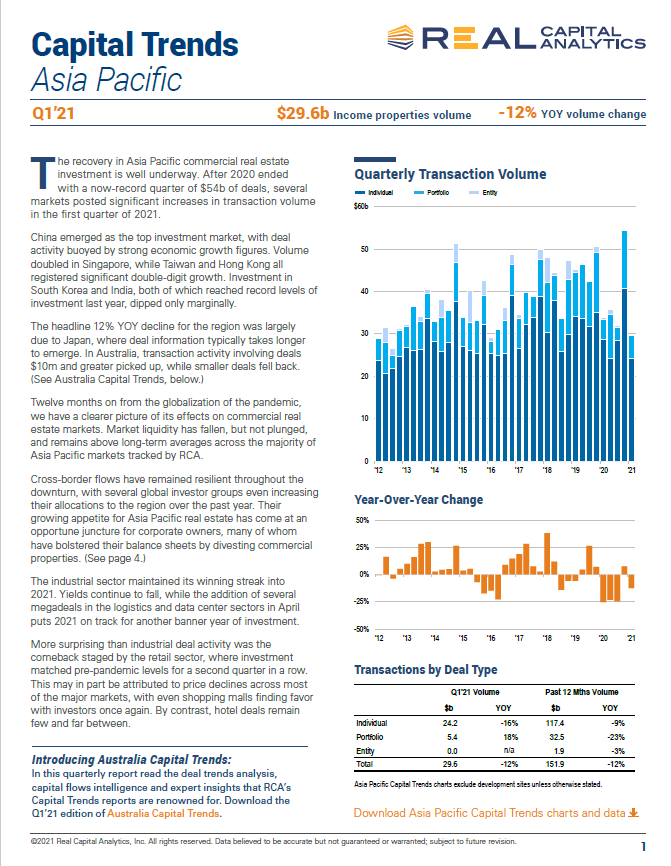
  • Global commercial real estate (CRE) investment volume fell by 31% year-over-year in Q1 2021. A strong rebound is expected in the second half of the year on the back of economic recovery and widespread COVID-19 vaccinations.
  • The pandemic has affected global investment markets to varying degrees. APAC led the global investment recovery in Q1. Markets like Tokyo, Seoul and Beijing showed resilience throughout the pandemic. Markets in North America, led by Los Angeles, Boston and Dallas, have recovered rapidly, while European markets lagged due to COVID resurgences.   
  • Industrial property investment remained strong in all three global regions. Hotel investment gained traction in the U.S. as prices dropped and distressed sales came to market. Core office and retail assets held up well in Asia Pacific.
  • Yield spread between property and bond narrowed based on rising bond yields across global markets. Global industrial yield continued to compress driven by strong market fundamentals and demand. Office yield remained stable in Q1 but showed signs of expansion in the U.S. Retail yield edged higher driven by softness in Europe.
  • Real estate total return remained positive in 2020 thanks to a stable income return. Many investors are turning to opportunistic and distressed investment in 2021 for higher returns. Greater emphasis is placed on tenant credit and rent roll growth under the influence of the pandemic.

A GOOD START TO A YEAR OF EXPECTED ECONOMIC RECOVERY

  • With the economy on the mend with positive news from the vaccine distribution, controlled easing of travel restrictions as well as the return of workers to their workplaces, investment sales activity picked up in the first quarter of the year, with the residential sector leading the string of deals. Investment deals amounted to some S$3.8 billion in Q1 2021, representing an uptick of 26.7% year-on-year (y-o-y) from S$3.0 billion in Q1 2020.
  • The residential sector retained momentum with some S$1.7 billion of investment deals at the start of 2021. The Good Class Bungalow (GCB) segment continued to draw strong interest due to its rarified and coveted status, as well as the entry of more family offices setting up in Singapore. The sale of a GCB at Nassim Road for S$128.8 million or S$4,005 per square foot (psf) on land in late March broke all previous sales records from this asset class. At the same time, developers were beginning to replenish their land banks through partnerships.

Return of institutional capital and increasing industrial investment deals

Institutional investors and real estate funds sped up their hunt for industrial assets. In fact, among the aforesaid HKD1.9 billion transactions, all were acquired by funds or institutional investors. In January 2021, Kailong, a fund manager active in Greater China, acquired Hang Fat Industrial Building near Lai Chi Kok station. This property is expected to be redeveloped into a new industrial office building3 . Another pan-Asian fund manager, SilkRoad, also purchased Smile Centre near Fanling station, which is currently leased for logistics use. Meanwhile, Goodman purchased ground floor to fourth floor of Seapower Industrial Centre in Kwun Tong, with cold storage facilities, for HKD570 million (USD 73.5 million).

Looking into 2021, we believe institutional capital and funds will become more active again, given the pent-up acquisition requirements that have piled up over the last 18 months due to the market uncertainties, which now seem to be easing. Compared to the retail and office sector, industrial properties demonstrated a high level of resilience and stability in terms of rents and capital values. Meanwhile, the industrial Revitalisation Scheme 2.0 also presented investors with redevelopment opportunities, and some investors are eyeing the relaxed plot ratio restrictions to improve the return on their investments with higher floor area ratios.

Whatever happens, real estate investors need to be innovative and adaptable, forming investment strategies which align with these structural changes.

COVID-19 has plunged the world into one of the most uncertain periods on record. Gold has hit record highs, equity volatility is elevated and government bond yields around the world remain low. Yet against this backdrop, we predict that real estate investment will remain attractive, thanks to lower volatility than other asset classes, a history of strong returns through longer-term direct investment, and, crucially, its ability to generate income in a world where 60% of bond yields globally are below 1%1 and over $14 trillion have negative yields.

For the service sector, a greater domestic workforce of support staff will offer renewed demand for office space. Localised employment growth in manufacturing, storage and service sectors will also enhance demand for other types of real estate, including residential and healthcare. There will also be indirect opportunities for international real estate investment. As an alternative to increased localisation, cross-border property investment offers global diversification and more options to meet revenue targets.

Nationalism and the advent of trade wars were already on the ascendency, but recent disruptions to business continuity, and overseas travel caused by the pandemic will only accelerate this trend. This has prompted discussions of reshoring (bringing foreign operations back home), onshoring (bringing supply chains within national borders) and nearshoring (bringing operations closer to home). Some types of real estate will thrive as a result. The logistics sector is seeing additional occupational requirements, which have translated into an even stronger investment demand.

Key Forecasts and Outlook: Logistics & Industrial Market

•Across APAC, demand for logistics space has been supported by a long-run shift from physical to online retailing. COVID-19 has driven up e-commerce volumes sharply, while expansion in the cold chain sector and new infrastructure developments should boost demand further. •Most investors and developers already see logistics warehouses as a core asset class.
•With firm demand and limited supply in China’s Tier 1 cities, tenants and owners may have to seek space and opportunities in locations away from the main centres.
•Japan stands out as underserved by modern logistics stock, even though the small modern logistics clusters (e.g. Nagareyama/Kashiwa near Tokyo and Ibaraki City near Osaka) offer some of APAC’s largest and most advanced warehouses. The low availability of modern units means investors and developers can apply value-add strategies to older stock. It is increasingly common to demolish and rebuild.
•Australia has ample Grade A logistics stock, but it is tightly held and vacancy rates are well below their long-run averages. Investors should be willing to buy a portfolio of assets to achieve scale.
•In India, Mumbai and Delhi NCR have vacancy rates of 10-11%, but the other logistics clusters have vacancy of 15-30%. New supplying 2020 is modest in all markets except Delhi NCR.
•Singapore is one of the best-served Asian logistics markets, with a per capita Grade A stock on a GFA basis of 0.8 sqmetres(versus under 0.2 sqmetresin Osaka or South China). As a result, vacancy is 11.7% and we expect modest average annual five-year rent growth of 0.8%.
•Demand for cold chain delivery is soaring. Looking ahead, we expect that big purpose-built cold chain warehouses will be built near ports and transport hubs, while renovated cold chain warehouses will be located nearer cities for easy distribution. Occupiers and owners will find opportunities in both types.