
APREA Logo

Knowledge Hub

Summary: CBRE’s latest Asia Pacific Leasing Market Sentiment Index reveals that overall leasing sentiment improved across most markets and sectors in Q3 2025:

Office: Occupier sentiment is strengthening as trade tensions ease and office attendance mandates tighten. All markets except for mainland China are reporting an increase in tenant enquiries and inspections. Overall expansionary sentiment is being driven by India and North Asia markets. Aligning with CBRE’s 2025 APAC Office Occupier Survey, more tenants are demanding well-located offices with a superior amenity offering.

Retail: Improving clarity around global trade policy is instilling retailers with greater confidence, triggering more enquiries and site inspections across most markets, except for Singapore. Stronger demand in India and Korea is providing a foundation for landlords to raise rental expectations. However, rising operating costs are prompting retailers to review portfolios and assess whether to relocate underperforming stores.

Industrial & Logistics: Enquiries and site inspections are gaining traction amid the stabilising trade outlook, setting the stage for a potential recovery. Growth markets including India and Southeast Asia remain resilient, while sentiment in Japan and Korea is strengthening on the back of easing supply-side pressure. Despite the uptick in demand, prospects for rental growth remain limited as tenants retain stronger leverage than landlords in negotiations.
Co-produced by Vistra Fund Solutions and APREA

The APAC real assets market is full of potential, but also operational, tax, and regulatory friction. This exclusive report reveals where the biggest opportunities lie, what’s holding investors back, and how leading firms are navigating the complexity.

Inside the Friction Index 2025:

  • Which APAC markets and asset classes are attracting institutional capital
  • Where investors face the highest levels of friction and why
  • How leaders use outsourcing, AI, and tech to gain a competitive edge
  • The trends redefining real assets: ESG, AI, and regulatory shifts

Explores the key drivers of demand, the regional nuances shaping growth, and the emerging expectations of tenants across China, India, and Southeast Asia.

The Asia-Pacific office market has expanded rapidly over the past decade. Grade-A office stock has nearly doubled to over 2.3 billion square feet, while occupied space has increased by almost 900 million square feet. Two-thirds of this demand has been driven by 17 cities across India, Southeast Asia and the Chinese mainland.

Key Highlights:

  • Grade-A office stock in APAC has nearly doubled to 2.3 billion sq.ft over the past decade.
  • Companies are taking a “Flight to quality approach” looking for ESG-aligned and tech-enabled buildings.
  • 2/3rd of demand has been driven by 17 cities across India, SEA and China mainland.

India is undergoing a dramatic demographic shift that presents both unprecedented opportunities and significant challenges for the senior living sector. The country’s senior population is projected to more than double from 156.7 million in 2024 to 347 million by 2050, representing 21% of the total population. This transformation is driving substantial growth in the senior living market, which is currently valued at INR 15,500 crore (USD 1.8 billion) and expected to expand to INR 64,500 crore (USD 7.7 billion) by 2030.

Despite this promising growth trajectory, the market remains severely undersupplied and in its early stages. With only 1.3% penetration compared to mature markets like the US and Australia that exceed 6%, India’s senior living sector has vast untapped potential. The current supply of approximately 20,000 units falls dramatically short of the estimated demand of 2.27 million households by 2030, highlighting the enormous opportunity for developers, operators, and investors in this rapidly evolving sector.

Summary: Colliers’ Global Capital Flows Report (September 2025) highlights cautious but steady growth in real estate investment activity worldwide, with Asia Pacific maintaining a leading role despite global headwinds.

Key highlights include:

  • Singapore, Japan, and Hong Kong ranked among the top 10 global sources of cross-border capital.
  • Japan and Australia remain top global capital destinations, reflecting sustained investor confidence.
  • Office and retail sectors are leading the regional recovery, with office assets reclaiming the top spot in transaction volumes.
  • Land-led development continues to dominate, with seven of the top 10 global destinations located in APAC.

Don’t miss our exclusive interview with Martin Siah, Singapore Country Executive, Head of Southeast Asia Global Corporate and Investment Banking, Head of Asia Pacific Real Estate, Gaming and Leisure at Bank of America.

In our latest issue of APREA Investor Compass, the Deputy Chairman of APREA’s Singapore Chapter shares his story, his inspiration, and why he believes that there are currently significant dislocations and opportunities abounding in the real assets industry.

This issue also takes a look at investment opportunities in infrastructure and how regional ESG Trends in real estate are driving global integration.

Please find below the rebalancing results (effective 22 September 2025 start of trading) for the:

  • GPR/APREA Investable 100 Index
  • GPR/APREA Investable REIT 100 Index
  • GPR/APREA Composite Index
  • GPR/APREA Composite REIT Index (indicated with an asterisk)

GPR/APREA Investable 100 Index

INCLUSIONS

CHNCountry Garden Holdings Co
CHNLogan Group Co Ltd
HKGHysan Development Co.
HKGWharf Holdings
JPNAEON REIT Investment Corp
JPNJapan Logistics Fund
SGPCapitaLand Investment Limited

EXCLUSIONS

CHNCIFI Holdings Group
JPNMIRARTH HOLDINGS INC
THAAP Thailand PCL
TWNDa-Li Development Co Ltd
TWNWe & Win Development Co Ltd

GPR/APREA Investable REIT 100 Index

INCLUSIONS

AUSCromwell Property Group
KORESR Kendall Square REIT
MYSSunway REIT
SGPAIMS APAC REIT

EXCLUSIONS

AUSGrowthpoint Properties Australia
AUSHealthCo Healthcare and Wellness REIT
JPNStarts Proceed Investment Company
THACPN Retail Growth Leasehold REIT

GPR/APREA Composite Index

INCLUSIONS

CHNGuangdong – Hong Kong Greater Bay Area Holdings Limited
CHNMidea Real Estate Holding Ltd.
HKGCSI Properties Ltd
PAKDolmen City REIT *
SGPSing Holdings Ltd

EXCLUSIONS

AUSAustralian Unity Office Fund *
AUSNextdc Limited
TWNFull Wang International Development Co Ltd

Real estate investments during H1 2025 were largely driven by domestic investors in most Asia Pacific markets, while offshore interest persisted in key hubs such as Australia, India, Singapore and Hong Kong.

The region’s investment outlook is expected to remain steady and resilient through 2025 and into 2026, supported by a lower interest rate environment, moderating inflation and sustained economic growth across key markets.

Key insights:

  • Office remains the asset class of choice, with retail gaining pace.
  • South Korea, Japan and Australia drove nearly two-thirds of investment volumes.
  • Growing appetite for alternative asset classes such as data centres, life sciences and student housing.
  • Growing confidence of local investors, underscoring resilience across the region.

As workplace patterns continue to change, occupiers in Asia Pacific are accelerating the return to office and elevating the workplace experience.

CBRE’s 2025 Asia Pacific Office Occupier Survey, with insights from nearly 300 corporate real estate executives, highlights:

  • Workplace effectiveness: Insufficient small rooms (48%) and lack of vibrancy (35%) remain top challenges. Adjusting workstation sizes and desk-sharing ratios can help improve efficiency.
  • Tighter attendance protocols: 82% of occupiers now impose consequences for non-compliance (+16 percentage points y-o-y), with office utilisation improving in 2025.
  • Core and quality preference: Smaller companies display the strongest appetite for growth. 65% of occupiers planning to move prefer CBD cores, but most availability is in non-core areas.

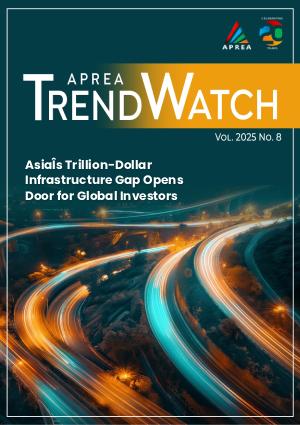
Asia faces a USD 1.7 trillion annual infrastructure funding gap through 2030, creating a massive opportunity for global investors. Demand is being driven by rapid urbanisation, digitalisation, and aggressive decarbonisation goals, with investor interest converging around data centres, renewable energy, storage, and logistics hubs.

In our latest issue of APREA TrendWatch, we explore opportunities in Asia’s infrastructure landscape as the region builds the backbone of its future growth.