Asia’s Real Assets Rebound: How Structural Tailwinds Powered Outperformance in 2025
Asia Pacific’s real assets industry staged a decisive rebound in 2025, outperforming amid macro uncertainty as stabilising financial conditions, supply constraints, and structural demand drivers restored pricing power and investor confidence. Across the region, rental growth re-emerged, REITs regained favour, and capital increasingly rotated toward assets aligned with decarbonisation, digital infrastructure, and long-term income resilience. As the market looks toward 2026, performance is being driven less by sentiment and more by fundamentals, setting up a more durable and disciplined phase of growth for real assets in the region.
Asian Market Outlook – December 2025 (B&I Capital)
Asian real estate securities saw strong performance in 2025, but face new headwinds as interest rate expectations shift. While Singapore continues to benefit from falling rates, Japan and Australia are confronting inflationary pressures and potential monetary tightening. Market dynamics remain highly regional, with significant differences in fundamentals and policy.
Key Regional Insights
Japan:
BOJ expected to hike rates soon amid persistent core inflation and weak JPY.
Labor shortages raising construction costs; strong rent growth across prime office markets.
Landlords now successfully introducing CPI-based escalations in fixed leases.
Near-zero vacancy rates point to continued rental upside.
Australia:
Strong economic data has pushed back rate cut expectations, with some forecasts now pointing to hikes.
Residential REITs still supported by demand and demographics but may face short-term consolidation.
Goodman Group could outperform in short term; exited position in National Storage after fair M&A offer.
M&A activity likely to continue — Abacus Storage King seen as a potential target.
Singapore:
Rates continue to fall, helping REIT earnings and facilitating acquisitions.
MAS’s EQDP program supports smaller listed companies, including REITs.
SREITs are attractive due to lower rate risk, strong fundamentals, and favorable currency outlook.
Parkway Life REIT set for 32% DPU uplift in 2026 from 2021; CICT and Frasers Centerpoint also favored.
Hong Kong:
Fed’s December rate cut had little market impact; much already priced in.
Residential and retail recovery expected in 2026; office remains sluggish but owner-occupier deals are a positive sign.
Hongkong Land continues to outperform via asset sales and capital return strategies.
New REIT initiatives like REIT Connect could be future catalysts.
Please find below the rebalancing results (effective 22 December 2025 start of trading) for the:
GPR/APREA Investable 100 Index GPR/APREA Investable REIT 100 Index GPR/APREA Composite Index GPR/APREA Composite REIT Index (indicated with an asterisk)
Building Sustainable Real Assets Future Together: Takeaways from the Asia Pacific Real Assets Leaders’ Congress
APAC is entering a new investment cycle, and APREA’s flagship conference, the Asia Pacific Real Assets Leaders’ Congress, examined how this momentum is reshaping strategies, capital flows, and long-term priorities.
Key highlights:
High-growth sectors such as data centres, logistics, student housing, and multifamily are becoming areas of focus, where demand is rising faster than supply and investors see real room to scale.
Markets including India, Japan, and Singapore stood out as engines of opportunity, combining strong fundamentals with policy shifts that are unlocking new pathways for long-term capital.
Infrastructure is becoming the next frontier, with the energy transition and digital connectivity expanding the scope of what investors consider essential, investable, and transformative.
As sustainability becomes inseparable from value creation, capital is increasingly flowing to assets that can deliver both performance and long-term positive impact.
Welcome to the inaugural APAC Investment Atlas, your strategic guide to commercial real estate investment across Asia Pacific. This report leverages Cushman & Wakefield’s proprietary TIME Score and Fair Value Index (FVI) to provide clarity on market cycles, pricing, and sector trends—empowering investors to make confident, data-driven decisions.
Market Overview: Resilience Amid Transition
Investor sentiment has improved, supported by recent rate cuts in several markets and liquid debt conditions. The near-term outlook remains mixed amid volatility, but activity and deal sizes have been rising.
TIME Score: Pinpointing the Cycle
The TIME Score (Timing the Investment Market Entry/Exit) is a forward-looking measure that helps investors identify where each market sits in the property cycle. With APAC’s all-property TIME Score trending upwards (currently 3.1), many markets are moving past stabilisation and into early growth phases. This signals a compelling window for strategic investment key markets including Australia, Singapore, and Japan.
The TIME Score distils multiple indicators into a single metric that reflects cycle stage (from downturn through inflection to recovery). It provides a practical framework to time market entry and exit across geographies and sectors.
Fair Value Index: Where Value Meets Strategy
The Fair Value Index (FVI) assesses the relative attractiveness of current pricing in prime office, retail, and industrial markets against long-term expected returns and risk-adjusted benchmarks. Across APAC, most tracked office and industrial markets are underpriced, offering attractive entry points. The APAC FVI stood at 62.5 in Q3 2025, up from 60.4 in Q1, with 46% of tracked markets underpriced and 63% of logistics & industrial markets underpriced. Australia’s logistics & industrial, Singapore’s prime office, and select retail assets stand out for relative value and forward growth prospects.
The FVI compares current market pricing with modelled fair value to indicate where pricing dislocation creates opportunity. Higher FVI scores signal broader under-pricing (more compelling value), while lower scores indicates that more markets are fully priced.
Strategic Themes
Core & Core-Plus: Prime CBD offices in low-vacancy markets; modern logistics facilities in supply-constrained nodes.
Value-Add: Reposition office stock with low ESG credentials; infill and upgrade in logistics; retail assets with positive rental reversions.
Sector Sweet Spot: Logistics & Industrial continues to outperform on structural demand and constrained supply; selected repricing opportunities in office and retail assets.
Cross-Border Capital: Growing interest from global investors into Asia Pacific, with increasing focus on platform-building in data centres, living, self-storage, and life sciences.
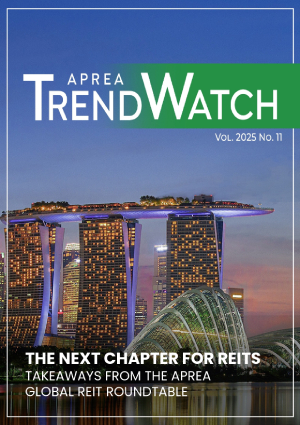
The Next Chapter for REITs: Takeaways from the APREA Global REIT Roundtable
Asia Pacific REITs are showing renewed momentum, with rising index performance, signs of recovery in key markets, and growing interest in sectors such as logistics, data centres, hotels, and healthcare. Technology and AI, better portfolio diversification, and increased focus on ESG are reshaping REIT strategies and narrowing the gap with US and European peers.
In our latest issue of APREA TrendWatch, we unpack these themes to show how APAC REITs are evolving from purely income-focused vehicles into dynamic platforms for long-term growth, innovation, and resilience.
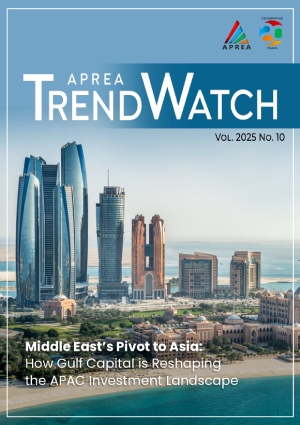
Middle East’s Pivot to Asia: How Gulf Capital is Reshaping the APAC Investment Landscape
Institutional investors from the Middle East are pivoting towards the Asia Pacific, channeling capital into real assets as part of long-term diversification, supported by urbanization trends and evolving policy frameworks. The flow is increasingly strategic and theme-driven, with examples spanning renewable energy platforms, targeted infrastructure financing, and rapid build-outs of data centers and AI-related infrastructure, alongside deep partnerships that improve governance and unlock co-investment.
In our latest issue of APREA TrendWatch, we explore how the Middle East–APAC corridor is reshaping markets, where capital is going next, and what it means for investors.
How Nature-Based Solutions Future-Proof Asia Pacific Real Assets
Nature-based solutions (NbS) are actions that work with and enhance natural systems to address climate, social, and economic challenges. They can include on-site measures such as green roofs, rain gardens, and permeable pavements, as well as larger-scale interventions like wetland restoration, mangrove rehabilitation, and urban forests. NbS can deliver multiple benefits like improving resilience against the effects of climate change, enhancing biodiversity, and providing people with green space, delivering positive impacts to well-being. In Asia Pacific, where rapid urbanisation and climate risk converge, NbS are vital for future-proofing real assets whilst delivering positive environmental and social outcomes.
The real assets sector is deeply dependent on stable, functioning natural systems for clean water, and climate regulation. As the effects of climate change increase in frequency and intensity, this dependency translates into material risks: flooding, landslides, drought, heat stress, and ecosystem degradation that directly degrade asset performance and value.
NbS are increasingly recognised across ASEAN as a cost-effective response to climate change, offering both mitigation and adaptation benefits.
At the site level, urban NbS can provide measurable benefits. Green roofs and living walls lower energy demand by insulating buildings and reducing the urban heat island effect. Rain gardens and bioswales improve stormwater management, cutting flood risk and lowering maintenance costs. For example, constructed wetlands and rooftop farms in Bangkok have proven to reduce runoff by up to 85% while lowering surface temperatures by several degrees. Such measures not only reduce operational costs but also help properties meet tightening building codes and ESG requirements, unlocking access to green finance.
Beyond individual assets, landscape-scale NbS are crucial for long-term resilience, and there are some prime examples already across the region. Restoring mangroves along coastlines in Vietnam and the Philippines provides natural flood protection while supporting local livelihoods. Similarly, wetland restoration around Manila Bay delivers flood protection valued at more than 30 times the annual investment cost. These ecosystem-level interventions safeguard entire catchments and urban regions, indirectly protecting the value and viability of real assets across the APAC region.
Importantly, evidence from within the real asset market shows us that NbS integration creates tangible financial upside. Buildings with strong green credentials and nature access consistently command rental and sales premiums of 5–10%, higher occupancy rates, and better resilience against insurance cost increases. In a region where climate risk threatens to turn non-resilient properties into stranded assets, NbS are emerging as both a defensive strategy and a driver of competitive advantage.
To begin integrating NbS, asset owners should take a phased, practical approach:
Build the business case – Assess site-specific climate and nature-related risks and quantify opportunities for operational savings, asset value enhancement, and financing access.
Engage Cross-Functional Teams – Maximise feasibility by ensuring buy-in from across the organisation—including finance, engineering, and operations—from the very beginning of the business case.
Start small and with curiosity – Pilot on-site solutions such as modular rain gardens, vertical greening, or rooftop vegetation. These low-cost interventions provide proof of concept and momentum for scaling.
Collaborate for impact – Partner with governments, NGOs, and academic institutions to co-design projects, access technical expertise, and align with regulatory incentives.
Design for multiple benefits – Prioritise multifunctional NbS that deliver cooling, flood management, biodiversity, and community value within limited urban space.
Measure Success – To capture the full value of NbS projects, be prepared to measure success beyond traditional metrics, by utilising both qualitative and quantitative tools.
Nature-based solutions are no longer optional enhancements; they are central to the resilience, performance, and long-term profitability of real assets in Asia Pacific. From small on-site designs to landscape-level ecological restoration, NbS offer a cost-effective path to align real estate portfolios with climate imperatives, regulatory shifts, and investor expectations. Real asset owners who act now will not only protect against mounting climate risks but also position themselves at the forefront of a nature-positive, future-ready economy.
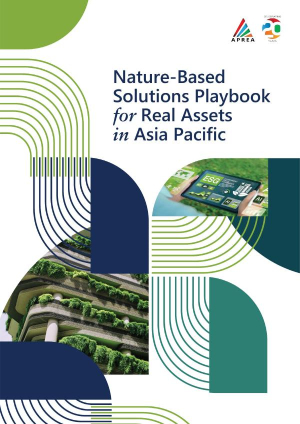
For more information, check out APREA’s “Nature-Based Solutions Playbook for Real Assets in Asia Pacific” a comprehensive guide detailing the business case and strategic frameworks for embedding NbS to unlock long-term value and enhance resilience for the real assets industry.
What’s Happening (and What’s Next) in Automotive Retail Real Estate? (CBRE)
Recent years have seen the global automotive industry grapple with an array of challenges including supply chain disruption, the ongoing transition to and subsequent slowdown in EV sales, evolving consumer requirements; and, most recently, escalating geopolitical tension and tariffs.
Other hurdles include a need to comply with 2030 net zero and sustainability targets (for manufacturers continuing to build petrol engine cars) and regulatory requirements related to new technologies such as connected and autonomous vehicles.
Labour shortages and a widening skills gap pose further challenges, as auto firms struggle to recruit employees with new and sought-after technical skills such as those related to EV technology, software, and data analysis.
Against this backdrop, many auto firms in Asia Pacific are reorganising operations, reducing headcount, and engaging in M&A activity and strategic partnerships; a process that is inevitably reshaping their commercial real estate requirements.
Explore the shifting dynamics of the region’s real assets landscape amid evolving economic conditions. The study identifies both cyclical and structural investment opportunities, emphasizing resilience, innovation, and sustainable growth as key priorities for investors.
Offices in markets such as India, Australia, and Japan could offer an attractive entry point with rental growth prospects looking more positive. Core assets with proximity to amenity and public transport are increasingly sought after, with the gap in occupier preference for centralised and decentralised locations widening.
Industrial & logistics assets in locations with higher potential for manufacturing occupier demand, such as Southeast Asia and India are expected to outperform. Dry logistics in Korea will continue to capture investors’ interest. E-commerce continues to evolve, helping to drive demand for logistics space in fast adopting markets.
While retail demand has been more conservative due to global trade uncertainty, most markets are expected to see rent growth continue in 2025 and 2026. Tailwinds include population growth and rate cuts in Australia; solid tourist arrivals offsetting slower domestic consumption in Japan and Korea; and strong leasing demand from local retailers in India.
Living sector demand continues to accelerate despite the limited scale of this asset class in Asia Pacific. Investors are advised to stay focused on established markets such as Japan, where cash-on-cash yields remain attractive and vacancies remain low. Other options include developing or acquiring projects for build-to-rent or student accommodation in markets with significant supply shortfalls, such as Australia and Hong Kong SAR.
Data centres continue to grow as a primary investment option for investors in Asia Pacific. With demand for AI strengthening, supply across most markets in Asia Pacific is projected to be unable to meet demand. Opportunities for investment in tier I markets such as Japan, Australia and Korea will continue to surface as operators look to recycle assets, while development partnerships will remain an option in growing Southeast Asian markets.
Kemmu Kawai joined Longevity Partners Japan in September 2022 as the Country Director. Based in Tokyo, he oversees all operations and activities in Japan, the Asia-Pacific region and beyond. He brings him more than 16 years of experience in finance where he specialised in real estate and credit investments. Before joining Longevity Partners, he served as a Portfolio Manager at Norinchukin Bank and as Investment Manager at Center Point Development.