SS&C Intralinks’ new report, Gender Diversity and Dealmaking 2022, draws on data from more than 11,000 M&A deals announced between 2010 and 2021 and features commentary from senior dealmakers to understand this trend.
Download the new report to understand:
Why women CEOs outperformed men during the pandemic on post-deal share price, ROE, EBIT/sales and EBITDA/sales
How short-term investor reaction to deals announced by female leaders has slightly improved since our first report
Innovative female CEO M&A strategies and decision-making, such as managing risk by leveraging more advisors and structuring cash-only or all-stock deals
Significant gender-based differences in acquisition target types and deal processes
Why the pandemic has improved perceptions of female CEOs and diversity
To address climate change, leading real estate funds and companies around the world are setting decarbonization and net-zero targets. These targets can differ widely and consist of many elements, and some may be more credible than others. In this report — which builds on our net-zero report for companies, “Breaking Down Corporate Net-Zero Climate Targets” — we outline an approach for evaluating real estate funds’ and companies’ decarbonization and net-zero targets. It aims to help the industry set net-zero commitments, as well as support asset owners in evaluating decarbonization targets of companies and funds they invest in. It argues that best practices for decarbonization and achieving net-zero are:
Comprehensive: Include all significant sources of emissions, even those that may be hard to quantify, including Scope 3 emissions from tenant-controlled energy use and development activities.
Ambitious: Pursue absolute reductions in the short and long term, in line with accepted, science-based pathways.
Feasible: Demonstrate progress toward goals, supported by a robust business strategy
Environmental, Social and Governance (ESG) integration is no longer a choice today. In the global Race to Zero[1], led by UNFCCC, over 5,200 businesses, 1,040 cities and 440 investors have stepped up their ambition and joined the global alliance to catalyse climate change. Following COP26, over 90% of global GDP has committed to achieving net zero by or near mid-century.[2] According to the 17th Edition of the World Economic Forum Global Risks Report, environmental risks were perceived to be the five most critical long-term threats over the next 10 years.[3] Climate risks are investment and business risks – the damage caused by climate change is projected to result in an increase of up to 41% of global property premiums until 2040.[4] With the building and construction sector accounting for about 40% of global carbon emissions[5], the real estate sector is in a prime position to advance sustainable development.
Integration: Strong Fundamentals for Business and Climate Resilience
City Developments Limited (CDL)’s ESG strategy stems from its corporate ethos, “Conserving as we Construct” established in 1995. Its value creation business model is anchored on four key pillars—Integration, Innovation, Investment, and Impact; guiding CDL to achieve three key deliverables: “Decarbonisation”, “Digitalisation & Innovation” and “Disclosure and Communication”. The CDL Future Value 2030 sustainability blueprint, implemented in 2017, maps out clear strategic goals and ESG targets across CDL’s business strategies and operations.
CDL’s sustainability portfolio reports directly to the Board Sustainability Committee with ESG factors effectively integrated into its business, operations and growth strategy. In 2018, the CDL Group introduced its G.E.T. strategy—focusing on Growth while adopting an ESG lens, Enhancement of assets to drive operational efficiency and Transformation to deliver long-term and sustained value.
Innovation: Scaling up Sustainable Technologies for a Green Revolution
Recognising that innovation is a key accelerator of climate solutions, CDL set up a Green Building & Technology Application team in 2020. The team collaborates with the organisation’s Enterprise Innovation Committee, leveraging cutting-edge technology to reduce CDL’s carbon footprint in the way it designs, builds, and manages its assets.
To advance circularity solutions, CDL is studying the feasibility of advanced low-carbon construction methods and materials to reduce embodied carbon. To do this, CDL has ramped up on buildable designs moving towards less labour-intensive processes, and focuses on Integrated Digital Delivery and Design for manufacturing and Assembly (DfMA) technologies. Through this, CDL can reduce reliance on on-site workers, enhance workplace safety and health, and drive productivity improvements in construction and facility management.
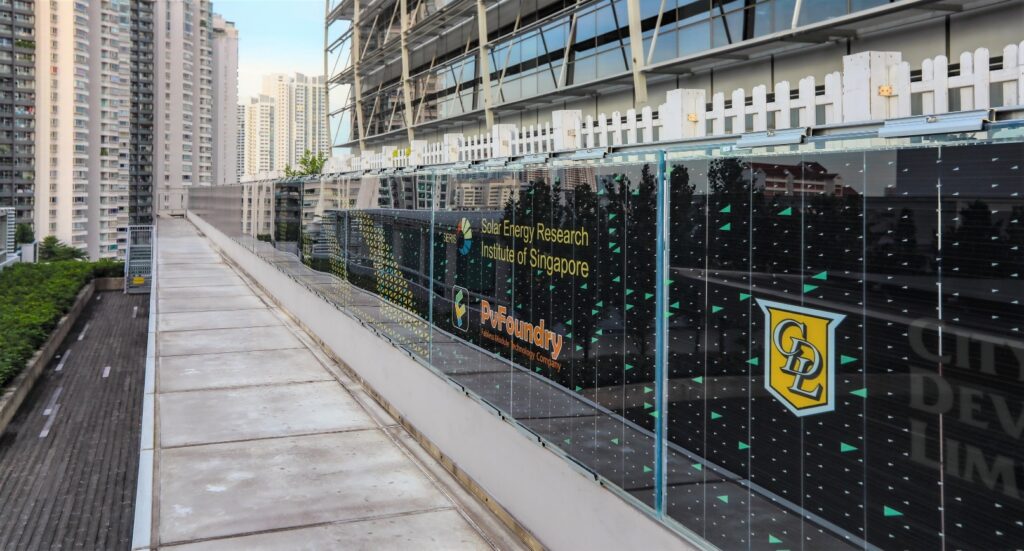
CDL also capitalises on the power of cross-sector partnerships to develop low-carbon technologies. The company has partnered with the Solar Energy Research Institute of Singapore to pilot Building-Integrated Photovoltaics (BIPV) modules and panels at various developments. The pilot on Bifacial BIPV panels with prints at CDL’s Sustainability Academy aims to optimise aesthetic value whilst generating power.
CDL and SERIS piloted a new generation of PV art wall (bifacial BIPV panels) at the Singapore Sustainability Academy at City Square Mall in 2020. This serves as a testbed for more efficient PV Installations
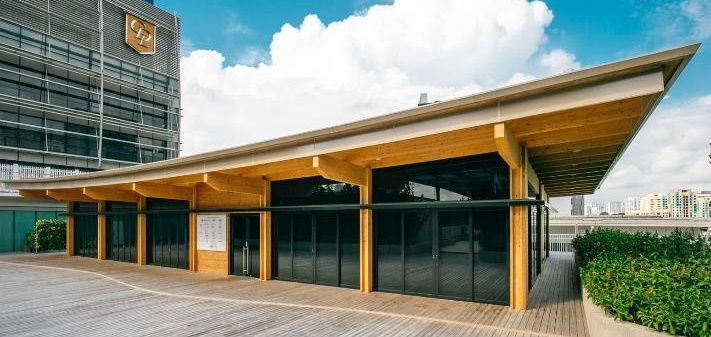
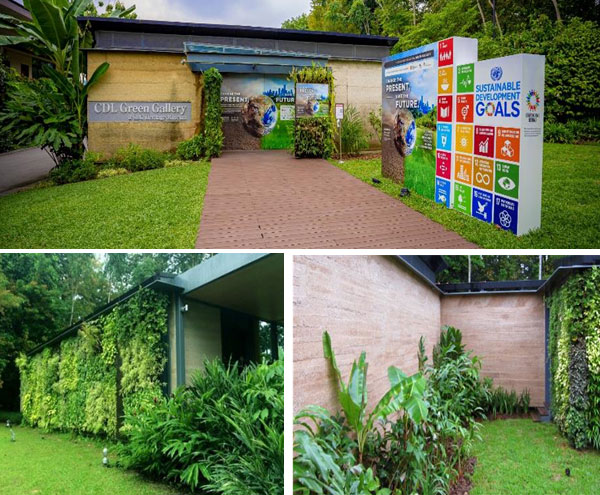
In order to achieve a net zero world, zero energy buildings are the way forward. To date, CDL has built two net zero facilities using eco-friendly technologies—the Singapore Sustainability Academy (SSA) and the CDL Green Gallery at the Singapore Botanic Gardens. The SSA, a BCA Green Mark Platinum-certified building, is the first in Singapore to have its construction materials, Cross Laminated Timber and Glued Laminated Timber, verified by the Nature’s BarcodeTM system as coming from responsible sources.
The SSA is the first ground-up initiative and zero-energy facility in Singapore dedicated to capacity building and thought leadership for climate action. Since its opening in 2017, it has tapped on 3,200 sq ft of solar panels on its rooftop as its energy source. The entire facility is built with over 80% of structural materials that come from sustainable sources.
In February 2021, CDL became the first real estate conglomerate in Southeast Asia to sign on to the World Green Building Council’s (WorldGBC) Net Zero Carbon Buildings Commitment. At COP26, CDL was one of 44 pioneering companies to expand its commitment towards a net-zero whole life carbon-built environment. Through this commitment, CDL pledged net zero operational carbon by 2030 for its new and existing wholly-owned assets and developments under its direct operational and management control. This also entails a reduction in embodied carbon and compensating residual upfront emissions via offsetting for new developments by 2030 and for all buildings to be net zero carbon by 2050.
To move towards a low carbon economy, CDL has aligned itself with even more ambitious carbon emissions reduction targets that have been successfully assessed and validated by Science Based Targets Initiative (SBTi) in 2021, in line with a 1.5°C warmer scenario. CDL was the first Singapore real estate company to validate its targets by SBTi for a 2°C warmer scenario in 2018.
The CDL Green Gallery is built with several eco-friendly technologies, including two innovative features – the biomaterial known as Hempcrete (largely made from the hemp plant) and a prefabricated modular system.
Investment: Building Leverage for the Future via Sustainable Finance
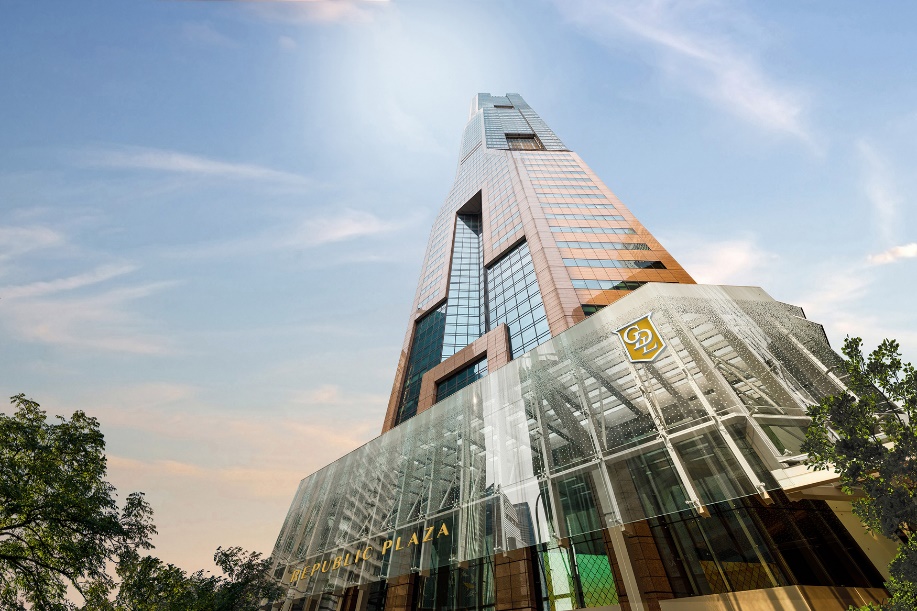
CDL’s Republic Plaza Green Bond was the first green bond issued by a Singapore company in April 2017.
CDL has secured more than $3 billion worth of sustainable finance, in the form of various green loans, a green bond, and a sustainability-linked loan, to help accelerate its green building action. It takes pride in issuing the first green bond by a Singapore company in 2017, which has helped to tap into alternative financing streams. In September 2021, CDL secured a discount for the SDG Innovation Loan provided by DBS Bank Ltd, for its successful R&D and pilot of digiHUB. This enabled CDL to be the first Singapore entity to achieve a discount on a sustainability-linked loan through the adoption of an innovative project that supports the SDGs on a large-scale basis.
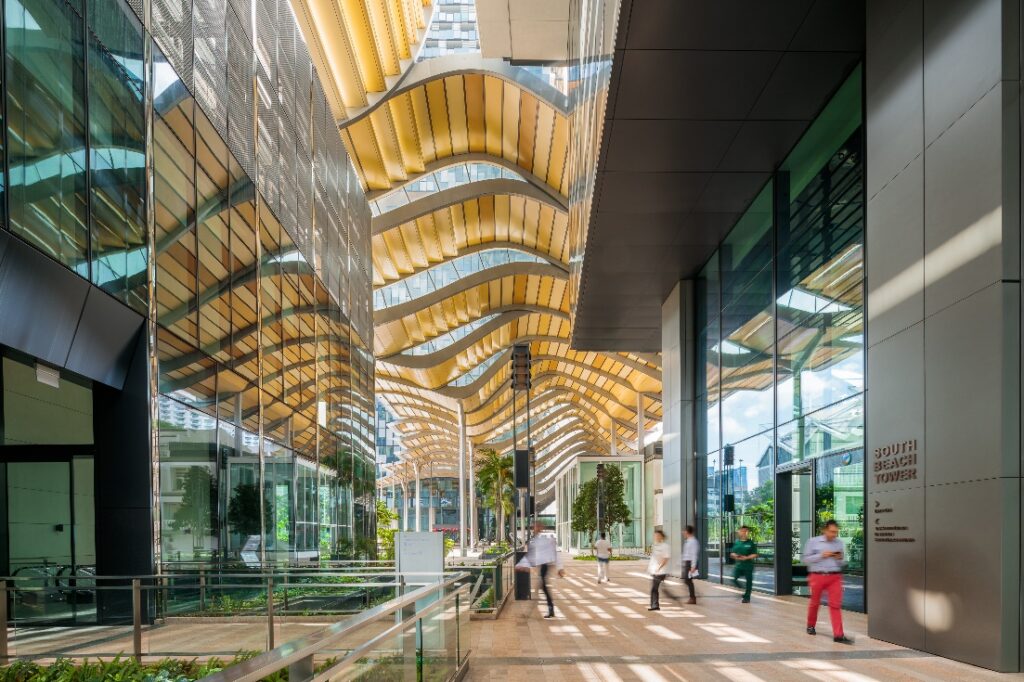
At CDL’s mixed-use development South Beach, PV panels have been installed at the tower roof and louver modules, covering a total area of approximately 1,800 m2.
What gets measured gets managed—CDL’s longstanding experience in ESG disclosure and sustainability has helped it identify gaps and improve its ESG performance. Its robust ESG integration and disclosures are widely recognised by 13 global ratings, rankings and indexes, including double ‘A’s in the 2021 CDP Global A List for corporate climate action and water security.
CDL is honoured to have achieved its best performance in the Corporate Knights’ 2022 Global 100 Most Sustainable Corporations in the World, jumping from 40th place in 2021 to 5th position this year. In addition, it has maintained its ranking as the world’s top real estate management and development company and Singapore’s top sustainable company for the fourth consecutive year, and has been the first and only Singapore company to be included in the renowned index for 13 consecutive years.
The race to zero requires conviction and engagement with all stakeholders. After two decades of integrating ESG into our business, we have captured growth opportunities while mitigating ESG risks, enhancing value for our investors, communities, and the planet.
Across the Asia Pacific, what are companies doing to achieve NET ZERO carbon emissions?
APREA’s latest issue of Knowledge Brief, The Race to Net Zero, gathers thought leaders in the region, from real estate developers and investors to assets managers and technology providers, providing insightful perspectives and best practices on how businesses and stakeholders in the real assets sector can embark on a journey to #sustainability.
What will 2022 and the next decade bring? In recent years, climate change has come to surpass corporate governance as the most pressing ESG issue commanding investors’ attention, and ESG investing truly has gone mainstream (and is attracting the regulatory attention to prove it). Yet there are new risks emerging for companies, investors and the planet in the coming decade that will test how well we have learned the lessons of the past.
In Conversation with Seth Tan, Infrastructure Asia, on ESG in Infrastructure Projects – Sustainability Update by Rajah & Tann Asia
Rajah & Tann’s Sustainability Practice brings to you the inaugural issue of the Sustainability Updates which shares with you insights distilled from conversations between our Sustainability Partners and experts across sectors and domains on key environmental, social and governance (“ESG”) developments and trends. In this issue, Lee Weilin and Soh Lip San, our Partners with the Sustainability Practice, explore ESG issues in infrastructure projects by speaking with Seth Tan, Executive Director of Infrastructure Asia (“InfraAsia”), on his views on green and sustainable infrastructure and ESG factors for bankable projects in the region.
Rajah & Tann’s Sustainability Practice brings to you the inaugural issue of the Sustainability Updates which shares with you insights distilled from conversations between our Sustainability Partners and experts across sectors and domains on key environmental, social and governance (“ESG”) developments and trends. In this issue, Lee Weilin and Soh Lip San, our Partners with the Sustainability Practice, explore ESG issues in infrastructure projects by speaking with Seth Tan, Executive Director of Infrastructure Asia (“InfraAsia”), on his views on green and sustainable infrastructure and ESG factors for bankable projects in the region.
APREA advocates the adoption of ESG and Sustainability Best Practices in the real assets industry. Making sustainable investment decisions is increasingly a part of APREA members’ DNA, and APREA is committed to be at the forefront of that transition to a net-zero world.
APREA advocates the adoption of ESG and Sustainability Best Practices in the real assets industry. Making sustainable investment decisions is increasingly a part of APREA members’ DNA, and APREA is committed to be at the forefront of that transition to a net-zero world.
Recently, APREA together with its ESG and Sustainability Committee conducted an ESG Member Survey to find out real assets companies’ sentiments towards their implementation of ESG.
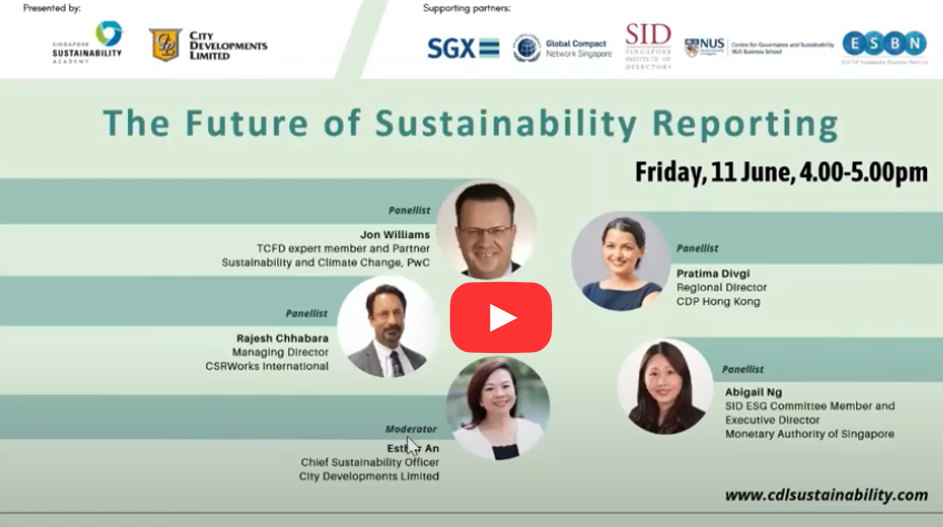
ESG developments and reporting trends 2021 – Fireside chat with Esther An, Chief Sustainability Officer, City Developments Limited
Now more than ever sustainability and ESG topics are coming to the forefront across the globe from a diverse group of stakeholders including employees, customers, suppliers, communities, investors and regulators. Driven in part by the Covid-19 pandemic, there is a focus on employee health & safety, supply chain resilience, and corporate culture, along with growing concerns on climate risk to reputation and the associated impact on corporate value creation.
Following the ESG webinar jointly presented by DFIN (Donnelley Financial Solutions), SGX RegCo and industry leaders in October 2020, DFIN’s John Truzzolino, Director of Corporate Governance Services continued the dialogue with Esther An, Chief Sustainability Officer of City Developments Limited (CDL). Esther is an active advocate for green building and sustainability, she spearheaded the publication of the first sustainability report using GRI standards in Singapore in 2008. Today, CDL is ranked as a top real estate company on the Global 100 Most Sustainable Corporations in the World 2020 list.
Watch the full interview to learn more about CDL’s sustainability journey, and hear Esther’s suggestions to businesses on driving preparedness for climate change, improving investor communications and creating decision-useful disclosures in the post-pandemic era.
MSCI Investment Insights 2021 Global institutional investor survey
Many institutional investors are facing their greatest challenges for many years. They are transforming their investment processes at high speed to reflect today’s imperatives, such as environmental, social and governance (ESG) investing, innovative technology, ever-shifting regulations and demands for greater transparency. Yet they must do this in a complex and unstable financial environment. I compare this challenge to changing the sails and masts of a ship as it is battered by a storm. For this report, we surveyed 200 asset owners (pension funds, insurers, sovereign wealth funds and endowments/foundations) owning assets of around $18 trillion. Reading it, I was struck by how the pandemic has further accelerated the shift to ESG. Asked for the top 3 trends that will affect their organization over the next three to five years, 62% cited either climate change or the increasing complexity of ESG measurement — far ahead of other themes such as market volatility and regulation. But it is not the only transformation. A new wave of data technologies is bringing very significant changes to investment processes. These technologies open the door to new ways of understanding markets and increasing efficiency.
Kemmu Kawai joined Longevity Partners Japan in September 2022 as the Country Director. Based in Tokyo, he oversees all operations and activities in Japan, the Asia-Pacific region and beyond. He brings him more than 16 years of experience in finance where he specialised in real estate and credit investments. Before joining Longevity Partners, he served as a Portfolio Manager at Norinchukin Bank and as Investment Manager at Center Point Development.