APREA Logo

Knowledge Hub

The guide tracks 37 key data centre locations across Asia Pacific with a comprehensive breakdown of costs covering land acquisition, advanced land clearance and demolition works, base build and fit-out construction costs. It offers a comprehensive analysis of the Asia Pacific data centre landscape, including key trends that are shaping the region’s data centre sector. This is the first year that Cushman & Wakefield has published its data centre development cost data.

The urban area and its associated design, planning, development and operation, plays and will continue to play a big role in bringing transformational change to address the changing way we live as well as our changing climate. To bring about beneficial living and urban environmental sustainability change that results in sustainable urban environs, in this report we will look at the following topics:

  • A Change for the Good
  • The 15-Minute City
  • Urban Public Space
  • Transit-Orientated Development
  • Ecological Solutions
  • Net-Zero Buildings

Key Takeaways

To hike sustainability and bring about beneficial urban environmental sustainability change that results in walkable sustainable urban environs, one concept cities in Asia Pacific can look to adopt and implement is the ‘15-minute city’ concept.

The 15-minute city is a fresh concept that promotes both urban environmental sustainability and urban livability.

When specifically considering urban public space in the Asia Pacific region in relation to sustainable 15-minute city urban environs, the aim for local governments is to generate all-inclusive citizen-friendly settings that are also economically workable.

To interconnect sustainable 15-minute urban environs, it is essential for cities in general, including those in Asia Pacific, to have a well-planned and efficient overall public transport system that is easily accessible, is convenient and cuts both journey times and air pollution levels for all their citizens.

The 15-minute city concept also places much emphasis on the need for greater food production via urban agriculture.

Finally, in order to reduce the amount of energy used by, and carbon emissions from, buildings in the Asia Pacific region, including buildings in walkable 15-minute city precincts, it will additionally be important to take the next step and go carbon neutral, which requires a “carbon balance” to be established.

Singapore’s retail e-commerce market is projected to grow at a 9.9% CAGR from 2022 to 2027, from S$5.8 billion in 2022 to a size of S$9.2 billion in 2027. Emerging trends such as shopping festivals, live selling and online grocery shopping have presented unique challenges for businesses in managing their logistics supply chain. With the adoption of omnichannel retail models and the outsourcing of last mile deliveries to 3PLs, the need for strategically located warehouses becomes paramount.

This report seeks to explain how the logistics sector is positioned to capture e-commerce demand, as well as potential recommendations for landlords and occupiers as they seek to future proof their logistics real estate portfolio.

This report was originally published in https://www.cbre.com.sg/insights/reports/the-evolution-of-e-commerce-and-its-impact-on-singapore-logistics-real-estate

With carbon reduction deadlines looming and regulations tightening, more businesses are adopting fast-evolving technologies to measure, monitor and manage their emissions and guide future sustainability decisions.

Sustainability technologies will account for the biggest share of increased tech budgets for both occupiers and investors over the next three years, according to JLL’s survey of 1,000 companies. Over two thirds of occupiers say tech that helps them to manage and report on their sustainability progress is a top budget priority.

Globally, 45% of occupiers and 62% of investors surveyed plan to adopt energy or emissions management tech in the coming year. Another 62% of investors are interested in tech that supports sustainability monitoring and reporting while evaluating climate risk in portfolio planning is an emerging area.

“Tech is a critical enabler for companies to better understand how they’re doing in terms of their net zero goals through from flagging risks in their portfolio to monitoring their day-to-day operations,” says Ramya Ravichandar, Vice President, Technology Platforms – Smart & Sustainable Buildings at JLL.

“There’s now a mature market to address companies’ sustainability reporting and management needs and ensure they can comply with incoming public disclosure regulations such as California’s new Climate Corporate Data Accountability Act.”

More than three years after the onset of COVID-19, Singapore retail sales have recovered and exceeded pre-pandemic levels. However, foot traffic and retail rents have yet to fully recover. CBRE’s proprietary study finds that consumers are now visiting malls less frequently but for longer durations. Consumption patterns have also changed, driven by the proliferation of e-commerce, rising income levels and increased focus on wellness and ESG.

This report identifies the main trends shaping Singapore’s retail property market in the post-pandemic era and provides recommendations for retail occupiers and landlords to navigate the structural shifts and cyclical recovery of Singapore’s retail market. Government initiatives, the return of tourist spending and a wider selection of locations are also providing opportunities to all stakeholders.

This report was originally published in https://www.cbre.com.sg/insights/viewpoints/singapore-retail-in-the-post-pandemic-era-trends-and-opportunities

Key findings:

  • Australia: Across almost all the Australian cities covered, cap rates in all sectors exhibited an upward movement quarter-on-quarter. Industrial assets in Australia with long lease expirations and low fixed-term rent experienced downward pressure on values during the last quarter.
  • China: In China, investment activity remains subdued with only individual investors and insurance institutes actively seeking out discounted assets and adopting a cautious approach to investment. This has resulted in subdued market sentiment in the property sector for Beijing and Shanghai compared to Q2. To vitalize the market environment, the central bank of China has been lowering the Loan Prime Rate (LPR) to alleviate the burden on loans, with the objective of unlocking resources for consumption and promoting nationwide GDP growth. In Beijing and Shanghai, the industrial sector experienced a wave of new supply as the take-up of existing stock slowed down. The government’s release of more industrial and logistics land resulted in an augmented supply in the market.
  • Hong Kong: Hong Kong interest rates have continued to gradually increase over the past year. Asset values are under increasing downward pressure, which is beginning to be reflected in pricing. Vacancies remain high and rental prices experienced downward pressure across all sectors.
  • India: In Bengaluru, Q3 office transaction volumes remained similar to the previous quarter, with a few transactions driven by individual investors as institutional players were less active. Deal sizes were smaller but more resilient, resulting in a marginal downward change in the cap rate in the office segment. In Mumbai, the retail sector is anticipated to gain traction in the near future, driven by demand from the luxury segment and the release of additional supplies of quality organized retail assets. Mumbai industrial demand remained strong in Q3, and the compression in the cap rate was attributed to lower availability of Grade A stock, coupled with a positive outlook from large institutional investors towards the sector. The investors were willing to trade off lower current yields for anticipated future growth in the sector.
  • Japan: Some investors may consider Japan a risk averse market for real estate investment since the start of the interest rate hike, primarily due to its relatively accommodative monetary policy. The sales volume of foreign investments in real estate has yet to witness a significant increase, although sentiment and interest remain strong. The Tokyo office sector performed well in Q3, with occupancy rates remaining at a healthy level, especially when considering the challenges faced by some other cities in terms of take-up. This is driven by the return to office culture – government statistics indicate that the hybrid working ratio in Tokyo was 44% in mid-2023, down from a peak of over 64% in 2021.
  • Korea: Seoul office assets remain in high demand, with rental levels holding firm for landlords. However, there is increasing downward pressure on values due to a lack of liquidity in the market.
  • New Zealand: In Auckland, there has been upward movement for more than a year in the office sector. Transactional activity remained subdued over the last quarter as investors continued to take a cautious approach to the market. The Reserve Bank of New Zealand has maintained a steady Official Cash Rate in its last three monetary policy meetings, indicating that rates are at or near their peak in the current cycle. With interest rates stabilising it is anticipated that greater clarity over asset pricing will emerge. This, in combination with the election having been completed, is likely to result in an uplift in sales activity during the final quarter of 2023 ad into 2024.
  • Singapore: Cap rates across sectors remain subdued, with a lack of sales evidence to support movement. Increasing lending costs are putting pressure on many investors and owners. However, there are other investors with deep pockets who are taking advantage of this opportunity to acquire assets for long-term investment.

The real estate market has experienced a significant change due to the global inflation and rise in interest rates in the last two years. Moreover, the sector has been undergoing a transformation driven by technological innovations, which has changed the outlook and expectations of the market participants. In response to the persistent inflationary pressures, the regulators in the APAC region have adopted various measures to protect the stability and integrity of the real estate market in Q2 of FY24.

One of the common themes across the region is the implementation of stricter anti-money laundering rules, which aim to increase the transparency and accountability of the transactions. For example, Australia, India, Singapore and Japan have all introduced new or enhanced regulations to combat money laundering in the real estate sector.

Another trend that is shaping the real estate market in the APAC region is the growing emphasis on environmental sustainability and social responsibility. Many developers and builders are adopting net zero targets and improving their ESG credentials by incorporating green technologies and practices into their projects. This not only reduces the environmental impact of their operations, but also creates value for their customers and stakeholders by enhancing energy efficiency and reducing energy costs. Therefore, by aligning their strategies with tech-enabled initiatives, they are creating a more resilient and competitive market.

These developments indicate that the APAC region is preparing for a new era of opportunities and challenges for investors and developers in the housing and commercial real estate sectors. The regulatory updates in Australia, India, Japan, China, Singapore and Hong Kong provide a framework and guidance for navigating the changing market conditions and expectations. They also reflect the diversity and dynamism of the region, which offers a range of prospects and potentials for diverse types of real estate investments.

In this edition of APREA Real Assets Bulletin, we have covered the regulatory updates pertaining to green transformation in real estate, tech-led strategies and initiatives adopted to streamline the real-estate transactions, and risk-mitigation measures undertaken by APAC economies through anti-money laundering measures for safeguarding the real estate sector.

The electric vehicle (EV) market in Asia Pacific has grown significantly over the past two years, with the region accounting for nearly two-thirds of global EV sales in 2022. 

As EV adoption continues to gather pace, demand for public charging infrastructure in Asia is also rapidly increasing, primarily due to the prevalence of apartments where the installation of private chargers is subject to regulatory restrictions and administrative barriers.

The growing number of EVs in Asia Pacific will require a significant increase in charging facilities. CBRE estimates the number of public charging points across the region will rise from around 2 million in 2022 to around 10 million by 2030.

All of these converging trends present a significant opportunity for real estate owners and investors to gain access to or expand their presence in the EV public charging infrastructure market.

This report was originally published in https://www.cbre.com/insights/reports/how-will-electric-vehicles-impact-real-estate-in-asia-pacific

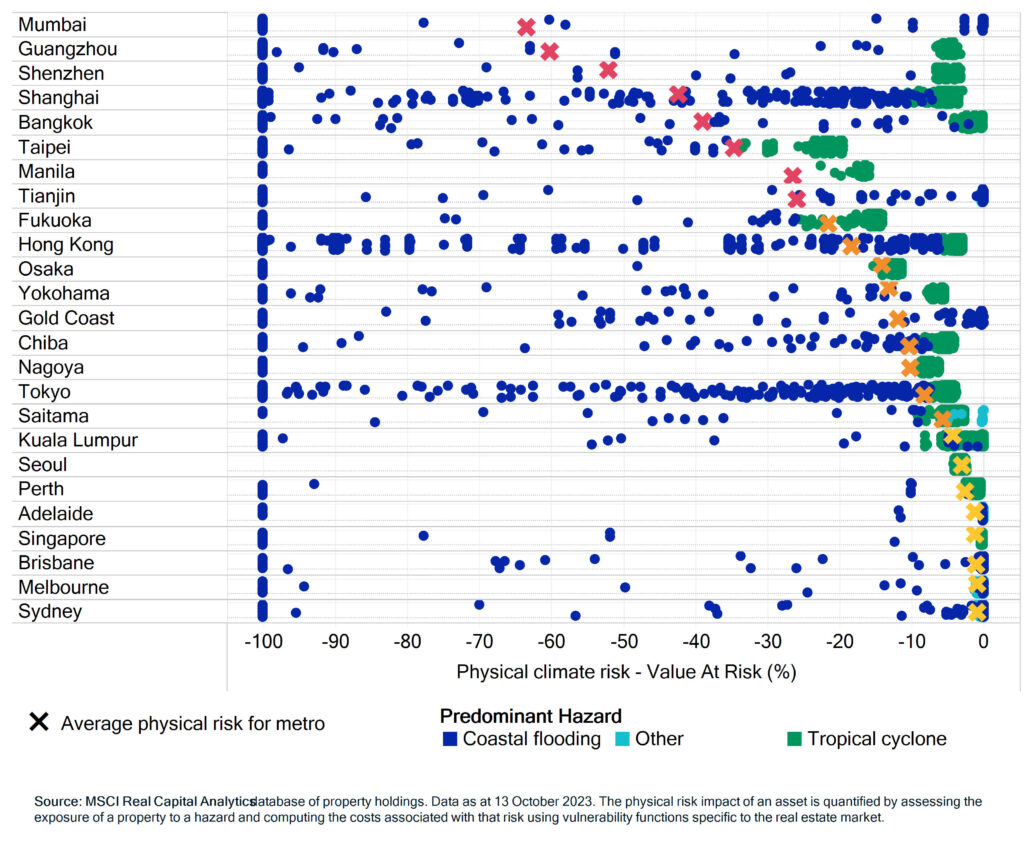
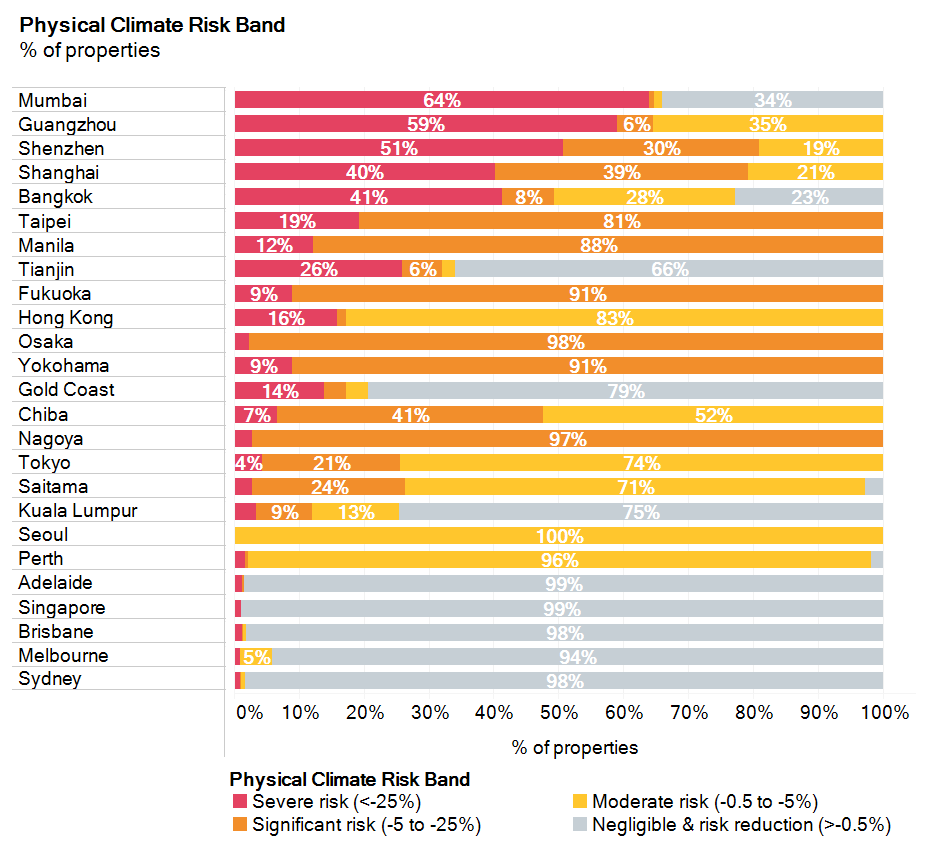
Applying climate analysis to MSCI’s Real Capital Analytics database of global property holdings, we can see a broad range of aggregated physical climate risks across real estate in selected Asia-Pacific cities. As we previously showed for cities worldwide, these risks were not equally distributed within each city.

Once again, location and topography were decisive factors behind the impact of physical climate change, reinforcing the idea that investors may wish to consider climate risk at the individual asset level, rather than relying solely on market-level data.

The charts below illustrate Average physical risk vs. risk distribution across major Asia-Pacific metros

Physical Climate Risk

Average for metro and asset-level

Physical Climate Risk Band

% of properties

Niel Harmse

Vice President
MSCI Research ×

Niel Harmse

Vice President
MSCI Research

Niel Harmse works on the real estate-solutions research team. He focuses on performance measurement, portfolio management and risk-related research for asset owners and investment managers. Prior to joining MSCI, Niel was an investment analyst at Old Mutual Property and a research analyst at Investment Property Databank. He holds a B.Com in economics and a B.Com, with honors, in econometrics from the University of Johannesburg.

According to the World Economic Forum, 80% of the buildings today will exist in 2050. The built environment is responsible for about 40% of global CO2 emissions. Retrofitting is the least capital-intensive way to make our existing buildings smarter and more efficient in order to reduce carbon emissions. It is also an effective and efficient way to drive financial outcomes capital and operational changes within the current parameters of a building’s design.