The Debt Funding Gap for Asia Pacific Real Estate (CBRE)
With the Asia Pacific commercial real estate market sitting at the top of the interest rate hike cycle, attention continues to focus upon the sizable volume of outstanding senior loans due to mature; a situation which could lead to a substantial funding gap in the coming years.
CBRE estimates that there is US$257 billion of outstanding senior commercial real estate debt in Asia Pacific, leading to a projected funding gap of US$8.4 billion between 2024-2026.
CBRE expects a funding gap to arise in markets where there is still some degree of capital value decline expected over the next three years. By total volume, Australia will have the biggest funding gap (US$4.6 bln) between 2024-26, followed by mainland China (US$2.9 bln).
The gap will be highly concentrated in the office sector, with CBRE expecting some further repricing over the remainder of 2024.
This report explores the commercial real estate debt market in Asia Pacific and the factors underpinning the debt funding gap in the region, including the markets and sectors that are likely to face the biggest gap, and implications for investors.
Nature Positive: Guidelines for the Transition in Cities (World Economic Forum)
This report, published in collaboration with Oliver Wyman, highlights the pivotal role of cities in leading the global fight against climate change and biodiversity loss. Coordinated city action for nature is not only vital to achieving the goals set by the Global Biodiversity Framework (GBF), but also strategically necessary given the climate-, health- and infrastructure-related urban challenges arising from existing unbalanced relationships with nature and the biosphere.
The pivotal role cooling can play for meeting company ESG objectives
ESG reporting has brought the conversation on “Net Zero” from the halls of multilateral organisations to corporate boardrooms across the world. Over the past decade, companies have been looking to better their ESG records. In India, since 2023, the Securities and Exchange Board of India (SEBI) has mandated the top 1000 listed companies (by market capitalisation) to file a business responsibility and sustainability report (BRSR) that discloses environmental data including energy, emissions, water, and waste. Starting from financial year 2024-2025 ESG disclosures are also applicable for the value chains of the top 250 listed entities (by market capitalisation) on a comply-or-explain basis.
Large corporations can look to cooling systems in their building infrastructure and operations to improve ESG performance across BRSR-defined KPIs of water & energy footprint, associated GHG emissions, circularity of resources, in addition to other social- economic parameters. In India, the buildings’ sector (residential and commercial) is responsible for 33% of total electricity consumption, projected to increase to 55% demand of total electricity generated by 2047. The building and construction sector also accounts for 32% of the total national GHG emissions inventory. Of a building’s total demand for energy, 57% is towards cooling requirements alone. As per the 2023 World Energy Outlook of the International Energy Agency (IEA), India experienced a 21% increase in electricity consumption from space cooling between 2019 and 2022. Being a developing and a rapidly urbanizing country, India expects to see a 1.5-2x increase in area under building construction in 2027, as compared to 2017, which combined with heat generation and Urban Heat Islands (UHI) effect from vehicles, appliances (air conditioners, refrigerators, etc), and decline in tree cover will further increase the electricity demand for cooling.
Businesses, especially those with large campus requirements, have the capacity to, on one hand, adopt innovative building design that incorporates passive measures to reduce the upfront cooling demand on a square metre basis. On the other, they are also well positioned to adopt disruptive cooling technologies such as district cooling/cooling as a service (CAAS) to meet residual cooling demand in a sustainable manner. Tabreed has demonstrated success across several ESG metrics in its existing projects through the Cooling as a Service model. For instance, at Tata Realty’s Intellion Park in Gurugram, Haryana, cooling system designed, built and operated by Tabreed, is able to serve 700 sft of area per ton of cooling to achieve an energy performance index of 70-90 kWh/m2/year.
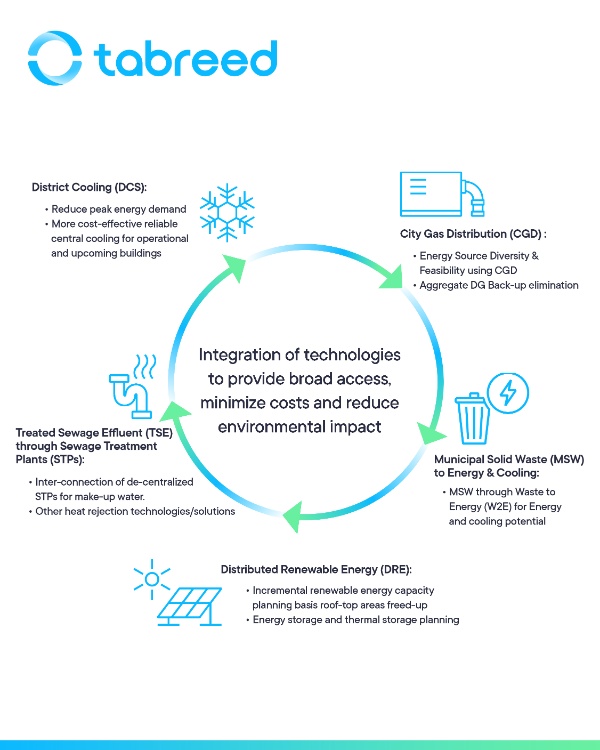
District cooling also allow for integrated solutions that can help achieve ESG requirements beyond energy. For example, district cooling plants can utilize grey water from on-site Sewage Treatment Plants (STP) which is generally discharged straight into rivers and lakes. Similarly, district energy integrated with waste to energy plants & city gas distribution plants can first, allow utilization of waste heat for cooling, second, reduce grid power requirement, and third, replace highly polluting Diesel Generator (DG) sets in case of grid failures by creating redundancy. The possibilities for using district energy as a means to achieve integrated solutions that improve resource efficiency from a systems’ lens are limitless. There is an opportunity here for businesses to not only become more sustainable & cost effective, but truly move the needle on energy and resource efficiency for the country.
Sudheer Perla
Managing Director, Tabreed Asia Country Manager, India, Tabreed
Knight Frank-NAREDCO Real Estate Sentiment Index Q1 2024
The Real Estate Sentiment Index is developed jointly by Knight Frank India and the National Real Estate Development Council (NAREDCO). The objective is to capture the perceptions and expectations of industry players to gauge the sentiment of the real estate market.
The Sentiment Index Q1 2024 highlights a decadal high, indicating heightened market confidence in real estate’s supply side, fueled by India’s strong economic landscape.
While activity remains limited in Australia amid delayed rate cuts, some buyers are returning to the retail sector now that pricing has been reset. The hospitality and living sectors are also attracting interest. H2 2024 will be the optimal buying window as some sellers expect the rate cute cycle to arrive by year’s end.
In Hong Kong SAR, the relaxation of LTV ratios for commercial real estate investment has improved sellers’ confidence and liquidity, leading to fewer discounted and distressed opportunities. More investors are looking at niche sectors such as student housing and data centres as the office market remains under repricing pressure.
Investment volume in Japan was supported by J-REITs and domestic property firms in Q1 2024. However, activity by foreign buyers weakened amid high interest rates globally. Interest in prime offices and hotels remains strong but investors are becoming more selective towards the residential sector.
Korea continues to see improved market sentiment on the back of easing lending rates. Positive carry is expected to occur by the end of 2024 as yields continue to expand and the cost of finance trends down.
Titled “Champion our Ecosystem”, Champion REIT’s Sustainability Report 2023 illustrates a collaborative endeavor that focuses on establishing a value-added network around stakeholders through sustainable performances in line with its 2030 ESG Targets and 2045 Net Zero Commitment.
The report is structured according to local and international regulations and frameworks, including Global Reporting Initiative (GRI) and Task Force on Climate-related Financial Disclosures (TCFD) with independent assurance. In its pursuit of higher standard of information transparency, the report further strengthens its climate-related information in accordance with the International Sustainability Standard Board’s (ISSB’s) IFRS S2 Climate-related Disclosures.
The Power of REITs: Insights into Resilience and Adaptability
Our latest issue of APREA TrendWatch examines the REIT landscape, focusing on insights from the APREA-SGX Global REIT Roundtable.
Ankur Gupta of Brookfield highlighted the resilience and importance of REITs in diversified global portfolios, emphasizing their strong fundamentals and ability to adapt to changing market conditions. He shared the evolution of REITs from niche assets to mainstream sectors, their low volatility, and their challenges, including competition from private funds and regulatory constraints.
We also explored regional perspectives, with Naoki Suzuki of KJR Management and Sanjeev Dasgupta of CapitaLand Investment (India) and CapitaLand India Trust discussing favorable investment climates in Japan and India, respectively, driven by strong rental growth and strategic investments in sectors like data centers and life sciences.
Life Sciences Real Estate – An Emerging Asset Class in Singapore (CBRE)
Singapore is one of the few APAC markets with a full ‘end-to-end’ life sciences value chain that comprises manufacturing, R&D, sales & logistics. Bolstered by supportive government policies, biomedical manufacturing has been the fastest growing among various manufacturing sectors. Strong venture capital funding and a vibrant life sciences startup ecosystem has also accelerated R&D, which has led to stronger demand for labs and expansion of manufacturing production capacity.
To date, Singapore has cultivated life sciences growth through a network of vibrant and strategically located clusters, such as Biopolis, Singapore Science Park, Tuas Biomedical Park and Kallang, giving occupiers a wide variety of options.
Although life sciences properties ranked top among preferred alternative assets for investment, such investible stock remains limited in Singapore. This paper highlights various key strategies in which investors can access the growth of this sector.
Kemmu Kawai joined Longevity Partners Japan in September 2022 as the Country Director. Based in Tokyo, he oversees all operations and activities in Japan, the Asia-Pacific region and beyond. He brings him more than 16 years of experience in finance where he specialised in real estate and credit investments. Before joining Longevity Partners, he served as a Portfolio Manager at Norinchukin Bank and as Investment Manager at Center Point Development.