
APREA Logo

Thought Leadership

On 13th September 2021, the Ministry of Law unveiled the Rental Waiver Framework (RWF) under the COVID-19 (Temporary Measures) (Amendment No 4) Bill. The RWF is expected to commence in October 2021.

During the Phase 2 (Heightened Alert) (P2HA) periods between (1) 16 May to 13 June 2021, and (2) 22 July to 18 August 2021, some businesses were disrupted by the safe management measures imposed to curb the spread of the COVID-19 virus. Under the Rental Support Scheme (RSS) announced in May 2021, the government introduced support measures to alleviate the economic impact on both small and medium enterprises (SMEs), as well as eligible non-profit organisations (NPOs). The support measures included two cash payouts – the first pay-out was to be disbursed starting from 6 August 2021, while the second payout will be disbursed in October 2021.


Table 1: Rental Support Scheme Payout
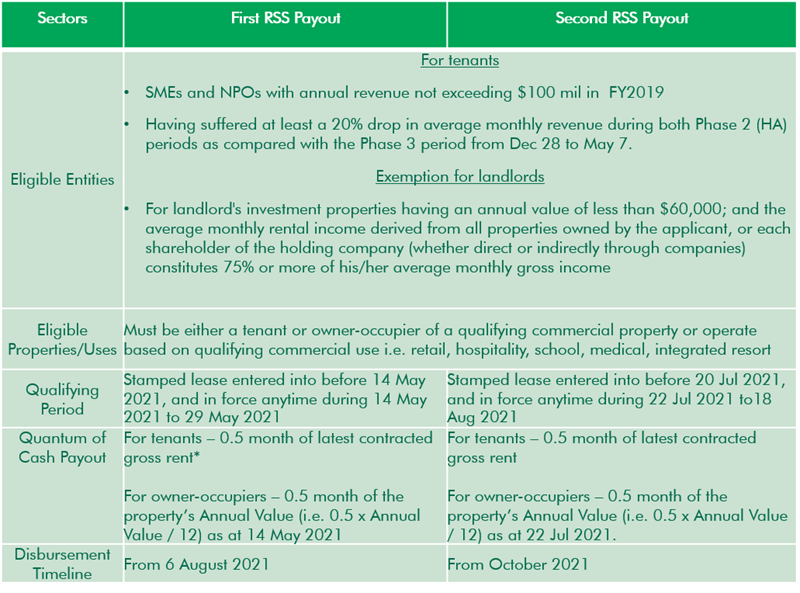
*Note: Gross contracted rent will include gross turnover rent, maintenance fees and service charges. In-kind assistance such as additional advertising or parking promotions cannot be offset.

In addition to the two payouts under the RSS, the RWF stipulates commercial landlords to provide two weeks of rental waiver to eligible SMEs and NPOs affected by the P2HA measures. This aims to ensure the fair co-sharing of rental obligations over the P2HA periods between the government, landlords and eligible tenants.

Table 2: Rental Waiver Framework (RWF)

Together with the one month of rental support in cash, coupled with the two weeks of rental waiver, qualifying tenants in privately owned commercial properties will receive about 1.5 months of rental support in total. This compares to about two full months across the two P2HA periods.

Landlords who have provided rental support to their tenants during P2HA may offset from their rental waiver obligations any direct monetary assistance or rental waivers provided from May 16 up to the date they receive all the tenant’s supporting documents.


CBRE Research Views
The mandatory rental waiver under the RWF is intended to establish a baseline position for the handling of tenants’ rental obligations. Ultimately, it is important for both landlords and tenants to work out mutually agreeable arrangements based on their specific circumstances, as challenges tied to COVID-19 are not a one-off but a long-term process.

The rental payouts and waivers this year can be considered to be more equitable and encompassing. Compared to the Rental Relief Framework in 2020, the latest RWF sets a directive for landlords to waive the 0.5 months of rental definitively. In addition, the payouts and waiver took into account gross turnover rent, maintenance fees and service charges, on top of the base rents.

Overall, the framework helps to ease the cashflow pressure for SMEs and NPOs, in particular those in the retail sector, which have been hit hardest during the pandemic.
 

For further information, please refer to the links below:

Rental Waiver Framework 2021 (mlaw.gov.sg)

Rental Waiver Framework for Businesses Impacted by Phase 2 (Heightened Alert) (mlaw.gov.sg)

IRAS | Government Cash Payout (2021 Rental Support Scheme)

This article was originally published in https://www.cbre.com/

A keen understanding of the nature of real estate and the legal and regulatory issues related to this asset class is critical to working out the basic features of any real estate deal. The Rajah & Tann Asia’s “Guide to the Real Estate Industry in Asia” gives you a brief overview of certain key insights to the real estate industry in the ten jurisdictions across Rajah & Tann Asia’s geographical footprint, namely, Cambodia, China, Indonesia, Lao PDR, Malaysia, Myanmar, the Philippines, Singapore, Thailand, and Vietnam. Topics covered in the Guide include the legal framework, types of real estate, ownership and tenure, taxes as well as important issues that an investor of real estate in the region should take note of.

In its second edition, we hope that this Guide will be a useful aid to investors who are navigating or looking to navigate this part of the world for their real estate investments.

A key pillar of our strength is our Rajah & Tann Asia network with offices in these ten jurisdictions, as well as dedicated desks focusing on Japan and South Asia. With the most extensive legal network in Asia, our lawyers have a tight grasp of the local culture, business practices, and language not just within their own home countries, but in the other markets in which they frequently conduct cross-border deals as well. Our depth of transactional and regulatory experience allows us to advise clients strategically and creatively, from structuring to eventual execution and implementation of the transaction.

This gives us an unparalleled edge over our competitors in presenting and pursuing solutions that are both practical and cost-effective. It provides our clients with the “home advantage” in any corporate real estate matters.

This article was originally published in https://www.rajahtannasia.com/

  • The total strata office transaction volume climbed steadily to 162 units in the first half of 2021, up from 134 in H2 2020 and 79 in H1 2020. Cautious optimism on Singapore’s growth outlook, as well as investor interest in possible strata office buildings collective sales and from owner-occupiers, boosted sales volume.
  • While the number of strata offices sold in H1 2021 jumped by a noteworthy 20.9% on a half-yearly basis, total transaction values increased 106.6% in the same period to S$691.5 million (excluding the collective sale of Maxwell House). This surpassed all previous half-yearly transaction values that hovered below S$600.0 million since H1 2015.

To know more about the report, download it below.

This article was originally published in https://www.knightfrank.com/

COVID-19 induced lockdowns have exposed the weaknesses of income-producing properties around the world. As a result, two-tiered markets have formed, with more resilient prime assets continuing to hold their values, while non-prime assets are seeing their values deteriorate. In response to this, we are witnessing massive moves to repurpose assets and bring them to relevance in the evolving landscape across the region.

There are five demand drivers consisting of both the pull and push factors influencing the Great Asset Repurposing of the Decade.

This article was originally published in https://www.knightfrank.com/

Highlights

1.The Appellate Court for insolvency matters, the NCLAT, in its recent landmark ruling has destroyed the idea of inter-creditor seniority amongst secured creditors in the liquidation waterfall.

2.Unlike liquidation under the Companies Act, liquidation waterfall under the insolvency Code is based on the election made by the secured creditor, between enforcement outside the code or relinquishment to the liquidation estate.

3.Sub-classification amongst secured creditors is irrelevant where the secured creditor elects to relinquish its security interest.

4.Such liquidation waterfall is likely to better the position of dissenting secured financial creditors at the resolution stage as well.

As China benefits from being “first in and first out” of the COVID-19 pandemic, it has become increasingly attractive to investors both locally and from around the globe. In response, as a joint effort of our Research, Valuation and Capital Markets teams, in late 2020 we conducted an investor intentions and cap rate expectations survey, collecting valuable responses from mainland China’s largest commercial real estate (CRE) investors, both domestic and international.

The survey results revealed strong investor interest in China’s Tier 1 cities – especially in office assets in Beijing and Shanghai, as well as growing interest in business parks. Investor interest in retail assets also remained relatively solid, driven by China’s rapid recovery from the pandemic. Not surprisingly, the majority of survey respondents also demonstrated interest in logistics and data centers in Tier 1 and surrounding satellite cities. Among the major Tier 2 cities, Hangzhou – China’s rising tech city and provincial capital city of Zhejiang, emerged as the top choice, followed by Chengdu.

In terms of cap rate expectations, cap rates for CBD office properties in Beijing and Shanghai will likely remain low in 2021, ranging between 3.9% and 4.6%. In contrast, office cap rates in Shenzhen and Tier 2 cities are expected to rise slightly. For retail investments, cap rates are expected to stay relatively steady in Shanghai, Guangzhou and the major Tier 2 cities, while an uptick in cap rate is likely in Beijing and Shenzhen. In addition, cap rates of business park properties are anticipated to remain stable across all major cities in China, while most respondents expect further compressions in cap rates of logistics facilities and data centers in and around Tier 1 cities.

  • Tenant enquiries and site inspections continued to rise but momentum slowed compared to the previous two months.
  • Flexible space demand remains steady, with most respondents stating that they had not detected any major change.
  • Respondents reported stronger downward pressure on rents, while incentives are expected to increase in most major markets.
  • After staying positive for two months, leasing sentiment deteriorated slightly, falling back into negative territory. Landlord strength also weakened.

Last year was a tough one for commercial real estate in Singapore and Malaysia. But with record-breaking transaction volumes rounding out 2020 and Covid-19 vaccines rolling out at speed, there’s hope on the horizon.


This week, Yardi brought together some of the region’s brightest economic brains to unpack the data and unearth the trends. Here are the top five insights to help guide your investment decisions in 2021 and beyond…

  1. Both markets are on the move Oxford Economics is predicting a GDP growth rebound of 7.1% in Singapore and 5.4% in Malaysia. Singapore is likely to return to pre-Covid levels in the second quarter and Malaysia in the fourth. But “growth recovery is dependent on health success” and is tied to each country’s efforts to contain Covid infections, warned Oxford Economics’ lead economist for Asia, Sian Fenner. The vaccine rollout is key to recovery, Fenner emphasised. In Singapore, just under 24% of the population has received its first dose. A 80% vaccination rate – and with it herd immunity – will be achieved in Singapore by the third quarter. While just 2-3% of Malaysians are currently vaccinated, 70% of the population will be fully vaccinated by the end of the year, Fenner said.
  2. Economic scars will take time to heal Rebound and recovery in both nations will be influenced by “economic scarring,” Fenner told Yardi’s engaged audience of property professionals. It will take time for businesses to repair their balance sheets and for the labour market to address skills mismatches, she explained. Singapore has followed a V-shaped recovery after an historic fall in GDP. “Singapore has almost recouped its loss in output and its GDP is now close to its pre-pandemic level,” Fenner’s colleague and Oxford Economics economist Sung-Eun Jung said. But this headline figure masks sectoral differences. Manufacturing has posted a “stellar performance” due to strong demand for consumer electronics and pharmaceutical products. The services sector, hit hard by restrictions, will “continue to underperform”. The finance sector, meanwhile, continues to expand. Tightening restrictions in January, while not as disruptive as those in 2020, dipped Malaysia back into recession and “weighed heavily on the services side” of the economy, Fenner added. Infrastructure projects in Malaysia are a bright spot, with both short and long-term projects expected to have a “strong multiplier effect through the economy”.
  3. Asia Pacific investment volumes broke records last year We finished a horror 2020 with Asia Pacific investment volumes down 19% on the previous year, but with a record fourth quarter. “People were saving up their money for the final push,” said David Green-Morgan, managing director of Real Capital Analytics in Asia Pacific. “The deals just kept coming in.” This brought 2020 back into line with a respectable US$150 billion in investment. Nevertheless, Singapore was one of the region’s weakest real estate markets in 2020, with transaction volumes falling 60% year-on-year. Malaysia was not much better, posting a 56% drop, Green-Morgan added.
  4. Real estate performance is not just a Covid story Singapore was one of the most active commercial real estate markets in the region pre-Covid, Green-Morgan said. The city state was sixth placed in 2018 and 2019, but last year slid to 11th place on Real Capital Analytics’ rankings. Singapore’s $3.2 billion in sales volume was down 73% year-on-year. Kuala Lumpur, meanwhile, didn’t even scrape into the top 20. Rather than a Covid story, Singapore’s slip indicates a natural decline that the pandemic has simply “accelerated and heightened,” Green-Morgan said. Singapore enjoyed a “record year” in 2019, so “2020 was always going to be a struggle to match”. Covid-19 continued a downward trajectory in Malaysia’s commercial real estate activity that was already well underway. What has driven that decline? Green-Morgan said the most notable factor was ongoing fluctuations in the political environment that created uncertainty, followed by capital looking further afield to Vietnam. The Malaysian Government is looking to enact policies to make movement of capital easier, and that will be a “big boost” he said.
  5. There’s a deep pool of capital looking for deals Real Capital Analytics is expecting an increase in Singaporean activity this year. Green-Morgan pointed to deals at Samsung Hub, a 30-storey strata building completed in 2005, as a sign of the times. Prices have climbed and recent transactions have secured almost US$3,000 a square foot “quite a significant milestone for the Singapore market,” Green-Morgan added. Despite the challenges, the money continues to flow into Malaysian commercial real estate. The biggest deal last year was for a former air base in Kuala Lumpur, purchased in a joint venture between the Malaysian Government and China’s state-owned enterprise China Railway Engineering Corp. “The land deal was worth US$1.5 billion but it’s got a development value of $36 billion if it all pushes ahead. It’s a huge scheme in the ASEAN context,” Green-Morgan concluded.

Wrapping up the webinar, Yardi’s Devine observed the outlook for both markets is “positive yet challenging but still uncertain”. “One of the main things we’ve learnt over the last 12 months is that certainty is a fairly rare commodity”.

To Read More CLICK HERE

The best way to increase your investment certainty is with market intelligence. Missed Yardi’s latest Executive Briefing? Don’t miss the next one! Subscribe to our updates to keep your finger on the property market pulse.

Private assets face demands for transparency amid greater interest from investors seeking to understand risks, performance and how these investments compare to public securities. We speak with Peter Shepard, Head of Fixed Income, Multi-Asset Class and Private Asset Research and Brian Schmid, Global Head of Product Management and Applied Research at Burgiss.

Private assets face demands for transparency amid greater interest from investors seeking to understand risks, performance and how these investments compare to public securities. We speak with Peter Shepard, Head of Fixed Income, Multi-Asset Class and Private Asset Research and Brian Schmid, Global Head of Product Management and Applied Research at Burgiss.

Listen to Podcast Here: https://www.msci.com/perspectives-podcast/private-assets-withstand-public-attention

Occupiers adopt remote-working concept

At the end of the first quarter of 2020, the country was forced to go into a complete lockdown of business activity due to the pandemic.In March 2020, workplaces were shut, and employees were working from home for the first few weeks. By May 2020, while workplaces had begun to re-open partially with easing lockdown restrictions, not all companies were asking their employees to return to office. Further, we are still witnessing a large proportion of employees working from home. The trend of ‘Work-from-home’ and ‘Work-from-anywhere’ has gained significance thereafter and occupiers have displayed openness to remote working. The poll results suggest that a majority (60%) of occupiers foresee about 21% to 40% of their workforce to be working from a non-office location over the next 12-24 months. However, as occupiers are revisiting their density plans in existing offices to enable a safe return for employees, we expect a gradual revival of the sector and office absorption should start showing signs of recovery in H2 2021. We believe that occupiers will likely resort to a ‘hub & spoke’ model, offering flexibility to employees to work from anywhere or near clients. Hence, the indications are that flexible workspaces will likely gain significance in such a scenario.
