
APREA Logo

Knowledge Hub

The year 2023 was an especially tough one for real estate. Declines in asset valuations, which had begun in the second half of 2022 in many markets, proliferated across a broader range of markets through the rest of 2023. Transaction volume also continued to fall through the year, with dealmaking often paralyzed by the standoff between potential buyers and sellers on pricing.

Investors will be hoping for a better 2024, where we find a floor in pricing that will return the market to more-normal levels of activity. When and how that happens remain to be seen. It may be through increased distress forcing sellers onto the market. Or we might eventually see interest rates start to fall, returning confidence to potential buyers. Whatever the details of exactly when and how we reach that point, the sudden market movements we’ve seen over the last 12 to 18 months have shifted the playing field. Investors are reassessing their real-estate allocations and strategies to mitigate significant risks but also exploit opportunities posed by this market dislocation.

It has become clear over the last decade that environmental, social and governance risks are financial risks. What does that look like for the year ahead? The 2024 edition of MSCI’s Sustainability and Climate Trends to Watch (formerly ESG and Climate Trends to Watch) brings together the key questions that our global research team are asking, and offers thoughtful analyses and useful insights to help assess and navigate the investment landscape that lies ahead.

This report was originally published in https://www.msci.com/research-and-insights/2024-sustainability-climate-trends-to-watch

In our 33rd edition of Main Streets Across the World, we explore the near-term outlook for the retail sector and headline rents and ranking changes for the best-in-class urban locations across the world. In addition, we will share key indicators and trends to watch, including the cost-of-living crunch and changes in e-commerce.  

As the world continues to emerge from the impacts of the global pandemic, prime retail destinations have continued their rebound, recording mostly positive rental growth over the past year.

  • Globally, rents rose by an average of 4.8% over the past 12 months, an increase over the 3.7% growth shown in the previous year.
  • Asia Pacific led the world in 2023 at 5.3%, which was a strong improvement on the 1.1% growth experienced the previous year.
  • Europe also accelerated from experiencing growth of 0.9% YOY in Q3 2022 to 4.2% YOY in Q3 2023, albeit this higher rate was driven by exceptional uplift in Türkiye (without which growth in Europe averaged 2.1% for the year).
  • U.S. slowed from 17.0% last year, which was driven by supportive fiscal policies, to a more sustainable 3.2%.

Climate risk has rapidly emerged as a critical consideration for real estate investors, owners and occupiers.

Managing climate risk starts with pinpointing climate-related hazards, reporting these risks, and finally embedding climate risk management into your organizational processes.

This guide is a companion to help you better identify and mitigate physical climate risks. It may seem like a big task, but we help outline simple steps.

Globally, inflation appears to be stabilising, and interest rates have possibly reached their peak, suggesting a potential soft landing for the global economy. However, several risks persist, including geopolitical tensions, economic downturns due to tighter credit conditions, and the possibility of a resurgence in inflation triggered by unexpected spikes in oil prices.

Our latest paper explores the impact on the Singapore office, industrial, retail, private residential, hotels, and investment markets.

CBRE’s latest leasing market sentiment index reveals that regional leasing sentiment is improving amid a rise in enquiries:

  • Tenant enquiries and site visits registered an increase over the surveyed period. Leasing enquiries and inspections remained strong, led by retail.
  • While expansionary demand continued to strengthen across the retail sector, there was a slight weakening in requirements for office and industrial space.
  • More than half of the respondents believe that rents and incentives will remain flat. The remaining respondents were divided between those having a positive outlook for Singapore and Korea and those expecting a rental decline in Greater China.
  • Most major markets reported stronger leasing sentiment. Sentiment in Japan entered positive territory for the first time since 2020, while both Hong Kong SAR and Australia saw sentiment rebound from negative territory. Mainland China was the only market to witness negative sentiment, indicating that this market will require more time to recover.

This report was originally published in https://www.cbre.com.sg/insights/asia-pacific-insights/apac-leasing-market-sentiment-index

As the world continues to transition, companies are asking themselves how they can contribute, lower the effects of climate change, and bring meaningful value into the lives and communities in which they operate. Here at KIC we build and manage logistics centers, and we ask ourselves those questions during our entire process. From finding the correct building site, to the construction of the logistics center, all the way down to finding the best tenants and managing the property. Here is how energy generation and energy management are being used in our facilities to help bring about a low carbon future.


Energy Generation (PPA Application)

Construction and retrofitting buildings with more energy efficient features is becoming a common practice and an important factor to tenants. Logistics facilities can be power hungry structures especially those with cold storage and large rooftops. Therefore, it is important for builders and management companies to continue to apply new energy technology.

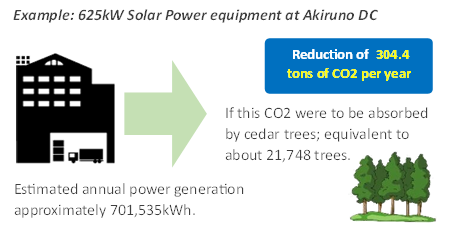
Solar energy and power purchase agreements (PPA) are perfect examples of how a logistics facility can implement new energy technology to help lower its carbon dioxide emissions. With a power purchase agreement (PPA), a third party installs a solar power generation system on the roof of the logistics building and supplies the generated electricity to the tenants. This allows the tenants to use green energy, lowers their electricity rates compared to conventional electricity and provides them with power even in the event of a disaster.

Energy Management

In addition to energy generation technology, energy management is also a very important factor in lowering electricity consumption and the overall carbon footprint of the facility.  Energy management increases efficiency and limits the waste of power. For example, saving energy by switching to LED lights. LEDs consume less power and have a longer life span. The power consumption of LED is about 20% of incandescent bulbs, 30% of fluorescent bulbs and 25% of mercury lamps. It significantly reduces the electricity bill and lasts about 10 years. As a result, fewer electric lights are thrown away and labor cost of switching light bulbs is reduced.

Conclusion

Overall, energy generation and energy management are important to tenants and investors. Simple solutions such as switching to LED lights are available as well as more complicated ones such as solar power rooftops and large capacity rechargeable batteries. As we continue forward, it is important to keep in mind that green energy solutions are already making their way into logistics real estate.

Katsuyuki Victor Mineta

Founder & CEO
KIC Holdings

Please find below the rebalancing results (effective 18 December 2023 start of trading) for the:

  • GPR/APREA Investable 100 Index
  • GPR/APREA Investable REIT 100 Index
  • GPR/APREA Composite Index
  • GPR/APREA Composite REIT Index (indicated with an asterisk)

GPR/APREA Investable 100 Index

INCLUSIONS

CHNPowerlong Real Estate Holdings Limited
CHNSino-Ocean Group Holding Ltd.
CHNSunac China Holdings Ltd.
JPNDaiwa Securities Living Investment Corp.

EXCLUSIONS

SGPLREIT SPLendlease Global Commercial REIT
THASPALI TBSupalai PCL

GPR/APREA Investable REIT 100 Index

INCLUSIONS

AUSHealthCo Healthcare and Wellness REIT
JPNMarimo Regional Revitalization REIT Inc
NZLPrecinct Properties NZ Limited & Precinct Prop Inv Ltd
THACPN Retail Growth Leasehold REIT

EXCLUSIONS

JPNESCON JAPAN REIT Investment Corporation
JPNHealthcare & Medical Investment Corporation

GPR/APREA Composite Index

INCLUSIONS

CHNChina Evergrande Group
CHNShimao Group Holdings Ltd
IDNPT Bakrieland Development Tbk
INDNexus Select Trust *
JPNArealink Co. Ltd.
TWNReaLy Development&Construction Corp

EXCLUSIONS

None

Asia Pacific Trends Q3 2023 features in-depth and up-to-date data and insights on the Office, Retail, Industrial & Logistics and Investment markets across the region. Key trends include:

Office:

  • Leasing demand remains weak as occupiers stay cautious
  • Mainland China, India and Tokyo account for bulk of activity
  • Transactions take longer to close due to slow approvals
  • Non-banking financial and tech firms drive demand
  • Most markets set to remain in favour of tenants

Retail:

  • Retail sales moderate but travel demand continues to provide strong tailwinds
  • Retailers stay in expansion mode; Location remains key as demand focuses on prime locations
  • Consumer demand for unique experiences drives leasing for non-traditional retail space
  • Japan remains most upbeat market thanks to strong tourist inflows
  • Leasing demand projected to remain robust in coming quarters

Industrial & Logistics:

  • Slowing regional economy continues to weigh on leasing activity
  • Strong demand from ecommerce platforms and stable activity from 3PLs
  • Supply pipeline remains significant
  • Investment volume holds steady in the first three quarters of the year
  • Leasing and investment volume forecasted to soften

Investment:

  • Sentiment remains weak despite slight uptick in investment volume
  • Re-pricing continues to constrain purchasing activity
  • Retail and hotel assets witness stronger deal flow
  • Japan remains most upbeat market
  • Investment to stay subdued amid high interest rate environment

{module title=”Asia Pacific Trends Q3 2023 (CBRE)”}

As experts in commercial real estate, our work is built on successfully identifying and navigating opportunities for our clients. In our fourth annual Global Investor Outlook report, we provide a comprehensive, in-depth look at the trends set to dominate the investment market and where we think opportunities can be found in the year ahead. We have synthesised views from our senior Capital Markets experts and investors around the world.

In 2024, challenging conditions will persist, but a clearer rate outlook and tightening bid-ask spreads appear to be on the horizon. As investors continue to seek stability in policy environments, the industrial & logistics (I&L), multifamily and office sectors largely remain their top picks in the upcoming year. As momentum builds, the best-positioned investors will be those who are ready to act on opportunity.

Global Key Themes

  • Real estate assets retain appeal despite ‘higher for longer’ interest rates. Pricing will continue to adjust to a more realistic equilibrium, and we expect transactions to pick up in H2 2024.
  • Pockets of opportunity are continuing to emerge under tighter conditions. Property funds are facing redemption pressures, and a higher cost of capital is seeing more owner occupiers unlock capital via sale and leaseback transactions.
  • A calmer rate environment is coaxing out capital. We anticipate investors will begin to deploy capital that is primarily opportunistic or value-add led on a selective basis.
  • Investors continuing to flock to I&L assets due to their perceived stability and growth potential. Investors are migrating to related sub-sectors such as cold/dark storage.
  • Number of alliances are growing as investors look at different opportunities to pool resources and mobilise funds. The complexity of accessing some specialised assets such as student housing and data centres will drive more partnerships and joint ventures between investors and developers.
  • Growing acceptance of ESG as a key element of investment decision-making. A record proportion (25%) of investors surveyed have ESG-based disposal and acquisition strategies in place, particularly in EMEA and APAC – up from 10% just two years ago. We expect a wave of disposals and value-add opportunities to enter the market.