
APREA Logo

Knowledge Hub

GLP data centers are designed, built and operated in accordance with GLP’s ESG principles. In China, GLP is one of the largest independent data center operators with assets that will deliver over 1,400 MW of IT capacity. Our full-service data center platform is led by a best-in-class team of over 700 professionals with deep domain knowledge across IT, utilities and mobile communications companies. GLP has committed to ensuring that 100% of its new data center projects in China comply with GB-A/T3 1 standards and ODCC2 2 certification.

Case Study: GLP Beijing Yizhuang Data Center (“GLP Beijing Yizhuang DC”)

GLP Beijing Yizhuang DC is a tier 3 cloud data center with a total GFA of 18,230 sqm and 17.4 MW power capacity. It is located in greater Beijing which is one of the key data center hubs in China. Sustainability was factored in all stages of the asset lifecycle from design to operations and management.
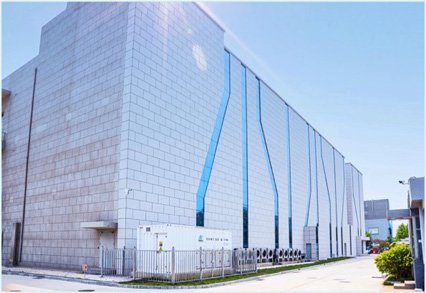
GLP Beijing Yizhuang DC is designed with reflective roofs to reflect solar radiation, reducing the heat island effect and energy required to maintain overall building temperature. The data center is designed to utilize high voltage direct current (HVDC) power supply which is more energy efficient and cost effective than traditional alternating current (AC) power distribution. It also uses a chilled water cooling system which requires less energy than conventional air-cooled chillers.

All server rooms are installed with intelligent lighting systems which are configured to prevent energy wastage and the data center is equipped with sustainable lighting fixtures which are 100% mercury free. These initiatives earned GLP Beijing Yizhuang DC a 96 out of 100 score in its Energy Star evaluation by the U.S. Environmental Protection Agency (EPA). Water usage was reduced by approximately 27% through water-saving appliances and the upgrading of faucets and pipelines, and approximately 62% of the data center’s daily operation supplies are sustainably procured.

In addition to its advanced environmental design features, GLP also enhanced the sustainability of the data center’s day to day operations. GLP Beijing Yizhuang DC is equipped with GLP DC Base, a proprietary multi-data center smart operation and management system which utilizes centralized control model, digital twin, and artificial intelligence technologies to monitor and manage performance parameters such as temperature, humidity, water and air quality to optimize energy efficiency. Through these measures, GLP Beijing Yizhuang DC was able to save approximately 260 tonnes of carbon emissions in 2022.
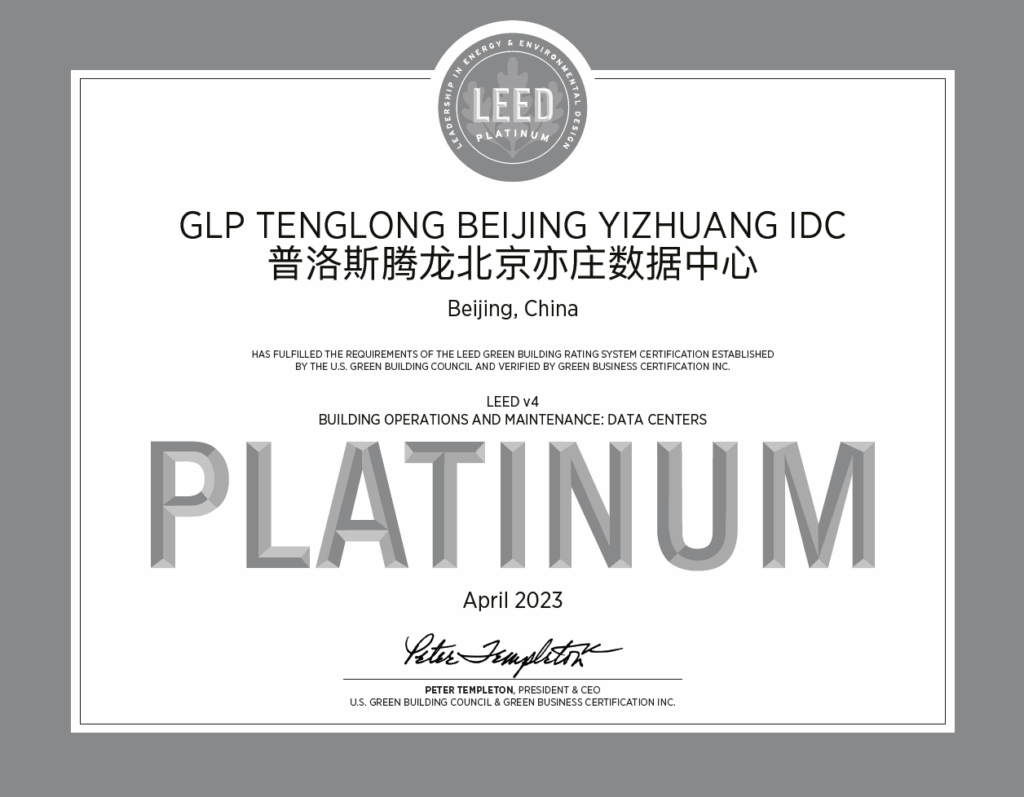
As recognition of its sustainable performance, GLP Beijing Yizhuang DC received Leadership in Energy and Environmental Design (LEED) v4 Platinum certification for building operations and maintenance. This is the highest level of certification by LEED, the most widely used green building rating system in the world, and GLP Beijing Yizhuang DC is one of the few data center infrastructure projects in China to achieve this level of certification.


1 GuoBiao (GB) standards are the highest classification of national standards with specifications issued by China for various products and services. A Tier 3 (T3) data center has multiple paths for power and cooling and systems in place to update and maintain it without taking it offline. 

2 Open Data Center Committee (ODCC) is formed by key data center industry players with an aim to create an open data center platfor in China and promote the development, acceleration and standardization of the industry.

Key Trends

  • Investment sentiment remains subdued
  • High interest rates continue to weigh on investor demand
  • Office (-40% q-o-q) and industrial (-52% q-o-q) investment declines sharply
  • Negative carry drives some motivated sellers to increase discounts
  • Cap rates set to expand further over remainder of year
  • Purchasing activity to remain muted but should resume in H2 2023
  • Prices to undergo further downward adjustment

This report was originally published in https://www.cbre.com/research-and-reports?PUBID=CA8D02B3-3EA7-409C-B5BA-0BD91194CD6E

Real estate remains a key asset class within investors’ diversified strategies even as the turmoil in global financial markets and the instability across the capital spectrum continue to cause concerns.

That’s backed by some solid fundamentals, particularly in Asia Pacific. One, the region’s market resilience, versus its European and the US counterparts, put niche assets here on top of investors’ radar, and now, the reopening of China comes in as a shot in the arm. Two, the flight to quality – led by climate actions and return to office initiatives, has fuelled tight occupancy and rental growth across key Asia Pacific markets. Three, alternatives powered by the region’s living, logistics and life sciences sectors are luring investors with new opportunities and robust growth potential. There are several other reasons.

The moot point is the impact of rising interest rates on valuations and cap rates across key Asia Pacific markets appears mitigated, as rental growth remains powered by strong demand on the back of tight vacancy. However, it’s vital today for real estate investors to proactively map the next 12 months and ensure a winning action plan to make the most out emerging opportunities in the year ahead.

Read more to find out the 2023 APAC action plan in a smart investor’s diary

The logistics sector in Asia-Pacific has seen increased interest from both investors and occupiers. This report highlights the prevailing trends including the diversification of demand, the continuing undersupply of logistics properties, and the implications for investors.

This report was originally published in https://www.knightfrank.com/research/report-library/the-state-of-logistics-asia-pacific-focus-report-2023-2023-10082.aspx

This report examines the investment capital flows to and from the Asia Pacific region in 2022, and highlights the key markets and sectors that saw notable inflows and outflows.

Key highlights include:

  • India was the only market in Asia Pacific to attract more international capital in 2022 compared to the previous year.
  • While Singapore remains the biggest source of capital in Asia Pacific, investment halved from 2021.
  • Western investment in mainland China fell to just US$500 million in 2022.
  • Interest and exchange rate volatility has eroded Asia Pacific investors’ appetite for U.S. real estate.
  • U.S. investment in Asia Pacific slowed significantly due to sharp interest rate hikes in H2 2022.

This report was originally published in https://www.cbre.com/insights/reports/2022-asia-pacific-real-estate-capital-flows

The Hong Kong Trade Development Council (HKTDC) and Link Asset Management Limited (Link) released a survey study, “Hong Kong Green Capabilities in Real Estate Development and Property Management: RCEP Opportunities”, which highlights seven distinct advantages of Hong Kong in the field of green buildings.

The report also underscores green building challenges across the Regional Comprehensive Economic Partnership (RCEP) countries, with which Hong Kong can strengthen collaboration in four major areas to expand Hong Kong’s and regional green building capacities to create a greener and sustainable future: climate risk assessment and design consulting; green financing; construction and facility management digitalisation; and green material certification and sourcing.

Read the Full Article

With the Asia Pacific commercial real estate market witnessing rapid increases in financing costs, attention is turning to the sizable volume of outstanding senior loans due to mature, which could lead to a funding gap in the next few years.

CBRE estimates that there is currently US$177 billion of outstanding senior commercial real estate debt in Asia Pacific, with a debt funding gap of US$5.8 billion set to emerge in the region between 2023 and 2025.

This Viewpoint looks at the factors underpinning the debt funding gap in Asia Pacific over the next few years, including the markets and sectors that are likely to face the biggest gap, as well as the implications for investors, borrowers and lenders.

This report was originally published in https://www.cbre.com/insights/viewpoints/Asia-Pacific-Viewpoint-Bird-s-Eye-View-on-Asia-Pacific-Commercial-Real-Estate-Debt-Market

  • Inbound investment in Singapore in 2022 reached US$7.585 bn, a marginal increase (3.4% y-o-y) from US$7.333 bn recorded in 2021.
  • APAC was the largest source of capital, accounting for 72% of real estate investment into Singapore in 2022.
  • Singapore’s outbound investment in 2022 reached US$28.284 bn, normalising from the record high of US$47.709 bn in 2021. Despite the drop, Singapore remained the top APAC outbound investor.
  • 2022 outbound investment volumes were driven primarily by higher investment in the U.K., which saw a 120% y-o-y increase.

This report was originally published in https://www.cbre.com.sg/insights/viewpoints/singapore-viewpoint-investment-in-out-2022

Global markets continued their journey of price discovery during Q1 2023, with investment activity subdued relative to previous years. The pricing alignment is most likely happening first in North America and Japan. For other locations, market yields/cap rates face another quarter of adjustments, before stabilizing.

Colliers Global Capital Markets – Insights & Outlook Report unveils the impact of interest rates on real estate pricing and investment volumes across the world. Aside from examining inflation trends globally, the report also analyses the impact on real estate pricing going forwards based on the Central Banks’ likely path on policy rates. 

Over the coming months, we will be looking at markets by sector and providing fresh Asia Pacific insights along with global markets research.

CBRE’s latest report explores the latest Asia Pacific Data Centre supply, demand and investment figures for 2022, and outlines key trends to watch for 2023.

Key highlights include:

  • New supply in Asia Pacific Tier 1 data centre markets (Greater Tokyo, Sydney, Singapore and Hong Kong SAR) fell from 2021’s record-breaking 399MW to 263MW in 2022.
  • Regional data centre vacancy fell to 12.4% on the back of solid demand, while leasing demand remained robust and continued to be driven by upgrading demand and ongoing expansion by hyperscalers.
  • CBRE expects 765MW of new data centre stock – representing around one-third of total planned capacity – to be delivered by 2025.
  • Investment demand weakened in 2022 owing to the rapid increase in financing costs and growing fears of a recession. Asia Pacific direct data centre investment turnover fell to US$1.4 billion, the lowest annual total since 2019.
  • CBRE has observed signs of improvement in the investment market in recent months, with nearly US$1.7 billion of new data centre funds raised in Q1 2023. Investment demand will be increasingly focused on greenfield development of prime assets, such as data centres with higher floor loading and/or sustainability certification.

This report was originally published in https://www.cbre.com/insights/reports/Asia-Pacific-Data-Centre-Trends-H2-2022
