
APREA Logo

Knowledge Hub

This article is an excerpt from the the white paper “Sustainability-Linked Insurance: Rewarding Climate Risk Adaptation” co-published by Link Asset Management, AXA and Marsh.
For decades, the real estate industry has viewed insurance as a necessary cost of doing business — a safeguard against unforeseen risks, but rarely a tool for creating value.

That paradigm is shifting.

Link Asset Management (Link) has introduced how real estate climate resilience efforts can be linked with insurance terms — a model that doesn’t just provide protection but actively rewards investment in climate adaptation measures.

By quantifying climate risk and making targeted resilience investments, Link, through its insurance broker Marsh Hong Kong, secured an 11.7% reduction in property insurance premiums — significantly outperforming the industry’s ~3% average. Even more importantly, Link negotiated an additional 7.5% premium reduction tied to its loss ratio, creating a direct financial incentive to continue investing in long-term climate preparedness.

This case study isn’t just about one company’s success. Rather, it highlights a fundamental shift and real-time opportunity for real estate firms — and insurers — to align incentives and build climate resilience.

  1. As a reminder – that extreme weather events are already becoming more severe under climate change, leading to significant financial losses
  2. As a showcase – of proactive climate risk adaptation measures
  3. As a call to action – to leverage the mutually beneficial relationship between asset managers and insurers for building climate resilience

From Risk Awareness to Resilience in Action

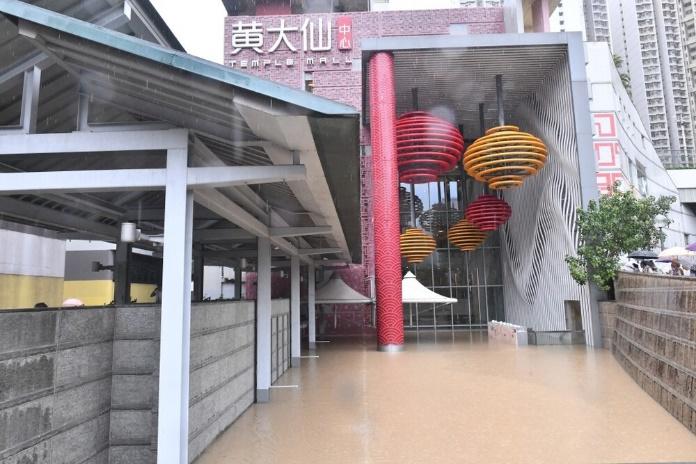
Extreme weather events are no longer an anomaly — they are an operational reality. In September 2023, Hong Kong experienced a “double whammy” of Super Typhoon Saola and record-breaking black rainstorms, causing widespread property damage. The conventional response across the real estate industry was reactive: filing claims, absorbing losses, and bracing for inevitable premium hikes.

Link chose a different approach. Rather than treating resilience as a cost, it saw an opportunity for investment — one that could be quantified, optimised, and ultimately rewarded.
Link reframed its relationship with insurers from a transactional one to a partnership in risk management:

  • Worked with Marsh Hong Kong to embed resilience efforts into a resilience-focused insurance roadshow, bringing 22 insurers into early discussions.
  • Presented quantifiable evidence of risk reduction, showcasing Link’s HK$5 million investment into flood resilience measures.
  • Collaborated with AXA on a Sustainability-Linked Insurance Proof-of-Concept, demonstrating how Link’s flood resilience measures could lower potential losses by 10- 20%.
  • Negotiated performance-linked premium reductions, securing additional cost savings contingent on a low loss ratio and incentivising continued investment in resilience.

By integrating risk identification, targeted mitigation, and transparent insurer engagement, Link transformed resilience from a defensive measure into a financial advantage.

The Resilience Framework: Six Pillars of Climate Adaptation

Building a resilience-linked insurance model requires a structured, data-backed approach. Link’s framework consists of six interconnected pillars:

  1. Comprehensive Climate Risk Assessments
  2. Asset-Level Resilience Enhancements
  3.  Standardised Emergency Protocols
  4. Preventive Maintenance and Drainage Optimisation
  5. Proactive Stakeholder Coordination
  6.  Rapid Recovery and Business Continuity Planning
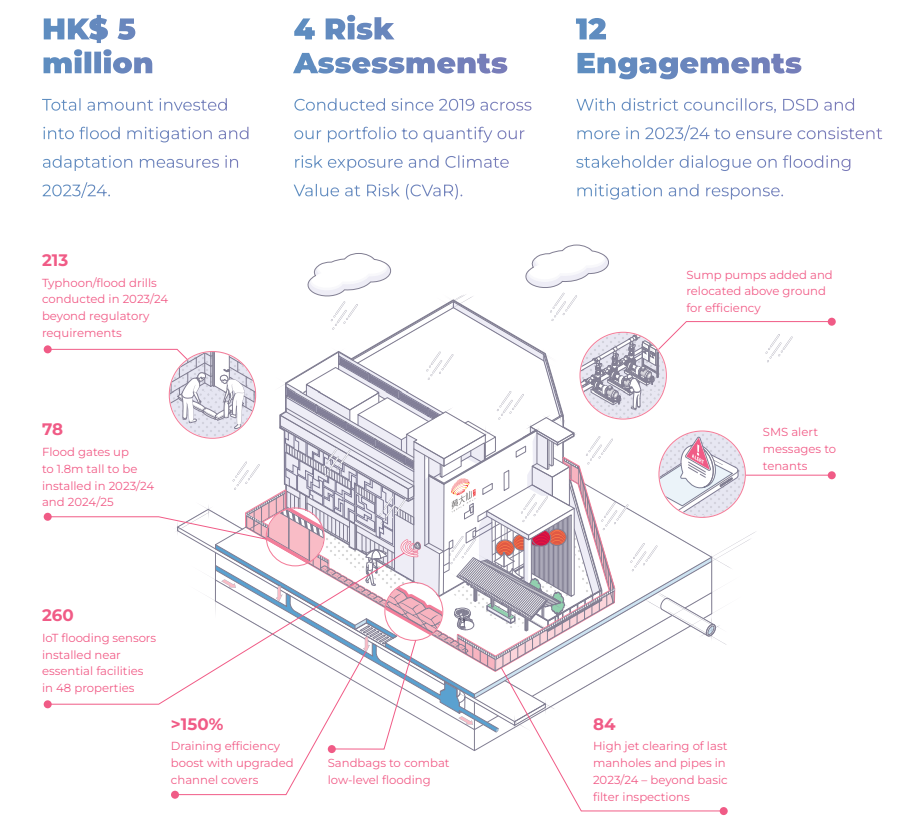
Each of these pillars feeds into Link’s resilience-linked insurance structure, ensuring measurable risk reduction, operational stability, and long-term financial savings.

From Resilience to Competitive Advantage

The results of Link’s resilience-first strategy were significant:
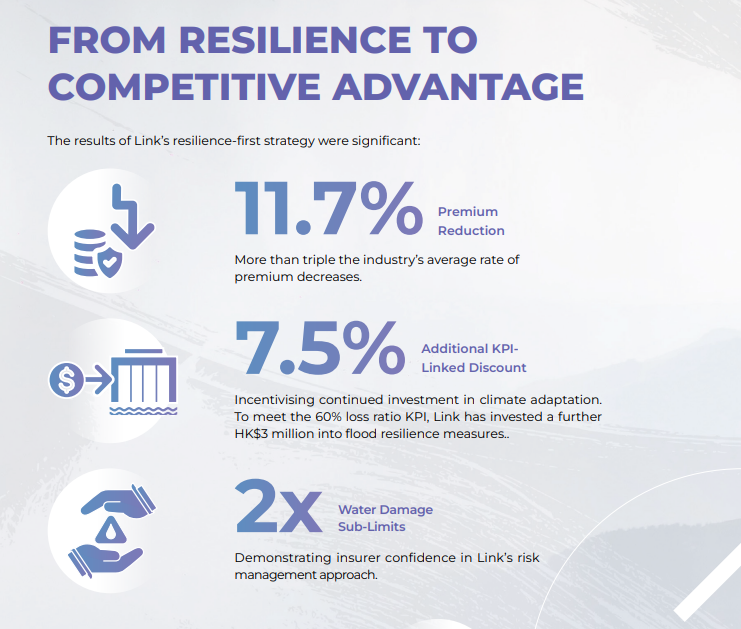
By embedding climate resilience into its operational and financial strategy, Link has proven that climate adaptation isn’t just a defensive measure — it’s a value driver.

“We welcome the efforts made by Link REIT to make their assets more resilient and sustainable, and are pleased to show our support through promising insurance capacity and T&Cs. Extreme weather and climate risk are real issues for real estate and best tackled when all stakeholders work together.

– Quoted by one insurer on an anonymous basis

What’s next?

  • For Real Estate Leaders: How can you integrate data-driven resilience into your portfolio strategy?
  • For Insurers: How can underwriting models evolve to incentivise proactive climate adaptation?
  • For Investors: How does climate resilience factor into long-term asset valuation?

Real estate is at a crossroads. Rising climate risks will continue to challenge traditional insurance models, but Link’s resilience-linked insurance structure offers a replicable blueprint for other asset owners.

The shift from reactive insurance to proactive risk management has begun — who will follow?
Singapore’s flexible workspace market has matured into a dynamic and diverse ecosystem, offering a broad range of solutions—from on-demand access for startups to fully managed suites for enterprises. This evolution reflects both the rising sophistication of occupier needs and the agility of operators in responding to them.

Today, with about 5% market penetration rate, the flex workspace market features a healthy mix of brand positions, ranging from premium hospitality-driven environments to value-oriented, efficiency-focused models. Our findings show that the top 10 brands (by market size) now command 80% of the market, with varied pricing and positioning offerings to meet the needs of businesses across all sizes and sectors. This ensures that companies can find workspaces aligned with their identity, culture, and operational goals.

Notably, flex space is increasingly integrated into asset strategies, with landlords and operators collaborating to enhance both building value and tenant experience. As the market continues to evolve, innovation and adaptability will be key to shaping the future of work. This report further explores what occupiers seek and how landlords and operators can continue to strengthen the value proposition of flexible workplaces in Singapore.

Evolving work patterns in the post-pandemic era, employees’ demands for a better workplace experience, the large regional supply pipeline and high vacancy, and the urgent need to enhance older properties to maintain their competitiveness are just a few of the factors converging to drive a new era of office innovation in Asia Pacific.

Supported and enabled by the latest technology, landlords and investors are striving to enhance tenants’ experience at every stage of their employees’ day; from the commute, to the work environment, and to the leisure offering.

Our latest report explains how innovation can drive these improvements via three pillars of office innovation:

  • Implementing a Human-centric approach
  • Introducing Physical enhancements
  • Embracing Digital integration

The Asia Pacific data centre sector has undergone a significant transformation in recent years, evolving from what was formerly regarded as a mere piece of infrastructure to a highly sought-after real estate asset at the cutting edge of technology.

The Artificial Intelligence (AI) and cloud services boom is driving robust demand for both colocation and hyperscale data centres across Asia Pacific, stirring interest from real estate investors keen to capitalise on this rapid expansion.

This report explores the key data centre investment trends, opportunities and outlook for the sector in Asia Pacific, and offers insights into the data centre occupier and investment markets in Australia, Hong Kong SAR, India, Japan, Korea, Mainland China, Singapore and Southeast Asia.

Please find below the rebalancing results (effective 23 June 2025 start of trading) for the:

  • GPR/APREA Investable 100 Index
  • GPR/APREA Investable REIT 100 Index
  • GPR/APREA Composite Index
  • GPR/APREA Composite REIT Index (indicated with an asterisk)

GPR/APREA Investable 100 Index

INCLUSIONS

AUSDigiCo Infrastructure REIT
CHNKerry Properties Ltd.
CHNSUNeVision Holdings Ltd.
JPN MIRARTH HOLDINGS INC
JPN Mori Hills REIT


EXCLUSIONS

JPNAEON REIT Investment Corp
MYSMah Sing Group Bhd
MYSSP Setia Bhd
THASansiri PCL
TWNCathay Real Estate Development Co Ltd

GPR/APREA Investable REIT 100 Index

INCLUSIONS

AUSAbacus Storage King
AUSDigiCo Infrastructure REIT
NZLAREIT Inc


EXCLUSIONS

KORShinhan Alpha REIT Co. Ltd.
SGPPrime US REIT

GPR/APREA Composite Index

INCLUSIONS

AUSEureka Group Holdings Ltd
CHNCountry Garden Holdings Co
CHNMinmetals Land Ltd
CHNSUNeVision Holdings Ltd.

EXCLUSIONS

CHNLVGEM China Real Estate Investment Co Ltd

The rapid growth of artificial intelligence (AI) and cloud computing is driving unprecedented demand for data centres across Asia Pacific. Despite expectations that data centre supply will double by 2028, the region still faces a shortfall of 15–25 gigawatts, primarily due to limited power availability and a shortage of AI-ready infrastructure.

AI workloads require over twice the power density of traditional setups, necessitating upgrades in cooling, floor load, latency, and bandwidth. Many current and planned facilities are not equipped to meet these new technical standards.

Addressing Scope 3 emissions has become increasingly vital in real estate, driven by rising expectations from investors, regulators, and stakeholders for meaningful climate action. According to the World Green Building Council, buildings account for around 39% of global energy-related carbon emissions. Of this total, around 11% is attributed specifically to embodied carbon emissions, which arise from materials and construction. With the building operational efficiencies continuously to be improved and electricity grids to be decarbonised, embodied carbon emissions represent a progressively larger proportion of total emissions. Hongkong Land has a long history of enhancing energy efficiency and reinvesting in existing assets, Scope 3 emissions represent nearly 90% of our total emissions. As a developer and owner of buildings, prioritise initiatives to address embodied carbon measurement, monitoring and reduction along the supply chains is crucial.

Hongkong Land’s Commitment to Scope 3 Emissions Reduction

Our 1.5°C aligned near-term science-based targets is to reduce 22% carbon intensity for Scope 3 greenhouse gas emissions by 2030. As the first Hong Kong-based developer to create bespoke embodied carbon assessment tools. These tools adopt a supplier-based approach to estimating emissions and provide a level of granularity. Hongkong Land integrates these across project design, tendering, and construction. The company actively collaborates with industry partners to standardise procurement guidelines, focusing specifically on five key construction materials: cement, concrete, façade, rebar, and structural steel.

Case Sharing on New Development in Shanghai

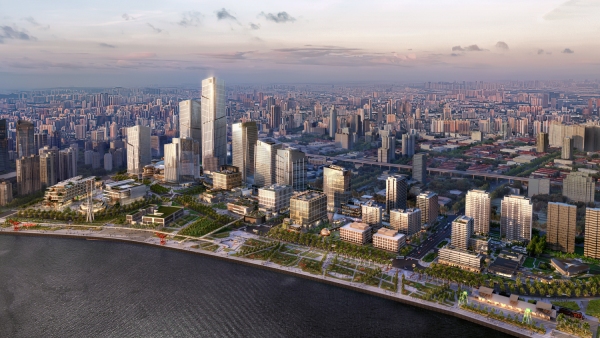
Hongkong Land’s Westbund Central is the Group’s largest-ever single investment, it is an US$8 billion development encompassing approximately 1.1 million sq. m. of prime mixed-use property strategically located at Shanghai’s Xuhui Waterfront. Westbund Central demonstrates Hongkong Land’s proactive and strategic approach to embodied carbon management. Utilising our bespoke embodied carbon assessment tools, the project team systematically measures the embodied carbon intensity associated with the development. The team closely reviews construction materials and actively pursues opportunities to minimise embodied carbon through targeted optimisation efforts. By applying detailed schematic design analyses and structural material optimization techniques, the project has already achieved significant reductions. Specifically, these optimisation strategies have resulted in a achieving a 16% overall carbon reduction in structural steel and a 7% in concrete.

Westbund Central, China

Case Sharing on Transformation of LANDMARK in Hong Kong

Hongkong Land’s Tomorrow’s CENTRAL project, a plan to invest over US$400 million by expanding and upgrading its LANDMARK retail portfolio over a three-year period, has established an ambitious target to divert at least 75% of total construction waste by weight from landfills. Before commencing refurbishment works, we conducted a comprehensive pre-refurbishment audit, systematically assessing and analysing the waste likely to be produced from demolition activities. The audit provided a clear, quantitative overview of anticipated waste streams and identified actionable opportunities for reclaiming, reusing, and recycling materials, guiding contractors to maximise resource recovery and circularity.

We identified 15 major construction materials and products including concrete, glass, wood, metal, and others for prioritised reuse, circular recycling, and diversion from landfills. By integrating circular economy principles, the project reduces demand for new raw materials, diminishes waste disposal volumes, and significantly lowers embodied carbon emissions associated with material extraction, manufacturing, transportation, and disposal.

LANDMARK ATRIUM, Hong Kong

Conclusion

Through these targeted initiatives and strategic actions ranging from bespoke embodied carbon assessment tools and structural design optimisation at West Bund, to comprehensive pre-refurbishment audits and circular material reuse strategies in Tomorrow’s CENTRAL. Hongkong Land demonstrates a robust and proactive approach to reducing embodied carbon emissions. We will continue to make significant strides towards sustainability targets 2030.

In APREA’s Real Assets, Real People, we talk to a leader in the real assets industry to gain insights on their experiences and strategies for success.

Here’s Anshul Singhal,Managing Director of Welspun One

Stay ahead of the curve with APREA’s exclusive monthly update tracking the performance of China REITs.

APREA C-REITs Roundup provides the latest info and developments in C-REITs. Available for APREA members only, this important resource is your key to navigating the landscape of C-REITs.

Stay ahead of the curve with APREA’s exclusive monthly update tracking the performance of China REITs.

APREA C-REITs Roundup provides the latest info and developments in C-REITs. Available for APREA members only, this important resource is your key to navigating the landscape of C-REITs.